


Block Blue Light at Night: 3 Tools That Actually Work (2026)

How to Block Blue Light at Night: 3 Tools That Actually Work (2026)

For three years, I did everything the internet told me to do.
Night Shift on my iPhone, scheduled from sunset to sunrise.
F.lux on my MacBook, dialed down to the warmest setting it offered.
I thought I had solved the blue light problem.
I still couldn't fall asleep before 1am.
I'd lie there with a body that felt wired, a mind that wouldn't quiet, and a quiet suspicion that something in my "optimized" routine was still broken.
Then one day, on March 2017, I arrived to a beautiful farm in rural Quebec
I set up my tent and slept under the stars.
The only source of light after sunset was fire and candlelight.
Three nights later, I was asleep by 8:00 PM
For the first time in my entire adult life, I woke up before the sunrise, feeling like energy was surging through my veins like electricity.
I felt rested and deeply energized.
So what changed?
Although I had been doing all the best practices of filtering my screens from blue light somethign was still off
That was the moment I realized what every blue light article online had failed to tell me.
The screens were maybe ten percent of the problem.
The bulbs above my head were the other ninety.
LED lights in the ceiling in my house, the streetlights, the lights down the mall, the supermarkets....
Night Shift and F.lux only dim your screens, while the LED bulbs throughout your home keep firing the same 450 nm wavelength into your eyes.
Real circadian protection requires consistency across all three sources. Here is how to actually do it.

Why Blue Light at Night Disrupts Your Biology
Your eye has two jobs.
It sees, and it tells your brain what time it is.
That second job runs through a tiny set of cells called intrinsically photosensitive retinal ganglion cells, or ipRGCs.
These cells have a peak sensitivity in blue light .
When ipRGCs detect that wavelength, they signal the suprachiasmatic nucleus in your brain.
That signal says: "It's daytime. Stay awake. Suppress melatonin."
By evening,your eyes become roughly one thousand times more sensitive to light than they were at noon.
This means that very little amount of artificial light disrupts your sleep and circadian rhythm.
💡 Nerd Section
Research: Room light below 200 lux suppresses melatonin in 99 percent of subjects and shortens melatonin duration by approximately 90 minutes (Gooley et al., Journal of Clinical Endocrinology & Metabolism, 2011). In preschoolers, evening exposure between 5 and 40 lux suppressed melatonin by 69 to 98 percent (Hartstein et al., Journal of Pineal Research, 2022). For context, a typical bedroom ceiling LED sits between 150 and 300 lux at face level.
The reason most people miss this that their photoreceptors in the eyes, which are designed for darkness, became completely dormant
Why is that?
Because they've been perpetually exposing their eyes to artificial lights after sunset for many years.
The rods, which are the receptors that are responsible for enabling nighttime vision, become lazy and dormant.
At this point, your perception of brightness becomes extremely off.
A room can feel "dim" to you while delivering thirty times the melatonin-suppressive threshold your ipRGCs care about.
Sunlight vs LED Bulbs: What Your Retina Actually Sees
Sunlight contains every wavelength in balance.
The blue in sunlight is held in check by the red, orange, yellow, and green wavelengths surrounding it.
Your biology evolved to read that balanced cocktail and respond accordingly.
LED bulbs do not work this way.
They produce a sharp, isolated spike around 455 nm, with very little of the supporting spectrum that softens daylight.

Sunlight delivers a full rainbow. An LED bulb delivers a blue dagger with no balance. (Source: VivaRays brand research)
That isolated spike is the part that drives reactive oxygen species production in your mitochondria and inflammation in your retina.
In other words, this is what causes the eye burning, eye strain, and headaches when you're sitting in your office during the day, staring at a screen and sitting under artificial lights.
This led many companies to launch yellow-tinted Blue Light Glasses in order to eliminate the inflammatory blue light during the day.
Now look at what happens when you put a typical "yellow tinted" blue light blocking glasses between your eyes and that LED.

Like you can see above, those glasses completely eliminated that blue spike
And while this may seem amazing, it's actually terrible during the day, because your brain needs blue light in order to stay awake, energized, and alert.
So wearing such glasses, although may eliminate the eye strain, will end up making your circadian disrupted. You'll start feeling low on energy and tired during the day, when you're supposed to feel energized and at your peak.
Now look at what a properly-engineered daytime lens does instead.

Without VivaRays Daytime Harmonizers (left) the LED spike stays sharp and isolated. With them on (right), the blue is rebalanced against the rest of the spectrum, much closer to what sunlight actually delivers. This is the difference between bloking blue light and harmonizing it.
The benefit, especially during long days indoors:
==> Less eye strain,
==> Higher productivity
==> Better concentration
For office work and computer use, see the Daytime Circadian Glasses collection.
Why Screen Filters Alone Don't Work
Most blue light advice online is built on a quiet assumption that is wrong.
The assumption is that screens are THE source.
Screens are A source.
They are not the source.
In 2024, 90 percent of U.S. households reported using LED lighting, and 63 percent rely on LEDs for most of their indoor lighting, up from 4 percent in 2015 (U.S. EIA, 2024).
In one decade, we replaced incandescent bulbs (which emit a warm, sun-like spectrum) with LEDs (which emit a phosphor-driven blue spike).
So when you sit at your laptop at 10pm with F.lux dimming the screen to a warm 1900K, there are typically four to twelve LED bulbs around you still firing 4000K to 6500K white light into your peripheral vision.
The phone gets the tint.
Your face gets washed in melatonin-suppressing wavelengths from every other direction.
💡 Nerd Section
Research: A 2025 review in Lighting Research & Technology concluded that night-shift display modes on smartphones provide negligible melatonin protection in real-world bedtime conditions (LR&T, 2025). A separate meta-analysis of blue-light filter apps found no significant effect on sleep latency or subjective sleep quality (Singh et al., 2024).
This is the trap I fell into for 7 years ago
I felt productive because I had configured my devices.
Although I filtered all the screens , my eyes were still receiving the wrong signal, confusing my brain about the time of the day, and completely wrecking my hormones

Tool #1: Night Shift (iPhone) and Night Mode (Android)
How to Filter Blue Light on iPhone
iPhone has three layers of filtering most people never combine.
- Settings → Display & Brightness → Night Shift. Scheduled "Sunset to Sunrise," slider all the way to More dim.
- Settings → Accessibility → Display & Text Size → Color Filters. Turn ON, choose Color Tint, and dial Intensity + Hue to a deep red.
- Settings → Accessibility → Display & Text Size → Reduce White Point. Set to 100 percent to lower the brightness floor.
- Settings → Accessibility → Accessibility Shortcut. Set Color Filters as your triple-click shortcut for one-tap toggling.
Here is what the spectrometer reads at each stage.
Default iPhone screen, no filters:

CCT 7014K, illuminance 14.9 lux. That's a noon-sky color temperature beaming into your eyes at midnight.
After applying Night Shift + red color filter only:

CCT 1393K, 6.52 lux. Better. There's still a visible blue peak though.
After activating Night Shift, Color Filters, Reduce White Point, and True Tone:

CCT 1001K, 3.66 lux. Blue is almost entirely gone, with only a small green tail and a strong red peak. This is the best iPhone can do natively, but the screen is still emitting light.
3.66 lux is still well above the 1-lux melanopic threshold your biology wants in the final hours before bed.
And remember, the screen is one source.
Your kitchen still has six 4000K LEDs in the ceiling.
Here is what the same scene looks like with VivaRays Nighttime glasses added on top of the fully-filtered iPhone.

0.36 lux. Below the melanopic threshold. This is the only configuration that meets the consensus recommendation.
How to Filter Blue Light on Android
Most Android devices don't have inherent control of the screen color the way iPhone does.
Eye Comfort Shield or Night Light shifts color temperature but rarely lets you get to true red.
The workaround is a free app: Blue Light Filter - Night Mode by Leap Fitness Group.
It's simple and configurable: red overlay, brightness reduction, scheduled activation.
Use it the same way you'd use iPhone's Color Filter feature.
Same caveat: it filters the screen, not the room.
Tool #2: F.lux for Mac, Windows, and Linux
F.lux is the original.
Created by Michael and Lorna Herf in 2009, it predates every built-in screen filter on every operating system.
It goes deeper than Night Shift in three ways.
First, F.lux lets you dial down to 1200K, the warmth of candlelight
Second, F.lux includes a "Bedtime" mode that dims aggressively in the hour before you sleep.
Third, F.lux includes a "Backwards alarm clock" that warns you when you're past your wind-down window.
To install F.lux:
- Download from justgetflux.com (free for Mac, Windows, Linux)
- insert your geographical location and set your wake time
- Click Recommended Colors and choose Classic f.lux or Custom
- In the early evening, set to "Candle" (1900K) or "Dim Incandescent" (2300K)
- 2-3 hours before bed, switch to "Ember" (1200K) for optimal melatonin protection

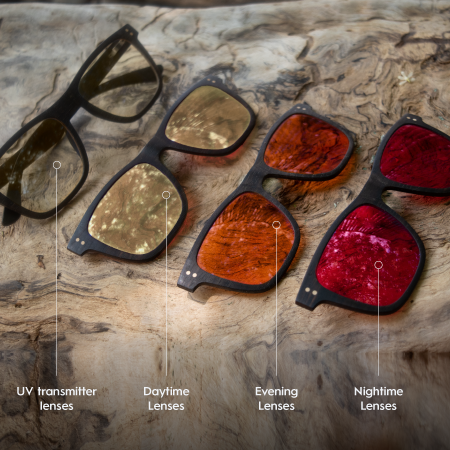
Tool #3: VivaRays Evening and Sleep Glasses
This is the missing piece.
Night Shift filters one device.
F.lux filters one device.
Glasses filter every photon that enters your eye, regardless of which bulb, screen, or LED source produced it.
That is the only intervention that solves the problem we have actually created in modern homes.
VivaRays offers two evening lens tiers, designed for different stages of the wind-down.
Evening (Orange Lenses)
Worn from sunset until 1 hour before bed.
They block 100 percent of blue and green light up to 520 nm.
They decrease color temperature down to 1700K (the warmth of fire).
They decrease the brightness reaching your eyes by 4 times.
You can still cook, work, read, talk to your family, watch TV.
You just stop signaling "daytime" to your brain while you do it.

VivaRays Evening lenses (left) vs typical orange-tinted blue blockers (right). Most amber lenses on the market still allow quite a bit of blue and green light up to 520 nm and fail to drop the color temperature all the way down to 1,700 kelvins
Nighttime (Red Lenses)
Worn in the final 1 hour before bed.
They block 100 percent of blue and green light up to 570 nm.
They lower color temperature to roughly 1000K.
They decrease brightness reaching your eyes by 10 times.
At this point, your room can be fully lit and your biology behaves as though it's already dark.

Other "red" blockers although look red still allow spikes of blue and green light to enter. VivaRays Nighttime lenses filters out 100% of the blue and green light all the way up to 570 nm.
💡 Nerd Section
Research: The international consensus statement on indoor evening light recommends a melanopic equivalent daylight illuminance (mEDI) of 10 lux or less in the 3 hours before bed (Brown et al., PLoS Biology, 2022). For a typical home lit at 150 to 300 lux, this is functionally impossible without either turning off the lights or wearing lenses that block the melanopic-active wavelengths.

You can browse the full range on the Evening Circadian Glasses collection.
Do Blue Light Filters Actually Work? What the Research Really Says
If you've Googled this question recently, you've seen the headlines.
"Blue light glasses don't work."
"Mayo Clinic: save your money."
"Cochrane review finds no effect."
I want to address this directly because the conclusion of this study is misleading.
In 2023, the Cochrane Library published a meta-analysis of 17 randomized controlled trials on blue-light filtering spectacle lenses (Singh et al., Cochrane Database, 2023).
The conclusion: no clinically meaningful effect on visual fatigue or sleep quality.
This finding is real, and it is also extremely narrow.
Look at what the studies actually measured.
They measured clear-lens computer glasses worn during the day to reduce digital eye strain.
They did not measure amber or red evening lenses worn after sunset against bedroom LED lighting.
A clear-lens daytime computer glass blocks roughly 5% of blue light emitted from LED lights
No, Clear Lance is all an absolute scam because they block blue-purple light up to 420 nanometers.
Now, look at the emission of an LED bulb.
An LED bulb and screen start emission at 430 nanometer and spikes at 455 nanometer.
That's why these Clear Blue blockers are an absolute scam.
And that's what the Cochrane study reviewed
Several studies, including research highlighted by Harvard Health and published in the National Institutes of Health, show that orange and red-tinted glasses protect melatonin production by filtering out blue light and green light
💡 Nerd Section
Research: The Cochrane 2023 review explicitly limited its scope to "blue-light filtering spectacle lenses prescribed for the general population for digital device use." The included trials used lenses with 10 to 25 percent blue-light reduction worn in daylight or office conditions (Singh et al., 2023). The review did not assess high-tint amber or red lenses used in evening protocols, which is the category that targets the ipRGC pathway after sunset.
Comparison Table: Night Shift vs F.lux vs Blue Light Glasses
Here is the side-by-side, because most articles on this topic refuse to publish one.
| Tool | Blocks Screen Blue | Blocks Room LEDs | Cost | Best For |
|---|---|---|---|---|
| Night Shift / Night Mode | Partial | No | Free | Daytime warm shift, eye comfort |
| F.lux | Better | No | Free | Evening computer work |
| VivaRays Evening (Orange) | Yes | Yes | 147$ | After-sunset, full home protection |
| VivaRays Sleep (Red) | Yes | Yes | 147$ | Final 1 hour before bed |
The cheap tools handle a small slice.
The complete tool handles the whole problem.
You don't have to choose just one.
In fact, the protocol below uses all three.
Quick How-To: Filter Blue Light on your TV
TVs have no native option to filter out blue and green wavelengths on the vast majority of models.
The most effective way to filter out the light from your TV is by wearing your VivaRays Evening glasses after sunset and switching to your Nighttime glasses one hour before bed.
This is the most effective approach because it goes beyond just filtering screen light.
It lets you filter out ALL artificial light reaching your eyes, not just from your TV, but also from your phone, your laptop, and the LED bulbs throughout your home.
This is the only way to fully and consistently protect your circadian rhythm in a world full of disruptive lighting.
Your Evening Light Protocol (Putting All 3 Together)
This is the system I run nightly now, with three years of "I optimized the wrong thing" behind me.
Sunset minus 30 minutes
Night Shift and F.lux activate automatically (you scheduled them once, they run forever).
Sunset: put on Evening (orange) lenses
Put them on before turning on any indoor lights. This is the single most important habit shift. Most people put on glasses at 9pm; the biology cares about the moment artificial light enters your evening.
One hour before bed: switch to Sleep (red) lenses
Or turn off all overhead LEDs and use a single dim red or warm incandescent lamp. From this point forward, your eyes should see nothing brighter than firelight.
Wake time: get morning sun within 30 minutes
Step outside, or sit near an open window for 5 to 10 minutes of natural light. This is the anchoring signal that tells your brain when "day" starts. Without it, the evening protocol works less well.
Repeat tomorrow
The system rewards consistency, not perfection. Run it nightly for 14 days before judging the results.
A Final Reframe
Watch any nocturnal animal in a zoo.
They look fine for a season, then their reproductive cycles break, then their immune systems degrade, then they develop stereotypies (the pacing, the rocking, the chewing).
We've known for fifty years that zoo animals exposed to artificial lighting at the wrong times develop the same cluster of metabolic and mood issues we see in modern humans.
We just don't apply the lesson to ourselves.
The 6500K bulb above your kitchen island is not benign.
The phone screen at 11pm is not benign.
The way out is not more willpower or one more melatonin gummy.
The way out is a consistent light environment that matches the biology your body still has, the one it brought to this moment from a few hundred thousand years before the LED was invented.
Frequently Asked Questions
Do blue light filter apps actually help me sleep?
Built-in apps like Night Shift and F.lux modestly reduce screen blue light but do not address the LED bulbs around you. A 2024 meta-analysis found no significant effect of filter apps on sleep latency or quality (Singh et al., 2024). They work better as one part of a full evening protocol than as a standalone fix.
What about warm-color LED bulbs (2700K or 3000K)? Are those safe at night?
Warmer LEDs reduce the visible blue tint but most still emit a measurable spike at 450 nm because of how phosphor-coated LEDs are constructed. They are better than 5000K daylight bulbs but still suppress melatonin at evening room intensities (Brown et al., 2022). The fix is either incandescent, red, or wearing lenses.
How long before bed should I start blocking blue light?
Start at sunset, not at bedtime. The first hour of evening light exposure is roughly 5 times more melatonin-suppressive than the last hour (Nagare et al., 2019). If you wait until 9pm to put on glasses, you've already absorbed most of the disruptive dose.
Do I still need glasses if I use Night Shift and F.lux?
Yes, if you spend evenings in a room with any overhead lighting. Night Shift and F.lux only filter the screen you're looking at. Your peripheral vision still receives the full spectrum from every lamp, ceiling LED, and TV in the room. Glasses filter all light entering your eye regardless of source.
Can kids use blue light blocking glasses?
Yes, and the evidence suggests they may benefit more than adults. Children show much steeper melatonin suppression at low light intensities, with 5 to 40 lux suppressing melatonin 69 to 98 percent (Hartstein et al., 2022). See the Kids Blue Light Blockers collection.
Does red light affect sleep?
Red light (above roughly 580 nm) does not meaningfully suppress melatonin because the ipRGC system has very low sensitivity at those wavelengths (Brown et al., 2022). This is why red-tinted sleep lenses can be worn under normal room lighting without disrupting your circadian rhythm.
Stop optimizing the wrong variable. Get a consistent evening light environment, the way your biology was designed to receive it.
Explore the Sleep BundleSources
- Brown TM, et al. (2022). Recommendations for daytime, evening, and nighttime indoor light exposure. PLoS Biology. Link
- Gooley JJ, et al. (2011). Exposure to room light before bedtime suppresses melatonin onset and shortens melatonin duration in humans. JCEM. Link
- Hartstein LE, et al. (2022). High sensitivity of melatonin suppression response to evening light in preschool-aged children. Journal of Pineal Research. Link
- Nagare R, et al. (2019). Effect of exposure duration and light spectra on nighttime melatonin suppression. Link
- Singh S, et al. (2023). Blue-light filtering spectacle lenses for visual performance, sleep, and macular health in adults. Cochrane Database. Link
- U.S. Energy Information Administration (2024). LED bulb adoption in U.S. households. Link
- Yetish G, et al. (2015). Natural sleep and its seasonal variations in three pre-industrial societies. Current Biology. Link
- Lighting Research & Technology (2025). Effectiveness of smartphone night-shift modes on melatonin suppression. Link
- Spectral graphs and device measurements adapted from The 7 Steps for Harnessing the Power of Light for Health, VivaRays brand guide.
Leave a comment