


Blue Light Glasses vs Circadian Glasses

Do Blue light blocking glasses work?
If you've tried blue light glasses and they didn't work, the problem isn't you, and it's not that blue light glasses are a scam.
The problem is that most blue light glasses ignore how the science of light, nature, and your circadian system actually works.
That's why we make a clear distinction between blue light glasses and what we call circadian eyewear which are designed around nature's light and its impact on your biology, not just color filtering.
Here's what you need to know.
Part 1: Understanding the Real Problem
Your Body Runs on a 24-Hour Light Clock
Your circadian rhythm is an internal clock that tells your body:
- When to feel asleep and when to feel alert
- When to have energy and when to wind down
- When to burn fat and when to store fat
This clock is controlled entirely by the light entering your eyes
For thousands of years, your body evolved with this pattern:
- Day: Bright, full-spectrum sunlight
- Sunset: Dimming, warming light
- Night: Darkness
Modern life broke this. Now you get dim light all day, then bright screens and LED bulbs at night.
Your living room at night is 1,000 times brighter than a full moon.
That's why you can't sleep.
Why the Blue Light Debate Misses the Point
Everyone's arguing: "Do blue light glasses work or not?"
Wrong question.
Blue light glasses work, only if they filter out the right wavelengths at the right times eliminating the right intensity of brightness.
The Science: Melanopic Load
Your circadian system responds to three factors:
- Spectrum: which wavelengths of light reach your eyes
- Intensity: how bright the light is
- Duration: how long you're exposed
Most blue blocking glasses block the wrong spectrum and ignore intensity.
Effective circadian eyewear reduces melanopic load strategically, at the right times, in the right amounts for circadian control.
Part 2: The 4 Big Mistakes Most Blue Light Glasses Make
Mistake #1: Blocking Blue Light When You Need It (During the Day)
Blue light during the day is essential.
It produces:
- Dopamine (focus, motivation)
- Cortisol (energy, alertness)
- Serotonin (happy mood, well-being)
When you block blue light during the day, you feel tired, foggy, and disconnected.
What you need isn't blocking…it's harmonizing.
You need to reduce the harsh blue light spike from screens and LED'S that leads to eyestrain and headaches. You also need to keep enough blue light while keeping it proportionate with the other frequencies of colours that symbiotically comes with blue light to balance it.

Bottom line: Don't wear yellow tinted blue-blocking glasses during the day that block all blue light. Wear harmonizing lenses that balance light without disrupting your biology.
Mistake #2: Not Blocking the Right Wavelengths at Night
Here's what most people don't know:
Melatonin suppression happens across 400-570nm (blue AND green light), not just blue and also melatonin also is suppressed by bright light.
Screens and LED lights emit blue and green light between 430 to 570 nm.
- Clear lenses: Block 5-20% of blue light below 430nm. They are completely useless for day and night because they block a frequency of blue light that is not emitted from LED lights and screens.
- Many orange/red lenses: Block blue but leak a LOT of green light between (500-570nm), which still suppresses melatonin.
This is why you may wear orange or red glasses and still feel wired.
When tested with a spectrometer, most orange lenses leak the exact wavelengths that keep your brain alert.

Bottom line: Orange glasses should block 100% between 400 to 525nm and Nighttime glasses must block 100% of 400-570nm .
Color alone doesn't tell you if they work.
Mistake #3: Not Reducing Brightness at Night
Even if glasses block the right wavelengths, your circadian system also responds to how bright the light is.
Your body doesn't just detect color. It also detects intensity.
In nature, nighttime light is:
- Warm in color (reds/oranges)
- AND extremely dim (firelight, moonlight)
Most blue light glasses only change the color. They don't effectively reduce how much total light reaches your eyes.
This is called melanopic load: the total circadian stimulus from spectrum + intensity + duration.
Even "good" orange lenses fail if the light behind them is still too bright at your eyes.
Bottom line: Evening & Nighttime glasses need to reduce both wavelength & brightness to truly protect melatonin.
Mistake #4: Using One Pair All Day
Your body needs a different light at breakfast versus bedtime.
Nature doesn't give you the same light from sunrise to midnight. Your glasses shouldn't either.
One pair can't both preserve daytime energy AND protect nighttime melatonin.
Blue light glasses treat light as a problem to block. Circadian eyewear treats light as a signal to be timed.
Bottom line: Effective circadian eyewear requires different lenses for different times of day.
Part 3: What Actually Works
The 3-Phase Solution
Your circadian rhythm has three phases. Your glasses should match them:
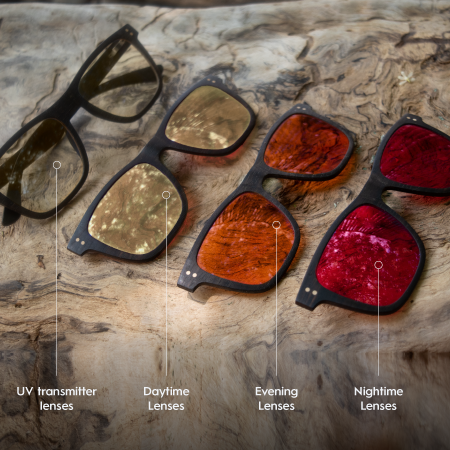
Phase 1: Daytime (Yellow Lens - Harmonizing)
- What it does: Balances unhealthy blue light, preserves healthy blue light for energy and focus
- When to wear: Morning through sunset
- Result: Alertness without eye strain and headaches
Phase 2: Evening (Orange Lens - Filtering)
- What it does: Blocks 100% of blue and the harmful green up 520 nm light + reduce brightness by 4 times.
- When to wear: After sunset
- Result: Natural wind-down, melatonin production begins
Phase 3: Night (Red Lens - Blocking)
- What it does: Blocks 100% of blue and green light up 570 nm light + reduces brightness by 10 times
- When to wear: 1 hour before bed
- Result: Deep sleep
This is why VivaRays is a 3-in-1 system, is one full system for full circadian control. 3 lenses. one rhythm

Part 4: How to Tell If Your Glasses Are Working
Good Signs:
- Daytime: You feel alert and focused (not tired, no more eyestrain and headaches)
- Evening: You naturally feel relaxed, like sitting around the bonfire
- Night: You fall asleep easier, wake up more rested
Bad Signs:
- you feel tired and foggy during the day → blocking too much blue during the day
- Still wired at night in orange or red glasses → lenses are leaking 480-550nm wavelengths or not reducing brightness enough
- No change after 3-4 days → glasses aren't blocking the right spectrum
The Bottom Line
Most blue light glasses fail because they created products not aligned with human biology.
Your body doesn't need "less blue light." It needs the right light at the right time:
- Harmonize during the day → support energy and focus
- Filter at evening → begin wind-down
- Block at night → protect melatonin and repair
Light drives energy. Darkness drives repair.
VivaRays exists to help you realign with nature's light and dark cycles so you can restore your sleep, energy and vitality.
Next: How to compare blue light glasses correctly and how to tell whether a lens truly supports circadian rhythm or just looks like it does.
Leave a comment