


How Artificial Light Is Destroying Your Children's Health

What's happening inside your child's body under artificial light goes far deeper than most parents realize. And the solution is simpler than you'd expect.
When you were born, you came into this world naked.
No clothes. No sunscreen. No sunglasses.
Your body is inherently designed to be exposed to the natural and full spectrum of sunlight.
That is why we have light receptors in our skin and in our eyes that capture light and create powerful physiological changes in our body.
Past generations of kids enjoyed the benefits of sun exposure and being connected to the earth by playing outside for multiple hours during the day.
If you were born before the 1990s, you can probably relate to this.
Remember the glory of being able to play outside and enjoy mother nature?
There is nothing more nurturing to a kid's mind and creativity than being able to freely explore the natural environment.
Observing the different colors and shapes of nature.
Listening to the balanced rhythms of vibrating brooks and streams, the pounding of the waves upon the shore, the tweeting of birds and chirping of insects, the whispering of the wind through the trees.
Every kid is born a genius and an artist at heart.
Unfortunately, our current way of living is stultifying the genius in every kid, forcing them to sit in a box, under unbalanced artificial lighting, and conditioning them to memorize and repeat, rather than think, play, explore and create.
This new generation is spending most of their time indoors, partly due to the fear around sun exposure and also because of technology, which transformed our lives into an indoor existence.
Here's a question worth sitting with: what is all this artificial light actually doing to our children's developing bodies?
I know something about this firsthand. As a kid, I suffered from headaches, agitation, and inability to focus in the classroom. My teachers diagnosed me with "ADHD." Twenty years of depression and disorientation followed, until I discovered the one thing that changed everything.
I'll tell you that story in a moment.
But first, let's understand what's actually happening to our children's biology under artificial light, and what you can do about it TODAY.
What Are the Common Sources of Artificial Light Harming Your Kids?
Over 50% of U.S. teenagers now average four or more hours of daily screen time (CDC, 2024).
Smartphones. Tablets. Laptops. Smart watches. Classroom smartboards. Fluorescent tubes. LED ceiling lights.
The sources of artificial light are everywhere.
But what makes artificial light so different from natural light?
To understand this, you need to understand what natural light actually is.
The full spectrum of sunlight is composed of ultraviolet (UV) light, visible light (the colors of the rainbow) and infrared (IR) light.
Both ultraviolet and infrared light have a significant impact on our health even if we can't see them.
In nature, the spectrum of light changes constantly. Some wavelengths are present all the time (like infrared) and others aren't (like UV or blue light).
Here's the critical point: blue light is very prevalent in nature during the day. It tells our brain it's daytime and increases our alertness and energy elevels
But it never comes in isolation. It always comes alongside red, orange, infrared, and the other frequencies of color that balance it out.
So what happens when we are exposed to it in isolation from LED lights and screens during the day?
To say the least, it becomes extremely destructive to our biology, and I will be sharing all the science, so keep reading.
And after sunset? This is wehn the real damage happens
There is no blue light whatsoever in nature at night. Zero. None.
For millions of years, our biology evolved with this rhythm
- Blue light during the day, balanced by other wavelengths.
- Complete darkness at night.
Now look at what we've done.
Artificial light from LED bulbs and screens emits a narrow, isolated spike of blue light with almost no UV or infrared to balance it.
It's like listening to a single trumpet played at full volume, nonstop, while the rest of the orchestra sits silent.

And we're blasting this isolated blue light into our children's eyes not just during the day, but after sunset too, when their biology expects total darkness.
The double disruption
During the day, artificial light gives your child isolated blue light without the balancing frequencies that nature always provides alongside it.
After sunset, it gives them blue light when nature provides none at all.
This constant, unbalanced signal disrupts the internal clock that governs their sleep, hormones, growth, and immune function.
Let's see how this junk light affects kids and what you can do about it.
How Does Artificial Light Cause ADHD and Behavioral Problems in Kids?
An estimated 7 million U.S. children (11.4%) have been diagnosed with ADHD as of 2022, roughly one million more than in 2016 (CDC, 2024).
A 2023 meta-analysis of over 81,000 children found that kids with 2+ hours of daily screen time had 1.5 times higher odds of developing ADHD symptoms (PubMed, 2023).
But here's what most people don't realize.
This diagnosis is the effect of non-harmonious living. Don't make the mistake of treating the effect as the cause.
My teachers at school did not know, and as a result, they identified me with the label "ADHD" and mistakenly perceived this label as the cause, rather than the effect of a cause that they were blind to.
My intuition knew the cause.
This is why I misbehaved and created different strategies for my teacher to kick me out of the classroom.
I felt exalted to be outdoors, exploring and listening to nature's silent rhythms while feeling nourished by the full spectrum of sunlight.
After some time, my teachers picked up on my strategy, and was forced back into the classroom.
That felt extremely torturing.
It literally stifled my genius for so many years. I had to suppress my inner light and intuition which always guided me away from the artificial lighting in the classroom into the glorious light of nature.
The results were tragic: 20 years of depression, chronic fatigue, and disorientation which finally led me to hit a bottom in my life, where I entered a very dark place of the soul.
Today, 20 years have passed since my diagnosis, and our society is still blind to the cause, regardless of the fact that many studies have been conducted to open our eyes to this fact.
I see it everywhere now.
I was at a restaurant last year. Beautiful sunset pouring through the windows, painting the sky in orange and pink.
And at the table next to me, a little girl sat hunched over an iPad. Face lit blue. Eyes glazed.
The most spectacular light show on earth was happening right behind her, and she was hypnotized by a screen.
Her parents weren't bad people. They just didn't know what that screen was doing to her brain.
The Sarasota study: In 1973, researcher John Ott walked into classrooms that were lit with cool-white fluorescent tubes and changed the lighting to full-spectrum lighting that mimics sunlight. The results? Kids who could not sit still and focus became calm, more focused, and their grades improved. They also developed one-third fewer dental cavities over five months. Two similar studies were conducted in 1975 in California and Washington with similar results (Journal of Learning Disabilities, 1976).
When natural sunlight hits your eyes, you start producing dopamine (the spark plug for focus and motivation).
It plays a role in cognition, memory, motivation, mood, attention and learning. It's also important for our decision making process and our sleep regulation.
When kids never go outside and are constantly in an environment lit by artificial light, they can't produce dopamine in a sufficient amount.
This leads to low dopamine levels which are associated with cravings, sugar addiction, low energy, lack of motivation, learning disabilities, behavioral problems, anxiety and depression.
There is a reason why most kids and teens are addicted to video games, sugar and social media. They all trigger dopamine release and activate their reward system.
But here's the key.
The big problem with screen addiction is that artificial light destroys our dopamine levels over time creating a vicious circle where children need even more stimulation to get the effect.
Giving your kid screen time on a TV, smartphone or tablet to keep them entertained and calm reinforces the problem you were trying to solve in the first place.
| Age Group | AAP Recommendation | Circadian Biology Recommendation | Key Risk |
|---|---|---|---|
| Under 2 | No screens | No screens, no artificial light at night | Most transparent lenses, highest vulnerability |
| Ages 2-5 | Max 1 hour/day | 1 hour max, never after sunset | 85% melatonin suppression from 1hr pre-bed light |
| Ages 6-12 | Max 2 hours/day | 2 hours max daytime, never after sunset | 1.5x ADHD risk at 2+ hours daily screen time |
| Ages 13-18 | Consistent limits | Circadian lenses mandatory after sunset | Peak circadian sensitivity during puberty |
Screen time guidelines: medical recommendations vs. circadian biology perspective
Why Is Children's Myopia Rising So Fast?
Global myopia in children jumped from 24% in 1990 to nearly 36% in 2023, and researchers project it will hit 40% by 2050, affecting over 740 million children worldwide (PubMed systematic review, 2024).
During the pandemic lockdowns, myopia rates in young children aged 6-8 spiked dramatically as screen time replaced outdoor play.
Blue light has short wavelengths, which causes light to scatter more easily than other colors.
When looking at a computer screen or other digital devices that emit significant amounts of blue light, the scattering of light reduces contrast which leads to eye strain.
Think of it like trying to read through a fogged-up windshield. Your eyes work hard to focus, and over time, they start to deform.
Since blue light has a higher index of refraction than the rest of visible light, it focuses in front of the retina which is why excess blue light exposure can lead to a condition called blue myopia.
Long exposure to an incomplete spectrum of light can lead to dry eyes, eye strain, loss of visual acuity, migraine and eventually macular degeneration.
Here's the part that should concern every parent.
Children's eyes are more vulnerable than adult eyes. Their lenses are more transparent and their pupils are bigger so more light gets through (PMC, 2023).
The child's eye lets almost everything in.
In sunlight, the blue light is balanced by the rest of the spectrum. Nature doesn't promote blue over red. She dances between them.
But LED screens isolate the blue and blast it directly into your child's developing eyes, hour after hour.
This increases the inflammation in the mitochondria of the eye, leading to all sorts of eye issues
How Does Screen Light Disrupt Your Child's Hormones?
A 2023 study tracking 129,500 Chinese children aged 10-18 across 72 cities found that artificial light at night was significantly associated with overweight and obesity, with stronger effects in boys (Nutrients, 2023).
A separate 15-year longitudinal study of 218,239 children confirmed: higher nighttime light exposure increases the risk of childhood obesity (BMC Medicine, 2025).
One of the most poorly known effects of blue light is the disruption of leptin.
Leptin is the hormone that tells your brain that you're feeling full after every meal .
If it's broken, your brain has no way of knowing how much energy is available in your body.
The brain literally freaks out because it thinks that you are starving, and as a result. it will start increasing your appetite and lowering your fat-burning ability.
Kids who lack sun exposure or who look at screens and are exposed to artificial light, especially at night, lose their leptin sensitivity and their metabolism becomes dysfunctional.
Since leptin has an impact on every hormone in the body, this can lead to inflammation, weight gain, diabetes, growth issues, delayed sexual maturation, and more.
Nerd Section: The leptin pathway and light
Leptin is released by adipose tissue and signals the hypothalamus about energy status.
When leptin sensitivity is intact, the brain correctly reads how much stored energy is available and adjusts appetite and metabolism accordingly.
Blue light at night disrupts the suprachiasmatic nucleus (your master clock), which directly controls leptin secretion timing.
When the clock signal is scrambled, leptin pulses at the wrong times. The hypothalamus stops "hearing" the signal, even when leptin levels are high.This is called leptin resistance.
The brain then behaves as if the body is starving: appetite goes up, metabolic rate goes down, and fat storage increases.
In children, whose hypothalamic pathways are still developing, this disruption can be especially pronounced.
A close friend of mine had been struggling with her son's weight for years.
She tried different diets, more exercise, fewer snacks. Nothing worked.
Then she learned about light and it's impact on Leptin
She quickly realized that her son did not have an obesity problem. He had a Leptin problem
She replaced the LED bulbs in his bedroom with amber incandescent lights, had him wear circadian glasses after sunset, and started getting him outside in the morning sun before school.
Within six weeks, he dropped the extra weight without changing what he ate.
His sleep improved. His teachers said he was calmer. His energy shifted completely.
She didn't fix his diet. She fixed his light.
Isn't that fascinating?
How many diet programs mention that?
We live our lives wondering about which supplement we should take and which diet to adapt in order to feel better.
But what about our light diet?
Can Artificial Light Weaken Your Child's Immune System?
Evening artificial light exposure raises cortisol levels and increases anxiety in children and adolescents, according to a 2024 review in Frontiers in Neuroscience.
When cortisol stays chronically elevated from artificial light exposure at night, it suppresses immune function, increasing the risk of allergies, infections, and autoimmune conditions.
Simultaneously, artificial light disrupts leptin sensitivity, which prevents the liver from converting vitamin D into its active form. Without proper amounts of vitamin D, the immune system becomes extremely weak.
So here's the devil cocktail that every child who's exposed to artificial light is dealing with :
1) Elevated cortisol
2) Suppressed melatonin
3) Low Vitamin D levels
This creates a triple hit to a child's immune system that no supplement can compensate for while the light environment remains unchanged (Frontiers in Neuroscience, 2024).
The cortisol-melatonin seesaw
Blue light at night pushes cortisol up and melatonin down, simultaneously.
This double hit weakens your child's immune system, disrupts growth hormone release, and impairs tissue repair during sleep.
Removing artificial blue light after sunset is one of the most impactful changes a parent can make.
Nerd Section: The cortisol-melatonin cascade in detail
Cortisol and melatonin operate on an inverse rhythm. In a healthy child, cortisol peaks in the morning (cortisol awakening response) and gradually declines through the day, reaching its lowest point around midnight.
Melatonin does the opposite: it rises in the evening as light dims and peaks in the middle of the night.
When artificial blue light hits the retina after sunset, it sends a "daytime" signal to the suprachiasmatic nucleus, which tells the adrenals to keep cortisol elevated.
Simultaneously, it suppresses the pineal gland's melatonin output.
High evening cortisol blocks growth hormone release (which depends on deep sleep), impairs T-cell and natural killer cell activity, and keeps the inflammatory NF-kB pathway active.
Meanwhile, without melatonin's antioxidant function, free radical damage from the day accumulates instead of getting cleaned up.
In children, whose immune and endocrine systems are still maturing, this nightly double disruption can compound over weeks and months.
Why Can't Your Kids Fall Asleep at Night?
Children are roughly twice as sensitive to evening light as adults.
In preschool-aged children, just one hour of bright light before bedtime suppressed melatonin by an average of 85.4%, with some children showing suppression as high as 98.7% (Journal of Physiology, 2022).
Under identical conditions, adults showed only 46% suppression, confirming that children are roughly twice as sensitive to evening light as adults.
Read that again. Nearly all of your child's melatonin, wiped out, by one hour of screen time before bed.
Kids and teens require more sleep than adults.
Their brain isn't fully formed yet and it needs more downtime to integrate their daily learning and consolidate their memory and skills.
I once visited a small village in Crete, Greece.
The families there had almost no artificial light. When the sun went down, the village went quiet. Candles and firelight. That was it.
The children would wind down naturally. No one had to fight them into bed. They just got sleepy when it got dark, like their bodies were designed to.
Their parents told me their kids slept deeply, woke easily, and rarely got sick.
I saw the same thing on a farm in northern Quebec, Canada.
The farm family had minimal electric lighting.
The kids followed the rhythm of sun. They slept deeply and woke up feeling energized
Now compare that to your child's evening routine.
Overhead LEDs blazing. A tablet or TV flickering. Maybe a nightlight in their room.
Every one of those light sources is telling their brain, "Stay awake. It's still daytime."
This light is not only destroying their sleep but it also negatively impacts their growth
You may be wondering how that is related?
This is because melatonin production controls growth hormone production at night, and without proper amount of GH, their growing brains and bodies start suffocating, as much as a plant would suffocate if you deprive it from sunlight.
All of this makes it harder for your kids to fall asleep at night, and as a result, they wake up feeling groggy and moody.
The accumulated poor sleep leads to learning difficulties, behavioral problems and developmental delay (PMC, 2023).
How Can You Optimize Your Child's Light Environment?
After 20 years of struggling, I finally found my answer.
I was volunteering on a farm in rural Quebec, Canada.
The only source of light I was exposed to during the day is some light. After the sunset, the only light entering my eyes was fire and candlelight.
Within days, something shifted. the night owl in me who used to stay up until 2-3 am was now sleeping shortly after sunset.
I went from deep depression and desperation to complete inspiration.
For the first time in my entire adult life, I'd wake up in the morning with energy surging through my veins like electricity
That experience changed the trajectory of my life and ultimately led to creating VivaRays.
Here are five changes you can make to protect your child's biology, starting today.
Get Them Into Morning Sunlight
Step outside with your child within the first hour after sunrise for at least 10 to 15 minutes.
Make sure they aren't wearing sunglasses. Let the light hit their eyes and skin directly.
Morning sunlight sets the stage for the entire day. Here's what it does:
- Dopamine production: Sunlight through the eyes triggers dopamine release, which is essential for focus, motivation, mood, and learning. This is the molecule most ADHD children are lacking.
- Melatonin timing: Morning light exposure starts the internal clock that determines when melatonin will be released later that night. No morning light signal means delayed, weaker melatonin at bedtime.
This single habit can shift your child's sleep, focus, and mood within the first week.
Protect Their Eyes with Circadian Lenses
Your child will inevitably be around screens and artificial light, whether at school, at friends' houses, or at home.
The goal isn't to eliminate all screens. It's to filter out the harmful wavelengths that disrupt their biology.
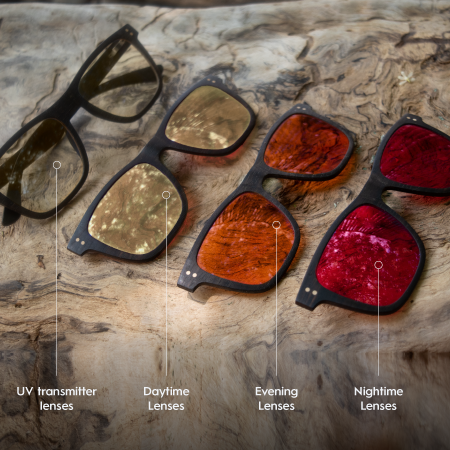
VivaRays Umy kids glasses are designed specifically for children. They come with both daytime and evening lenses, so your child is protected at any hour.
Daytime lenses filter the harshest blue light spikes from screens while still allowing the beneficial blue light that the brain needs to stay alert, energized, and focused
Evening lenses block the full range of blue and green light that suppresses melatonin after sunset.

Change Their Light Environment
Replace the LED and fluorescent bulbs in your child's bedroom and common evening spaces with amber or warm incandescent bulbs.
This one change can make a dramatic difference.
Standard LED bulbs emit a strong blue light spike even when they appear "warm white."
The only way to truly eliminate that spike is to switch to incandescent, amber, or candle light for evening hours.
Remember my friend whose son lost weight without changing his diet? The first thing she changed was his bedroom bulbs.
If you can't replace every bulb, start with the rooms where your kids spend time after sunset. Bedrooms first. Living room second. also make sure that the kids are wearing the VivaRays circadian lenses when they are exposed to screens and other LED light bulbs in different environments that you cannot control
Set a Screen Curfew
Set a hard cutoff for screens at least one hour before bedtime. Two hours is even better.
This is the window when your child's brain is most vulnerable to melatonin suppression, as we covered in the sleep section.
What do they do instead? Read a physical book. Draw. Play a board game. Talk.
The Crete village families I visited didn't need to enforce a screen curfew. They didn't have screens. Their children just wound down naturally when the light faded.
You can recreate that same environment by dimming lights and removing screens after sunset.
It won't feel natural at first. Your kids might resist. But within a week or two, their biology starts to recalibrate.
Lead the Way
Your children mirror you.
If you're on your phone until midnight with every light in the house blazing, no amount of rules will stick.
But if they see you stepping outside in the morning sun, putting on circadian glasses after sunset, and winding down with a book instead of a screen, they'll follow.
Children don't learn from instructions. They learn from what they see you do.
When you fix the light environment for your children, you fix it for yourself too.
I've seen families completely transform their evenings by making these changes together. Better sleep. Better moods. Calmer mornings. More connection.
Light is the foundation. Everything else builds on top of it.
"You are the light of the world. And the light of the world needs real light to thrive."
Frequently Asked Questions
Is blue light from screens actually harmful, or is it overhyped?
The concern is backed by peer-reviewed research. Blue light in the 460-480nm range suppresses melatonin by up to 85% in children (Journal of Physiology, 2022). The issue is not blue light itself, which is beneficial during the day from the sun. The problem is isolated blue light from screens, especially after sunset when nature provides none.
At what age should I start protecting my child's light environment?
From birth. Newborns and infants are the most sensitive to light disruption because their circadian systems are still forming. Keep nighttime feedings in dim red or amber light. Avoid screens entirely before age two. For older children, morning sunlight and evening light management become the priority.
Do blue light glasses actually work for kids?
It depends on the lenses. Many generic "blue light glasses" block only a small percentage of the blue spectrum. Effective circadian lenses must block the full 400-530nm range for evening use. VivaRays Umy kids glasses are spectrally verified to block the wavelengths shown in research to suppress melatonin.
Can changing light really help with ADHD symptoms?
Research suggests a strong connection. The Sarasota study in 1973 showed that swapping fluorescent classroom lights for full-spectrum lighting improved focus and behavior. Morning sunlight triggers dopamine, the neurotransmitter most ADHD children lack. Light changes are not a replacement for professional care, but they address a root cause that is often overlooked.
How much morning sunlight do kids need?
Ten to fifteen minutes within the first hour after sunrise is a strong starting point. The key is consistency. A daily habit matters more than duration. The light should reach their eyes (no sunglasses) and skin directly for the full biological benefit, including dopamine release and circadian clock setting.
What about school classrooms with fluorescent lighting?
Most classrooms use fluorescent or LED lighting that is heavy in blue spectrum and lacks infrared entirely. Daytime circadian lenses (like the VivaRays Umy daytime set) can filter the harshest blue spikes while still allowing enough visible light for reading and color accuracy. Pairing that with outdoor recess time helps offset the classroom light exposure.
Your child's biology was built for real light. Give it back to them.
VivaRays Umy kids circadian glasses protect your child's melatonin, dopamine, and developing eyes from the harmful wavelengths in screens and LED lights.
Shop Kids Circadian Lenses
Leave a comment