


Does this exist in nature?

Light: The Foundation Beneath Everything Else
The world of wellness is loud.
It's no wonder people feel confused, overwhelmed, and disconnected from their own intuition.
But here's the truth most people never hear: Health doesn't have to be complicated.
It becomes simple when we stop chasing trends and return to the one place that has always held the answers: nature.
That's the intention of this blog: to cut through the noise by using nature as the reference point with one question that clears the confusion: Does this exist in nature?
This is where we return to the fundamentals, the natural truths, and the rhythms that have always guided human biology.
Let's dive in.
The Foundation Everyone Overlooks
Everyone talks about food, exercise, and supplements.
But beneath all of them sits a foundation that rarely gets the attention it deserves: light.
You can eat the best food and take the best supplements, but if you have a light problem, your body won't work efficiently.
At the center of your brain sits the suprachiasmatic nucleus (SCN)—your master circadian clock.
This clock does not respond to food first. It does not respond to exercise first.
It responds to light first.
Light entering your eyes hits specialized cells that send signals directly to your SCN. From this master clock, timing signals spread to every organ, telling your body when to wake up, when to sleep, when to repair, when to digest.
This is why light is not a biohack. It is the reference signal that organizes everything else.
Your Mitochondria Need Light
Inside every cell, you have tiny engines called mitochondria. They're responsible for producing the energy that fuels everything you do—whether it's thinking, moving, creating, or healing.
Here's how they work: Mitochondria generate energy by breaking down food into electrons and transferring those electrons through what's called the electron transport chain.
No mitochondria, no energy. It's that simple.
In fact, Dr. Douglas Wallace won a major award in 2017 for his groundbreaking discovery that 90% of modern chronic diseases—including anxiety, depression, and loss of productivity—originate from mitochondria losing their efficiency.
And one main reason they're inefficient? A lack of light.
Why?
Nobel Prize Winner Albert Szent-Györgyi discovered that sunlight excites electrons in our mitochondria and creates the electricity that mitochondria need to break down food into energy.
It is now scientifically known that ⅓ of the energy we get comes from food and ⅔ comes from the sun.
Think of your mitochondria like the engine of a Ferrari.
Just like a Ferrari needs fuel, oxygen, and a spark to create internal combustion and generate energy, your mitochondria need fuel (food), oxygen, and a spark (light) to ignite metabolism.
But here's the key: If the ignition system isn't working properly, it doesn't matter how much fuel you add—the car won't run.
In other words, you can take all the best supplements, eat healthy foods, and try out the latest biohacks, but if you have a light problem, your engine won't work efficiently.
This brings us to an important distinction.
If light is essential for energy, then the type of light and the timing of that light matter deeply.
To understand what our biology actually needs, we have to return to nature and observe how light is delivered throughout the day.
What Nature Shows Us: The Three Phases of Light
Phase 1: Daylight (Sunrise to Sunset)
At sunrise, light is soft and warm. As the day progresses, brightness increases, blue wavelengths rise, and UV is gradually introduced.
This changing, full-spectrum light:
- Sets your circadian clock
- Drives vitamin D production
- Supports serotonin and dopamine during the day
- Regulates cortisol in the morning
- Lays the foundation for melatonin and deep sleep at night
- Fuels mitochondrial energy production at the cellular level
All of this requires full-spectrum light, delivered in the way nature designed it.
The problem? When you block full-spectrum light with sunglasses, "circadian" sunglasses, or prescription glasses, you dim and distort the natural light signal your biology expects.
Watch this video to learn more about how sunglasses affect your circadian signals, and why "circadian" sunglasses from companies like BonCharge and Ra Optics are adding confusion rather than clarity to the conversation about circadian health.
How We Work With Nature During the Day
At VivaRays, we asked a simple question: How can we support the rhythm of nature instead of blocking it?
First: Let Nature Do the Work
During the day, the priority is simple: go outside. Let your eyes receive full-spectrum sunlight the way they were designed to—unfiltered, balanced, and dynamic.
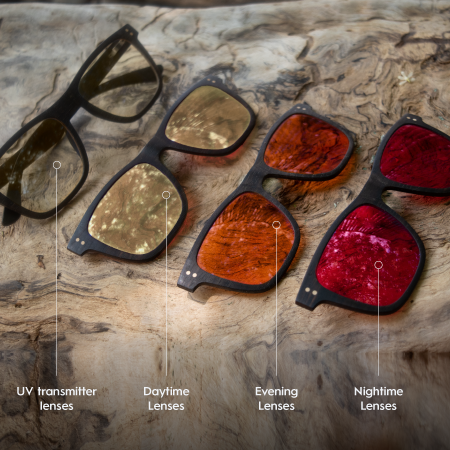
For those who need vision correction, we created UV Prescription Lenses that allow 60% of UV light into your eyes, rather than blocking 100% of UV like most prescription glasses. They're the world's first prescription glasses designed to work with your circadian biology.
When Indoors: Harmonize Artificial Light
Modern indoor environments are dominated by artificial light, especially LEDs that emit isolated blue light around 455nm, without the balancing wavelengths found in sunlight.
This is where our Daytime Lenses come in.
Unlike blue blockers that remove blue light entirely, our Daytime Lenses don't block blue light—they harmonize it. They balance the blue light with yellow, orange, and red wavelengths, bringing your indoor light environment closer to the balance found in nature, while preserving the beneficial blue wavelength your brain needs during the day to stay focused and alert.
Phase 2: Evening (After Sunset)
After sunset, what kind of light exists in nature?
Fire. Candlelight. Moonlight. Starlight.
The light becomes:
- Warm (amber, orange, red tones)
- Dim (very low intensity)
- Quiet (no blue, no green)
The modern problem? You're surrounded by artificial light everywhere—TVs, phones, fridges, LED bulbs, office lights, malls, airports.
The isolated blue spike from modern LEDs signals daytime to your brain, even at 10 PM—when your biology is expecting darkness.
This suppresses melatonin, the hormone responsible for sleep, cellular repair, and metabolic regulation. At the same time, it elevates nighttime cortisol, pushing your body into a state of alertness when it should be winding down.
That hormonal mismatch:
- Leaves you wired but tired
- Disrupts blood sugar regulation, even without eating
- Increases the hunger hormone ghrelin
- Suppresses the fullness hormone leptin
This is why late-night screen time often leads to cravings and snacking. When melatonin and leptin are suppressed, your body is more likely to store energy as fat rather than burn it.
How We Recreate Natural Evening Light
After sunset, the only light humans experienced came from fire—warm, amber firelight with no blue and no green light.
Our Evening Lenses are designed to mimic that natural firelight.
They block 100% of blue light and high-frequency green light up to 520 nm, removing the wavelengths that tell your brain it's still daytime and allowing melatonin to rise naturally.
At the same time, they're designed so you can still see clearly and function normally. You can work, cook, read, socialize, and move through your evening with ease—just as people once did around a fire.
Your body relaxes. Your mind slows.
"I used to lie in bed scrolling for an hour before sleep. Now I put on my Evening Lenses at 7 PM, and by 9 PM my body actually feels tired. I didn't realize how wired I was until I gave myself permission to wind down."
— Sarah, 42
Phase 3: Night (The Hour Before Sleep)
As you approach sleep, what exists in nature?
Darkness. True, deep darkness with stars in the sky that most cities can't see anymore due to light pollution.
Maybe the faint glow of dying embers. Maybe moonlight—but we're talking about 0.1 to 1 lux maximum.
Darkness is not passive. It is an active biological signal.
Research shows even 8 lux at night (nightlight glow) can suppress melatonin. Typical room lighting is 50-500 lux.
A full moon: 1 lux.
Your living room at night: 500-1000 lux.
Your home is 1,000 times brighter than nature intended.
How We Restore the Signal of Darkness
About an hour before bed, you need even deeper protection.
This is why we created our Red Lenses for evening and nighttime use.
They're designed to restore the signal of darkness by doing two essential things:
- Block 100% of blue and green light up to 560 nm using a patented melanin dye formula, removing the wavelengths most responsible for suppressing melatonin.
- Reduce overall brightness by 10×, reinforcing the signal to your brain that it's nighttime.
By removing the light frequencies and intensity that keep cortisol elevated and melatonin suppressed, red lenses help your body shift into its natural nighttime state—supporting sleep, metabolic regulation, and recovery.
You clip them on over your Evening Lenses, and for that final hour before bed, you're giving your body the complete darkness signal it needs.
What Good Light Looks Like in the Evening
When it comes to your home lighting after sunset, look to nature:
We love:
- Candlelight – The closest thing to firelight. Warm, dim, alive. Your body recognizes this instantly.
- Incandescent bulbs (under 2700K) – These produce a warm, continuous spectrum similar to firelight.
Good news: We're bringing Bio Lighting solutions to VivaRays soon—lighting designed to support your biology throughout the day and evening.
Your Next Step: Awareness First, Action Second
Before you close this page, sit with these questions:
- How much time do you spend in full-spectrum sunlight each day?
- Are you filtering nature's daylight with sunglasses or standard prescription lenses?
- What kind of light fills your home after sunset?
- How bright is your environment an hour before bed?
- When was the last time you experienced true darkness?
You don't need to change everything today. But awareness is the first step.
Here's what we recommend:
Start with observation. For the next three days, notice your light environment. Notice how your body responds.
Pay attention to your energy in the morning, your focus during the day, and how easily you fall asleep at night.
Then, if you're ready to make one change, start with evening light. That's where most people feel the difference fastest.
Ready to Align With Nature?
Start with observation. For the next three days, notice your light environment. Notice how your body responds.
Then, if you're ready to make one change, start with evening light. That's where most people feel the difference fastest.
→ Explore Our Circadian LensesLet nature guide you back.
With gratitude,
Roudy & The VivaRays Team
P.S. Have questions about which lenses are right for you? Email us at support@vivarays.com
Leave a comment