


Stop Wasting Money on Skincare: Fix This Hidden Aging Trigger Instead

The Silent Skin Destroyer: How Light After Sunset Is Secretly Aging Your Skin Every Night
⚠️ WARNING: What you're about to discover will change everything you thought you knew about skincare and aging.
Have you ever wondered why your expensive anti-aging creams aren't working as advertised? Why, despite spending thousands on serums and treatments, you still see new wrinkles appearing every month?
Here's the uncomfortable truth they don't want you to know...
Why the Skincare Industry's Biggest Lie Is Costing You Your Youth
For over 50 years, Big Skincare has convinced you that UV light is the enemy.
"Wear sunscreen!" they scream. "Stay out of the sun!" they warn. "Buy our $200 SPF cream!" they beg.
But here's what they don't tell you: after sunset, light becomes your enemy in a completely different way.
And while you've been obsessing over UV protection during the day, you've been unknowingly destroying your skin every single night.
The very moment you flip on that LED light, check your phone, watch Netflix, or even open your refrigerator...
You're bathing your face in what dermatologists are now calling: "The Silent Skin Destroyer"
The Shocking Discovery That Changes Everything About Aging
In 2023, groundbreaking research published in the Journal of Dermatological Science revealed something that sent shockwaves through the medical community:
Blue light from screens and LED bulbs penetrates your skin up to 1mm deep
Blue light damage happens when this light enters your eye at NIGHT, destroying your skin cells' ability to go into "repair & rejuvenation mode"
Translation: Every single night, you're accidentally fast-forwarding your skin's aging process.
How the "Netflix Effect" Ages You Every Single Evening
Let me paint a picture of what's really happening every night:
- 7:00 PM: LED-lit kitchen (AGING ATTACK #1)
- 7:30 PM: Opening the fridge under harsh blue light (AGING ATTACK #2)
- 8:00 PM: Checking emails on your laptop (AGING ATTACK #3)
- 8:30 PM: Driving under LED streetlights (AGING ATTACK #4)
- 9:00 PM: Scrolling Instagram in bed (AGING ATTACK #5)
- 9:30 PM: Bright bathroom lights during skincare (AGING ATTACK #6)
- 10:00 PM: Netflix binge session begins (AGING ATTACK #7)
- 11:00 PM: "Just one more episode..." (AGING ATTACK #8)
8 separate aging attacks. Every. Single. Night.
And that's just a "quiet" evening at home.
Each exposure is generating what scientists call "Reactive Oxygen Species" (ROS)³ - these are unstable molecules that break down collagen and elastin.
The Melatonin Hijack That's Stealing Your Youth
Your body produces a powerful anti-aging hormone called melatonin. This isn't just for sleep - melatonin is literally your skin's "overnight repair crew." It fights free radicals, repairs DNA damage, and regenerates collagen while you sleep.
🚨 Critical Discovery: Blue & green light exposure through the eyes after sunset CUTS your melatonin production by up to 50%.
Even 30 minutes of screen time can cut your melatonin levels in half. Which means less repair, more inflammation... and faster aging.
No wonder that $300 "miracle" cream isn't working.
What the Eye-Skin Connection Means for Your Aging
🤔You might be wondering: "Should I cover my face at night?"
That's a fair question.
If blue and green light is aging your skin... does that mean you need to start wearing a face mask after sunset?
The simple answer is No. You don't need to cover your skin. You need to protect your eyes.
Your eyes are the master regulators of your circadian biology. They act like light sensors, sending signals to every cell in your body, including your skin, telling them whether it's day or night.
👁️When you expose your eyes to artificial light after sunset, you're broadcasting a message to your body:
That means even if your face is in the shadows, the light hitting your retinas is enough to suppress melatonin, disrupt skin repair, and accelerate aging.
How to Stop Light from Aging Your Skin Tonight
You don't need to throw your phone away or live like a monk. You just need to be strategic about your light exposure after sunset.
Your 4-Step Skin-Protection Ritual
Wear Circadian Glasses to protect your circadian rhythm
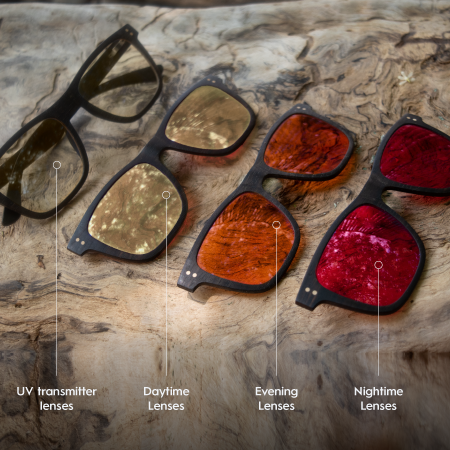
Use innovative 3-in-1 Circadian Glasses that feature three lenses in one frame:
- 🔹 Daytime Lens: Wear indoors during the day to harmonize artificial blue light while maintaining alertness and protecting skin from oxidative stress.
- 🟠 Evening Lens: Switch after sunset to block 100% of blue and most harmful green light, supporting melatonin onset and protecting skin from aging wavelengths.
- 🔴 Nighttime Lens: Use 1 hour before bed to block 100% of blue and green light and reduce brightness 20x, triggering natural melatonin release.
Dim Your Screens and Use Himalayan Lights
Turn on "night mode" and reduce brightness after sundown. Use dim lighting or Himalayan salt lamps at home.
Create a Screen-Free Wind-Down
Step away from screens entirely 1–2 hours before bed when possible.
Layer on Antioxidant Defense
Use antioxidant-rich serums (like Vitamin C or E) before bed to support your skin's natural repair process.
The Bottom Line: Why Your Light Matters More Than Your Serum
If your eyes are exposed to the wrong kind of light after sunset, your skin never gets the message to heal. It stays in "day mode," breaking down faster, night after night.
But now you know the root cause. And you don't need another serum - you need to fix the signal.
-
Block the damaging wavelengths
-
Restore your natural repair cycle
-
Watch your skin respond the way nature intended
Because the most powerful anti-aging decision you'll make isn't on your bathroom shelf. It's in your light.
References:
- MDPI - Effects of Blue Light on the Circadian System and Eye Physiology
- MDPI - Blue Light Penetration and Cellular Effects in Skin
- PubMed - Blue light induces mitochondrial DNA damage and free radical production in epithelial cells
- Harvard Health - Blue light has a dark side (melatonin suppression studies)
- PubMed - Blue-blocking glasses improve sleep and cognitive performance
Leave a comment