


Why Am I So Tired in Spring? (It's Not What You Think)

Happy Equinox, VivaRays family.
Today, March 20th, the sun crosses the celestial equator.
Day and night reach perfect balance: 12 hours each, all around the world.
This is one of the most special days in the entire year: the moment when the two fundamental opposing forces in nature reach complete equilibrium.
Think about the pendulum of nature.
In winter, darkness dominates. It brings with it stillness, introspection, recovery, and rest. Melatonin, the darkness hormone, rules this season. We sleep longer, we go inward, we restore.
In summer, light takes over. It brings with it heat, activity, fertility, growth. Cortisol, serotonin, and dopamine run on longer cycles. We expand, we build, we create.
But today? Today is the zero point.
On this special day, light and darkness become one. They completely balance each other out.
Polar opposites reach unity.
And this is exactly what all of nature is forever seeking: EQUILIBRIUM. Only to lose it, and find it again and forever repeating cycles.
Today is the hinge point. The moment the pendulum is at zero. It is when the seed that has been resting deep in the darkness of the earth starts pushing upward toward the light.
It is when everything you have been quietly building during the winter — through rest, reflection, and going inward — begins to spring into the light and come into being.
Every culture that has ever looked up at the sky has honored this day.
The ancient Egyptians aligned the Great Sphinx to face the rising equinox sun.
The Persians still celebrate Nowruz, their new year, on this exact date.
The Druids gathered at Stonehenge. This is humanity’s oldest recognition of something real: light and darkness govern life.
For those of us in the VivaRays community who live by nature’s rhythm, the spring equinox is an important turning point to be aware of and to help us prepare for shifting our rhythm gracefully.

Here’s what makes this day remarkable from a biology standpoint.
Starting today, something shifts.
If you live in the northern hemisphere, you're gaining roughly 3 to 4 minutes of daylight. Every single say.
By April? Nearly two full extra hours of light compared to February.
Your body knows this. Deep inside your brain sits a tiny structure called the suprachiasmatic nucleus — your master clock. And right now, it's trying to keep pace with the changing sun.
It can't do that on its own.
It needs real signals. Light hitting your eyes in the morning. Darkness after the sun goes down. Those signals travel through the retinal ganglion cells that tell your brain exactly where the sun is in the sky — and what time it really is.
When those signals are strong? Your body runs like it was designed to.
Cortisol peaks at the right moment. Melatonin rises exactly on cue. Sleep gets deep. Energy feels alive.
But here's where most people lose it.
They wake up indoors. Spend the brightest hours of the day behind walls and windows. Then bathe their eyes in artificial light long after the sun has set.
And their clock drifts.
That drift doesn't just feel like tiredness. It feels like disrupted sleep. Low morning energy. Brain fog. A vague, nagging sense that something is off — but you can't quite name it.
What Is Spring Fatigue and Why Do So Many People Believe In It?
Every spring, millions of people experience this and reach for a familiar explanation.
They call it spring fatigue.
There are 2 problems with that label.
Problem 1: Nature says it does not exist.
Step outside right now.
Look around.
The flowers are blooming. The animals are mating. The seeds are sprouting.
Every living thing is surging with vital energy, pushing upward toward the light. Birds are singing earlier. Trees are budding. The earth itself is waking up.
Is there any evidence in nature of spring fatigue? Not a single trace.
Nature explodes in spring and shows no sign of fatigue. It is the most energetically alive season of the entire year.
If spring fatigue were a real biological phenomenon, you would see it reflected somewhere in the natural world. But that is not what happens. What happens is the opposite. Life accelerates.
The only species on earth reporting spring fatigue is
the one that stopped living by natural light.
Problem 2: Science just confirmed it.
The myth goes like this: during winter, your body stockpiles melatonin. When spring arrives and daylight increases, your system has to burn through that surplus. You feel groggy for a few weeks while your hormones recalibrate.
This is biologically impossible. Your body doesn’t “store” melatonin like a battery. Melatonin production responds to light exposure in real time: darkness triggers it, light shuts it down.
There’s no surplus to burn through and science confirmed it
A year-long study of 418 people found zero evidence it exists.
There was no increase in exhaustion. No spike in daytime sleepiness. No drop in sleep quality. Nothing.
The study measured fatigue severity, daytime sleepiness, insomnia symptoms, and sleep quality across every season.
Researchers specifically looked at whether the rapid increase in daylight hours during spring correlated with any of these measures.
It didn’t. Not a single metric showed seasonal variation.
For context, a Bayes Factor below 0.1 means the data actively supports the conclusion that there is no effect.
- Fatigue severity vs. photoperiod: Bayes Factor = 0.1 (moderate-to-strong evidence against an effect)
- Monthly variations in fatigue: Bayes Factor < 0.001 (extreme evidence against)
- Seasonal variations in sleepiness: Bayes Factor = 0.02 (very strong evidence against)
So if it’s not spring fatigue, why do you actually feel drained every March?
The answer has everything to do with your light habits, and almost nothing to do with the season itself.
The Labeling Effect: Why Naming It Makes You Feel It
So if spring fatigue isn’t real, why does it feel so real to millions of people?
Because naming a condition changes how you experience your own body.
It causes people to pay more attention to tiredness they already have and attribute it to the season (Journal of Sleep Research, 2026). You’re not more tired in spring. You’re just more aware of it.
This is a well-documented pattern in psychology. It’s related to the nocebo effect — where negative expectations create negative outcomes.
Spring fatigue works the same way. The label primes you to notice tiredness. The culture reinforces it. Your brain does the rest.
What IS Real: Your Circadian Clock Can’t Keep Up
Here's what nobody talks about.
The spring equinox doesn't just bring more light.
It brings the fastest daylight changes of the entire year.
Your body’s master clock — the suprachiasmatic nucleus (SCN) in the hypothalamus — has to recalibrate to those changes in real time (PLoS Computational Biology, 2012).
That recalibration isn’t automatic.
It requires getting the right light at the right time and avoiding the wrong light at the wrong time.
The neurons in the SCN must shift and encode the new day length.
During winter, those neurons fire in a narrow, compressed pattern. As days get longer, they have to spread apart into a broader activity window. That takes time.
Then there’s the daylight saving time transition. In the spring, the clock jumps forward an hour
But the biggest problem isn’t the season. It’s what you’re doing with light.
Most people spend their days indoors under dim artificial lighting — nowhere near the 100,000 lux of natural daylight.
Then at night, they flood their eyes with screens and overhead LEDs that blast blue light at precisely the wavelengths (460-480nm) that suppress melatonin and delay the circadian clock.
The real problem isn’t that spring makes you tired. It’s that modern indoor life has disconnected you from the natural light-dark cycle your biology depends on. Spring just exposes how broken your light habits already are.
Your body needs consistent light signals for this adaptation to happen: bright in the morning, dim in the evening. The reality is that 95%+ of people simply aren’t getting it.
How to Fix Your Light Exposure Instead of Blaming a Fake Condition
Morning sunlight exposure within the first hour of waking anchors your circadian rhythm, turns off melatonin, stabilizes blood sugar, and improves sleep quality the following night (BMC Public Health, 2025).
On a clear day, 5-10 minutes is enough. Overcast? Give it 15-20.
Here’s a three-step protocol that addresses the actual causes of seasonal tiredness:
Get morning sunlight within 60 minutes of waking
Getting it through your window is not enough. Go outside.
Glass blocks the UV wavelengths that are most critical for signaling your SCN about the arrival of the new season.
Here is why that matters: UV light decreases during the fall, signaling to your body that winter is approaching. It increases during the spring, signaling that summer is on its way. Those signals directly determine your metabolic mode.
In winter mode, your body burns food into heat to keep you warm. In summer mode, it burns food into energy so you can move, build, and create.
Morning sunlight outside is how your body reads the season it is actually in.
On sunny days, five to ten minutes is enough. On cloudy days, give it fifteen to twenty. This single habit does more for your energy than any supplement.

Block blue light 2-3 hours before bed
Evening blue light exposure suppresses melatonin, delays circadian phase, and extends the time it takes to fall asleep (Frontiers in Neurology, 2025).
Where does this light come from?
Well, it’s everywhere.
Your computer screen, your phone, your television, your light bulbs at home, down the street, in the mall.
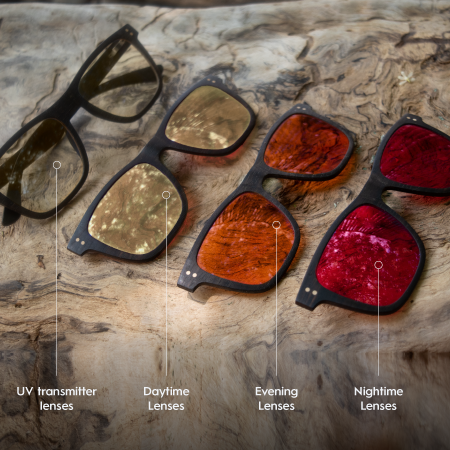
VivaRays Circadian Evening glasses help your body naturally transition into sleep while enjoying your usual evening activities.
They filter the blue and harmful green light up to 520nm, shifting your world into the warm, candlelit glow your body recognizes as evening. Wear after sunset
The VivaRays Circadian Nighttime glasses block 100% of blue and green light up to 570nm, while reducing brightness to maximize your melatonin production to the fullest and help you sleep deeper and wake up feeling rested.
Keep a consistent wake time across the equinox
Your SCN thrives on predictability. When you shift your wake time every weekend or “sleep in” to compensate for tiredness, you create social jet lag that compounds the daylight transition.
Hold your wake time steady and your body will adjust to the changing photoperiod faster.
This should not be complicated.
Morning light tells your body it’s daytime.
Evening darkness tells it to wind down.
When those signals are consistent, your circadian clock runs on time, regardless of what season it is.
Frequently Asked Questions
Is spring fatigue the same as seasonal affective disorder (SAD)?
No. SAD is a clinically recognized form of depression triggered by reduced light exposure, primarily during fall and winter. About 5% of U.S. adults experience it (NIMH, 2024). At VivaRays, we believe that SAD does not really exist. It’s a condition that happens when the body is confused about the time of the season because of disrupted light exposure. If you want to learn more about this, check out our winter series. Spring fatigue, by contrast, has no clinical definition and no measurable biological markers. The Basel study found no evidence that spring itself causes increased fatigue in the general population.
Why do I genuinely feel more tired in March and April?
You probably aren’t sleeping well, but not because of spring. The daylight saving time transition alone causes sleep fragmentation that can last a week or more (Stanford Medicine, 2025). Combine that with inadequate morning light, late-night screen use, and the labeling effect, and you have a recipe for tiredness that has nothing to do with the season.
Do blue light blocking glasses actually help with seasonal tiredness?
Blue-blocking lenses worn after sunset have been shown to nearly double melatonin production compared to clear lenses (PLOS ONE, 2024). By protecting melatonin production in the evening, circadian glasses help your body maintain a consistent sleep-wake cycle during the rapid daylight changes of spring.
How long does it take to adjust to spring daylight changes?
Your SCN can shift roughly 1-2 hours per day with consistent light exposure. With proper morning light and evening darkness, most people adapt to the spring transition within 1-2 days. Without those signals — stuck indoors under artificial light — the adjustment can drag on indefinitely. That’s when people start blaming “spring fatigue.”
Is there any biological basis for seasonal energy changes?
Yes, but not in the way people think. Fatigue in the Basel study actually decreased slightly with longer photoperiods, independent of season (Journal of Sleep Research, 2026). More daylight generally means more energy, not less. The real seasonal variable is how well your light exposure matches the natural cycle, and for most people, it doesn’t.
Get the right light at the right time
Your circadian clock doesn’t need a seasonal reset. It needs two things: bright light in the morning and darkness in the evening. Get those right, and your body handles the transition on its own.
Stop blaming the season. Start managing your light.

At VivaRays, our goal is to help more than 1 million people to live in rhythm with nature’s light and dark cycles and experience the aliveness and vitality that we are all born with.
Explore Circadian Glasses
Leave a comment