


winter flow 6: How to get 8 hours of energy from 60 seconds of cold exposure

Welcome Back, Beautiful Light Being
In our last blog, you discovered what happened when I plunged into that frozen river in Poland. How cold exposure activates your body's ability to generate heat from within and how it invigorates your mitochondria when sunlight is scare
Today, I'm going to tell you about day seven in Poland
The day I understood the power of combining cold and exercice
The Morning Everything Changed
Day seven of the retreat.
I wake up at 6:00 AM and it's pitch black outside. The sun won't rise for another two hours.
In my old life—back in Beirut, trapped in depression—waking up in darkness was torture.
Feeling low, heavy and unmotivated to kickstart the day
I'd set three alarms. Hit snooze for an hour. Finally drag myself out of bed at 10 AM—already feeling behind, already defeated.
But this morning in Poland? Everything is different.
I'm awake. Fully awake. Feeling alert, clear and ready
And here's what's absolutely fascinating.
I'm not the only one. I walk into the common area, and half the group is already up.
Moving. Talking. Laughing.
Someone says: "I haven't felt sharp and energized in the morning for years. What is happening to us?"
That's when it hits me. It's not just that we've adapted to the cold. The cold has changed something in our brains.
Let me explain
Why Dark Winter Mornings Feel So Hard
Here's what I learned later about why Beirut mornings felt so impossible:
Your body temperature follows a 24-hour cycle.
Every morning,, your core temperature rises shortly before sunrise, creating that feeling of alertness and readiness to start the day.
Then after sunset, it cools down, preparing you for deep sleep.
When your body temperature rises in the morning, it triggers a cascade of awakening hormones:
- Cortisol (your natural wakefulness hormone)
- Norepinephrine (alertness and focus)
- Dopamine (motivation and drive)
Those are you body's natural wake-up system. Think of them like your internal cup of coffee
But here's the problem in winter:
That temperature rise is triggered by light cues. Specifically, the anticipation of sunrise.
In winter, the sun doesn't rise until 8 or 9 AM, and the light signaling feels weaker.
What happens if you need to be up by 6, feeling sharp, alert and ready for the day?
Without strong light cues, that natural temperature rise feels sluggish. As a result you wake up groggy. And struggling to get going.
At this point, many people reach for coffee or blast themselves with bright artificial lights.
But here's the problem:
Coffee dehydrates the water inside your mitochondria.
Just like artificial blue light from screens and LEDs, caffeine expands the water in the cell and pulls away those five respiratory proteins you learned about in Blog 5—the ones that need to stay close together to produce energy efficiently.
When that cellular water dehydrates, those proteins drift apart. Energy production plummets.
You might feel a temporary jolt from the caffeine or an awakening response from blue light and yet' it's not sustainable because you're making your mitochondria less efficient
How Cold + Movement Solved This
In Poland, we weren't using coffee or artificial lights in the morning.
We were using cold & movement.
Every morning we started our days outside, in shorts at -10 degrees doing dynamic movement
Jumping jacks in the snow.
Squats by the frozen river.
Sprints through the forest in shorts.
And here's what happened:
Our body temperature surged.
Our body temperature surged.
You already know that when you expose yourself to cold, your body responds immediately with thermogenesis. Your mitochondria start burning fuel to generate heat.
Your core body temperature rises.
When you add movement to that? The effect amplifies.
Your muscles burn fuel. Your body generates even more heat.
And you know what's the best thing about adding exercise to the mix?
It makes cold exposure a lot easier. A lot more enjoyable.
And this surge in body temperature?
This surge in body temperature—combined from cold and movement—mimics exactly what's supposed to happen naturally each morning when your circadian clock is healthy.
Cold and movement together amplify the awakening signal your body is already trying to produce.
Research published in the European Journal of Applied Physiology found that cold water immersion at 14°C increased metabolic rate by 350% and drove a powerful rise in core body temperature.
A 2020 study in Physiology & Behavior found that combining cold exposure with exercise increased dopamine levels significantly more than either practice alone.
Here's why they work together so powerfully:
Both cold and exercise increase your core body temperature.
Both trigger an immediate surge of the same awakening hormones:
- Cortisol ↑ (your natural wakefulness hormone)
- Norepinephrine ↑ (alertness, focus)
- Dopamine ↑ (motivation, drive)
The same neurochemicals that sunlight produces during brighter months.
The same cascade that your body temperature rise is designed to trigger.
That's what we experienced in Poland.
Cold was doing what the missing sunrise couldn't.
Movement was amplifying it even more.
Strengthening the awakening signal naturally.
The Transformation I Felt
By day seven, I noticed something beyond wakefulness.
Motivation.
Not the forced, caffeinated, "I have to get through this" kind of motivation. I am talking about intrinsic real motivation.
That natural inner drive that makes you want to create, move, engage with life.
The kind of motivation I hadn't felt throughout my adult life
On day 7 of this gathering, I'm outside in the snow, barefoot. We're doing what Wim calls "dynamic movement": jumping jacks, squats, pushups in the cold.
My body is generating so much heat, I don't even feel the -15°C anymore.
And my mind feels crystal clear, focused and alive.
I'm thinking: "I want to write. I want to build something. I want to create."
Where was this coming from?
The Dopamine Discovery
Months later, back on the farm in Canada, I'm reading research.
And I found it.
A landmark study in the European Journal of Applied Physiology:
Cold water immersion at 14°C increased dopamine levels by 250% and norepinephrine by 530%.
250%. That's comparable to what you'd see with pharmaceutical interventions.
Except this is completely toxic free, no side effect, natural. free. Available to anyone.
But here's what's even more fascinating:
A 2023 study in Biology found that unlike the quick spike-and-crash of artificial dopamine hits—sugar, social media, blue light from screens—the dopamine increase from cold exposure remains elevated for 6 to 8 hours.
Six to eight hours.
A slow, sustained rise that keeps you motivated, focused, emotionally resilient throughout the day.
That's what I felt in Poland.
That's what everyone in the group felt.
Our dopamine tanks were full. From cold and movement combined.
From nature itself.
GOLDEN NUGGET: Dopamine is your inner drive fuel, the powerful force that makes you want to engage with life. Modern lifestyle drains it. Cold + exercise restores it. Naturally. Sustainably. Powerfully.
The Cruel Winter Trap
Here's the problem most people face:
Modern Winters deplete your dopamine from both sides.
On one side: Less sunlight.
On the other side: More artificial light.
You're indoors more. Under LEDs. Scrolling on screens.
Research from the National Institute of Mental Health by Dr. Samer Hattar showed that artificial light at night destroys dopamine levels.
So in winter, you're not just getting less of what builds dopamine (sunlight, cold, movement).
You're getting more of what depletes it (artificial light, screens, indoor living).
No wonder you feel unmotivated and lethargic.
Like you can't find the energy to pursue what matters.
GOLDEN NUGGET: You don't have a winter problem. You have a nature starvation problem. Artificial light is draining your dopamine while you avoid the natural forces—sunlight, cold, exercise—that would restore it.
The Solution Is Simpler Than You Think
What if you flipped it? Instead of avoiding the cold, you stepped into it.
Suddenly, you're outside. Getting whatever natural light is available. Getting cold exposure and moving your body.
Cold + light + exercise = The golden trinity.
Not three separate practices you have to fit into your day.
One practice that combines all three.
✨ GOLDEN NUGGET: The golden trinity—cold, light, and exercise—isn't three separate habits. It's one integrated practice that takes 5-10 minutes and activates every system your body needs to thrive in winter. Your ancestors did this naturally. You're just remembering.
5 Actions to Reclaim Your Wakefulness & Motivation
These build on what you learned in Blog 5. Think of them as the next layer. Practices that specifically target your morning alertness and sustained motivation throughout the day.
Action #1: The Golden Trinity - Cold + Light + Exercise
This is the most powerful practice in the entire series.
Step outside in lighter clothing (t-shirt when possible, shorts if you're ready).
Start moving immediately:
- 20 jumping jacks
- 10 squats
- Run in place for 30 seconds
- Repeat 2-3 times
Start with 5 minutes. Build gradually and celebrate after every practice
This will feel SO GOOD that your brain will start craving it
Action #2: Protect Your Dopamine at Night
Cold and exercise fill your dopamine tank during the day.
But you need to protect it at night.
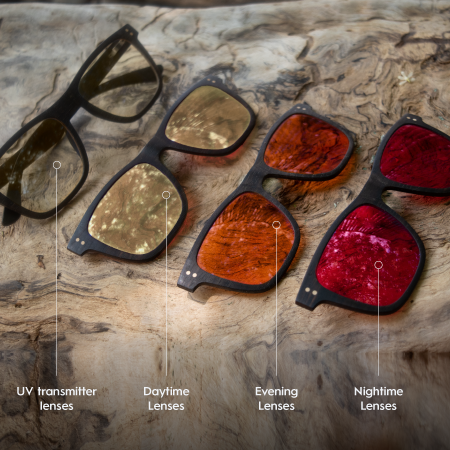
After sunset, wear Evening Lenses.
These filter out the blue light frequencies that suppress dopamine production and disrupt your circadian rhythm.
One hour before bed, switch to Nighttime Lenses.
These block virtually all stimulating light, allowing melatonin to rise fully and your neurotransmitters to restore overnight.
You wake up with your dopamine tank refilled, ready to embrace the cold and movement again.
✨ GOLDEN NUGGET: Growth happens at the edge of comfort. By embracing the cold, moving in it, and protecting your darkness, you're not just surviving winter, but you're building a version of yourself that thrives in it.
The Science Behind This Blog
Key Research Citations:
Srámek P, et al. (2000). "Human physiological responses to immersion into water of different temperatures." European Journal of Applied Physiology, 81(5), 436-442. [Cold water immersion: 350% metabolic increase, 250% dopamine, 530% norepinephrine]
Šrámek P, et al. (2023). "Short-Term Head-Out Whole-Body Cold-Water Immersion Facilitates Positive Affect and Increases Interaction between Large-Scale Brain Networks." Biology, 12(2), 211. [Dopamine elevation sustained 6-8 hours]
Kenttä G, et al. (2020). "Combined effects of cold water immersion and exercise on neurochemical responses." Physiology & Behavior, 223, 112967. [Synergistic dopamine increase from cold + exercise]
Hattar S, et al. National Institute of Mental Health. Research on artificial light exposure and dopamine suppression.
Buijs RM, et al. (2003). "The biological clock tunes the organs of the body: timing by hormones and the autonomic nervous system." Journal of Endocrinology, 177(1), 17-26.
Continue Your Winter Flow Journey
THE COMPLETE WINTER FLOW SERIES
Blog 1: Rediscovering Winter | Blog 2: Animal Resilience | Blog 3: Light Part 1 | Blog 4: Darkness | Blog 5: Cold Part 1 | Blog 6: Cold Part 2 (You Are Here) | Blog 7: Light, Cold & Weight | Blog 8: Food Is Light | Blog 9: Seasonal Eating | Blog 10: Vitamin 'G' Part 1 | Blog 11: Reconnecting with Earth
Leave a comment