


Winter Flow 9: Why You're Always Hungry in Winter

In our last blog, you discovered that food is light, captured by plants and read by your body as information.
You met Amy, who transformed her sleep, energy, and hormones by aligning her light environment and her food with winter.
Today, we're going to answer the question Amy asked me after her transformation.
On March 2024, two months after Amy's results, she writes:
"Roudy, I need to understand something.I've been eating 'clean' for years. Organic everything. Lean proteins. Whole grains. Smoothie bowls with berries. All the things health experts say to eat.And I felt terrible. Then I switched to eating squash, root vegetables, butter, beef, eggs, foods I was always told would make me gain weight and clog my arteries. And I lost 8 pounds. My hot flashes stopped. I'm sleeping through the night. My energy is steady all day.I don't understand. WHY did this work?What's actually happening in my body?"
I smiled when I read her email.
Because I'd asked myself the exact same question a few years earlier back at the farm…
The Discovery That Changed Everything
Winter 2018 , I'm at the farm in Canada.
I'm sitting at the kitchen table reading research papers, trying to understand something that's been puzzling me for months.
Why do I feel so different eating the same foods in different seasons?
That summer, when I ate berries and fresh vegetables from the garden, I felt energized, light and active.
But when winter came and I tried eating the same way, buying berries shipped from Chile, eating tropical fruits. I felt... off.
Not sick. Just... Something in my system felt off
I would feel tired shortly after I eat and I would feel hungry an hour after meals.
I thought: "Maybe it's the quality. Maybe imported fruit isn't as fresh."
But that didn't fully explain it. Because the squash and root vegetables I ate in winter, stored for months, made me feel better than the "fresh" berries flown in from summer climates.
Something else was happening.
Then I found it. A 2021 study in Frontiers in Physiology. The title captured my attention:
"Light-Sensing Proteins in the Gut."
I read the first paragraph, then I read it again and again. Scientists had discovered a photoreceptor AKA a light sensor in the intestinal wall.
Not in the eyes. In the gut… and they called it Opsin 3.
And when they shone light on gut tissue in the lab, it responded. The gut was literally "seeing" light.
I sat back in my chair thinking: WOW! My gut has light sensors.
Another study found these light sensors aren't just in the gut. They're in your heart. Your liver. Your kidneys. Essentially, all over your body.
Your entire system is wired to detect light information.
But here's the questions that kept me wondering:
How do these sensors "see" light when they're inside your body, away from sunlight?
We know that most frequencies don't penetrate deep enough except for red and infrared light.
As I kept thinking about this question over and over again, the answer came through as I vividly recalled my conversation with Hunt:
"That tomato is full of light. You're not just eating nutrients. You're eating sunlight and nature's love packaged in a bite."
It's the light from food that is hitting those opsin!
Bingo!
From a quantum biophysics lens, we know that when you eat food, it gets broken down into electrons and protons.
Those electrons carry the light frequencies from the sunlight that grew that food.
Those electrons travel through your digestive system and your gut's light sensors read them.
They detect:
- The electromagnetic signature
- The intensity
- The wavelength pattern
Your gut is literally reading the light barcode of every bite you take and using that information to tell your body what season it is.
Suddenly, everything made sense.
Why berries in winter felt wrong. They carried summer light codes. My gut read "summer." But my eyes, looking out at snow and short days, read "winter."
Why squash in winter felt right. It carried autumn/winter light codes. My gut read "cool season." My eyes read "cool season." The signals matched.
When the light my eyes saw and the light my gut read told the same story, my body knew exactly what to do. But when they contradicted each other? It led to metabolic confusion.
The Email I Sent Amy
I wrote her back that same day.
"Amy, here's what I believe is happening: Your gut has light sensors. They're called opsins. When you eat food, it breaks down into electrons that carry the light signature of where that food grew.
Your gut's sensors read those electrons and they detect the electromagnetic pattern, the intensity, the wavelength.
When you were eating mangoes and berries in January, your gut read: 'High UV. Summer. Abundance. Burn fast. Eat often.
But when you looked outside at Michigan snow and short February days, your eyes read: 'Low UV. Winter. Scarcity. Conserve. Rest.
Your body was getting two completely different messages.
Your eyes said 'winter.' Your gut said 'summer.' And your metabolism didn't know which program to run." So it tried to run both. Or neither. Or switched back and forth.
That's why you felt exhausted, inflamed, constantly hungry, even though you were eating 'clean.' When you switched to winter foods, your eyes AND your gut were saying the same thing: 'Winter and your body finally knew which program to run."
Amy wrote back again:
Wait. You said my EYES were reading winter. But I was under artificial lights at night, watching TV and on my phone before bed.Were my eyes even reading ''winter?"
Perfect question.I explained:
"In winter, your body expects long, dark nights." That darkness triggers extended melatonin production, a clear signal that it's winter, time to rest deeply and run the winter program." But when you're under bright LEDs at 9 PM, watching TV after sunset, scrolling your phone at 11 PM, your eyes are getting summer signals too.
So you had:
- Your gut reading summer (tropical fruits)
- Your eyes at night reading summer (artificial light causing short melatonin cycle)
- Your eyes during the day reading weak winter light (Low brightness, no UV light indoor light that is even dimmer than winter daylight)
Three conflicting signals and maybe more. Your body was trying to run summer mode, winter mode, and everything in between, all at once.
Amy's response:
"Oh my God. This is why getting morning sunlight and wearing the evening and nighttime lenses helped so much. This all makes so much sense right now!!! And when I removed the tropical fruits, my gut started reading 'winter' too. WAW! This is much simpler than I thought and it makes so much sense. It's like every cell in my body knows this! Thank you''
Amy's Next Question: What About Ketosis?
Three weeks later, Amy wrote again.
"Roudy, something weird is happening. I'm eating and craving a lot more fat than I used to and more calories probably. But I'm going longer between meals without even thinking about it.
''Yesterday I ate dinner at 4:30 PM. Didn't eat again until 9 AM this morning. 16.5 hours and I wasn't even hungry.
"Before, I was snacking every 2-3 hours and still felt starving."
"My friend told me I'm probably in 'ketosis' and that it's dangerous long-term. Is that true?"
Ketosis: Nature's Winter Mode
I sent her a long email that night.
"Amy, ketosis isn't a 'diet.' It's what your body naturally does in winter."
"For years, I'd heard about keto diets. Low-carb eating. Fat-burning mode. People debating whether it's healthy or not."
"But I never understood why my body seemed to crave it in winter and hate it in summer."
"Why meat, butter, eggs, fish, and bone broth were everything I wanted during winter, and why I stopped craving berries and fruits during that time."
"Also, why I could NOT function properly when I tried to eat the same winter diet in summer. My body was craving fruits all the time."
"Now it makes sense. I was able to see that Ketosis is not a willpower game. It's not meant to be a dogmatic diet . I's meant to be a natural, seasonal and purposeful process that we experience naturally in the winter
"When the signals align: short days, low UV, winter foods—your body shifts into fat-burning mode automatically."
"Not because you're making an effort to restrict carbs and using willpower and discipline to fast''
"Because you're naturally eating what's actually available in winter. And carbs are NOT very available."
"Also, naturally when you follow the sunrise and sunset time as your eating rhythm, you'll be fasting for longer hours and entering ketosis."
"Think about it: In nature, what food is naturally accessible in the winter?"
Mostly animal based fats and proteins
"Your body evolved to run on this fuel in winter."
"To burn stored fat for heat. To go longer between meals without crashing."
"This is ketosis."
I continued:
"Here's what happens when you eat fat in winter:"
- More energy per molecule: One fatty acid gives you 3-4x more ATP than glucose
- Fewer cravings: Fat keeps you satisfied for hours and helps you go 12-16 hours without food (which winter naturally requires)
- Fat burns into heat: Ketones prioritize warming you from the inside
"This is why your winter meals like beef, root vegetables, butter, bone broth, kept you satisfied for so long."
"Your body was running the program it's designed to run in winter."
GOLDEN NUGGET: Ketosis in winter isn't a diet trend. It's nature's design.
Getting Practical: What to Eat This Winter
I sent Amy a list.
Here's what your metabolism is expecting this season:
Proteins:
- Grass-fed beef, bison, lamb
- Wild-caught fish (salmon, mackerel, sardines)
- Pasture-raised poultry
- Eggs from pastured chickens
Healthy Fats:
- Butter and ghee from grass-fed cows
- Animal fats (tallow, lard from pasture-raised animals)
- Bone broth
- Olive oil (in moderation)
Winter Vegetables:
- Root vegetables: carrots, beets, turnips, parsnips, sweet potatoes
- Winter squash: butternut, acorn, kabocha, pumpkin
Winter Fruits (in moderation):
- Apples and pears (store well through winter)
- Citrus: oranges, lemons, grapefruit (winter harvest)
- Pomegranate
Other Winter Allies:
- Fermented foods: sauerkraut, kimchi, kefir
- Warming spices: cinnamon, ginger, turmeric, cloves
- Sea salt
- Organ meats: liver, heart, bone marrow
Where Your Food Comes From Matters
Amy wrote back:
"Okay, but here's my problem. I live in the suburbs. I can't hunt. I don't have chickens. I shop at the grocery store.How do I know if the food I'm buying has the right 'light code'?"
Another great question.
I wrote back:
"Amy, here's something critical most people miss:"
"That 'organic' label in the supermarket? It might be meaningless."
"Big corporations have learned to game the system. They grow food in warehouses under artificial lights. Ship it across the world. Let it sit in storage for weeks."
"Then slap 'organic' on it."
"But food grown under artificial light doesn't carry the same information as food grown under real sun."
"The light code is different. Or absent entirely."
"The real solution? Know your farmer."
"Go to farmers' markets. Find people growing food outdoors, in real soil, under real sun. Ask them questions. Visit their farms if you can."
"Food from a farmer you trust, grown 20 miles away, is infinitely better than 'certified organic' food shipped from another continent."
"The light information is fresher. The connection is real. And you're supporting people who actually care."
Amy responded:
"There's a farmers' market in my town every Saturday. I always drove past it thinking it was more expensive."
"I'm going this weekend."
5 Practical Actions to Align With Winter
Action #1: Remove Tropical Fruits
Bananas, mangoes, pineapples, papayas—these require year-round intense heat and UV.
When you eat them in winter, your gut reads "summer" while your eyes see "winter."
Metabolic mismatch.
Save tropical fruits for actual summer (and even then, prioritize local summer fruits).
Action #2: Eat Root Vegetables and Winter Squash
These grow in autumn and store well through winter for a reason.They carry the right light information for the season. Roast them. Make soups. Enjoy their natural sweetness. Your body will recognize the signal: "Winter. Steady energy. Fat-burning mode."
Action #3: Prioritize Quality Fats and Proteins
Winter is your season for rich, warming foods. But where that food comes from matters:
For fish: Always wild-caught, never farmed.
Farmed fish are raised in crowded conditions, fed unnatural diets, loaded with antibiotics.
Wild fish carry the light codes of the ocean and natural food chains.
For meat: Find animals that were raised on regenerative farms.
Where animals are loved, respected, part of a balanced ecosystem.
Not confined, stressed, and pumped with hormones.
That stressed animal's meat carries that signal too.
Find a local farmer doing it right. Build that relationship. This connection matters more than any label.
Action #4: Align Your Eyes and Gut
Remember: Your metabolism needs consistent signals.
During the day:
- Get outside for morning light (even 5-10 minutes)
- Let your eyes register winter's short days and low UV
After sunset:
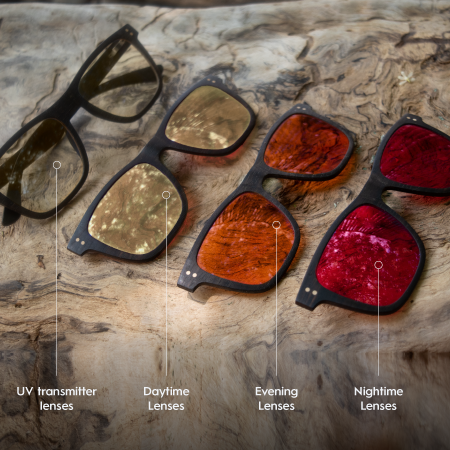
- Wear VivaRays Evening Lenses to protect your darkness
- One hour before bed, switch to Nighttime Lenses
This tells your eyes "long winter night", matching what your gut reads from winter foods
When your eyes and gut tell the same story, your body knows which program to run.
Action #5: Eat With the Sun
Have your meals during daylight hours.
Last meal before or near sunset.
A 2024 review in Annual Review of Nutrition confirmed: meal timing matters as much as what you eat.
Your circadian system expects food when there's light.
Eating late at night sends another summer signal (long days, late sunsets).
Winter rhythm: Eat while the sun is up. Fast while it's dark.
Start Small
You don't need to overhaul everything tonight .You've already made huge progress. Just pick one more shift.. Maybe it's switching from grocery store eggs to farmers' market eggs." Maybe it's adding bone broth to your routine. Maybe it's moving dinner an hour earlier. Just one thing."
The Deeper Truth
When we eat seasonally, we're not following a diet. We're participating in an ancient conversation.
Between our bodies and the cosmos.
Between our cells and the sun.
Between what we eat and the rhythm of light that governs all life.
Every meal becomes an opportunity to tell your body what season it is.
To align your internal rhythms with the external world.
To work with nature instead of against it.
This winter, see your plate differently.
Not as calories.
Not as macros.
Not as something to stress over.
See it as information.
See it as light, captured and stored.
Ready to communicate with every cell in your body.
No more confusion.
No more conflicting advice.
Just clarity.
The same wisdom that guided your great-grandmother.
The same knowing that guides bears through hibernation.
The same intelligence that's been keeping humans alive for hundreds of thousands of years.
You already know what to eat.
Your body has always known.
You just need to listen again.
The Science Behind This Blog
Key Research Citations:
Dan A, et al. (2021). "Opsin 3 in the human gut." Frontiers in Physiology, 12, 663027. [Opsin 3 photoreceptor found in intestinal tissue]
Karthikeyan R, et al. (2025). "Extra-retinal opsins in multiple organs." Chemical Senses, 50(1), bjaa001. [Opsin 3 expression in heart, liver, kidney, throughout body]
Pollack GH. (2013). The Fourth Phase of Water: Beyond Solid, Liquid, and Vapor. Ebner & Sons. [Exclusion zone water research—how light structures cellular water]
Yasumoto Y, et al. (2022). "Out-of-season food consumption disrupts circadian rhythms and metabolic homeostasis." Frontiers in Nutrition, 9, 93289. [Same food, wrong season = metabolic disruption]
UCSF / Ptacek & Fu lab (2025). "Seasonal changes in dietary lipid composition reprogram hepatic metabolism." Science, 387(6729), 123-134. [Modern life creates circadian confusion with year-round summer foods]
McHill AW & Butler MP. (2024). "Meal timing and circadian metabolism." Annual Review of Nutrition, 44, 369-391. [Meal timing as important as food choice]
Kruse J. Leptin prescription and seasonal light signaling through food. [Jack Kruse's work on electromagnetic barcodes in food]
Leave a comment