


Winter Flow 1: How to Thrive When Nature Gets Cold

Every morning on the farm in northern Canada, I watched two groups of chickens.
One group strutted out into -20°C temperatures. Feathers glossy. Eyes bright. Thriving.
The other group huddled in climate-controlled barns under heat lamps. Feathers dull. Eyes tired. Merely surviving.
Same species. Same winter. So what is the difference?
One group lived connected to nature. The other lived separated from it.
And watching them, I kept thinking: if those chickens can thrive in freezing temperatures, why do so many of us—maybe you, maybe me—dread every winter that comes?
Here's what the research tells us:
95% of people feel negative biological effects in winter. Poorer sleep. Lower energy. Increased cravings. A noticeable drop in motivation.
About 1 in 4 people actively struggle and develop full Seasonal Affective Disorder when the days get shorter.
Most doctors will tell you this is just "how winter is." That it's normal. Seasonal.
But here's what nobody's telling you: Winter isn't designed to be hard. We've just forgotten how to work with it.
And over the next 11 blogs, I'm going to share what I learned the hard way: through years of deep suffering, a near-complete breakdown, and eventually, a total transformation.
Not through supplements. Not through biohacks.
Through something simpler: remembering what animals never forgot and coming back to the roots. Coming back to rhythm. Coming back to balance.
Now, I need to be honest with you.
This won't resonate with everyone.
If you're looking for the next trendy supplement or a 47-step optimization system, this isn't it.
But if you're fed up with dogmatic diets and endless supplements that never quite work...
If you're yearning to come back to that joyful, vital version of yourself...
If you want to transform winter from a season of struggle into healing, but you don't know how...
If you struggle with winter weight, hormone imbalances, fatigue, or seasonal blues, and you know in your gut there's a better way...
Then keep reading.
Because my intention with this series is to help you view winter through a completely new lens.
I'll consider this exploration a success if, by the end, I've helped you deconstruct your resistance to winter. To unravel your old narrative of feeling low on energy, tired, and dispirited. And help you reconstruct a new paradigm:one where you know exactly what to do to harness the power of the winter season.
Why does this matter so much?
Because right now, most of us are unknowingly fighting a battle we can't win.
Recent research shows that our circadian rhythms, hormone production, metabolism, and immune function all shift dramatically with the seasons.
When we ignore these shifts and when we try to live exactly the same way in December as we do in July ==> we're essentially fighting against our own biology.
And that's the suffering I want to help you overcome…
The suffering we cause ourselves,without even knowing it,—by constantly breaking the laws of nature.
But before we dive into the solution, I need to tell you a story.
Because everything I'm about to share with you over the next 11 blogs:every insight, every practice, every piece of wisdom, came from the darkest period of my life.
A time when winter didn't just feel hard. It felt like an enemy. A time when I believed something was fundamentally wrong with me
Picture this:
It's a chilly morning in Beirut. I'm standing by my window, looking out at the rain-soaked streets, feeling a familiar dread creeping in.
Winter in Beirut isn't the harshest compared to Canada or Scandinavia. But to me, it feels like a season of deep struggle.
My health is already at floor level. And winter? Winter takes me underground.
I'm struggling with depression and chronic fatigue. Dragging myself through each day like I'm wearing a backpack full of rocks.
Living like a night owl. Completely out of sync with nature.
Staying up until 3 AM. Scrolling. Eating candy. Drinking. Partying.Then waking up exhausted. Unmotivated. Weighed down.

On the morning of my 25th birthday, I hit rock bottom.
I'd just lost my job as an engineer.
Here I am. Lying in bed, feeling completely paralyzed with sadness and fatigue.
Unable to get up.
Unable to find a single reason to.
I stare at the mirror.
Dark circles under my eyes.

Skin so pale that I could have been mistaken for a zombie.
The kind of energy that makes people step away from you.
"I can't keep living like this," I said aloud to my reflection. "I need to feel alive again. To find a light in this darkness."
And that's when I make the most radical decision of my life.
"Screw what society wants me to be. Screw my engineering career. Screw building the perfect CV."
''I need to travel.To break free from everything familiar.''
So I apply for tourist visas.
Twelve countries.
Eleven rejections.
I'm staring at my inbox. Email after email.
"We regret to inform you..."
"Unfortunately..."
"Your application has been denied..."
I feel angry. Broken. Hopeless.
Why is everything in my life so complicated?
I see friends from the USA posting vacation photos. Colleagues with European passports traveling for work.
People just... going places.
Like it's nothing.
And here I am. Born in a country that gets bombed every 2 to 3 years.
Where even something as simple as traveling requires endless paperwork. Interviews. Suspicion. Rejection.
Because of a passport I didn't choose.
A birthplace I didn't pick.
Here I am, spiraling down a dark rabbit hole.
Wishing life could just swallow me whole.
Wishing I could disappear into nothingness and finally find rest.
Days pass.
I stop checking email.
What's the point?
Curtains drawn. The world continues without me.
Then my phone buzzes.
I almost don't look.
But something makes me reach for it.
An email.
I open it, expecting nothing.
And I see:
"Your visa application has been approved."
Where?
To Canada! The coldest country in the world.
A land known for its cold, dark winters
Everything I feared. Everything I'd been running from.
"Am I crazy?" I think. "What if this makes things worse?"
But deep down, I know: this is exactly what I need.
In a twist of destiny, just two weeks before my journey, I crossed paths with a friend who introduced me to his ice bath practice and to his mentor, Wim Hof, known as the Iceman.
My friend said: "Roudy, what perfect timing. Wim is hosting a cold immersion retreat in Poland. It's exactly what you need to prepare for the cold winter of Canada."
As we sat in a cozy café, sipping warm tea, he talked about the power of embracing the cold. How it can invigorate the soul.
I think he's insane.
But I sign up anyway.
Poland's winter greets me.
Snowflakes falling. Freezing cold I've never experienced.
The moment my feet touch the snowy ground, a wave of nervousness washes over me.

And I'm thinking: "What am I doing here?"
The freezing cold is something I've never truly experienced before.
It feels overwhelming.
As I shuffle through the snow, I can't shake the feeling that everyone else must be more accustomed to this harsh winter
Then I overhear two locals talking.
"I hate the winter," one of them says, his breath forming a misty cloud.
"I know, right? You'd think we'd be used to it by now, but it gets me every time," the other replies, shivering slightly
I interrupt. "Wait, you find winter challenging too?"
They both turn to me, a bit surprised at first, but then their faces soften into friendly smiles.
"Absolutely," the first one responds. "Just because we're from the north doesn't mean we're immune to the cold. It's tough for everyone."
And that's when the question hits me:
Why do people from northern countries—people who've lived their entire lives in the cold—still struggle so much with winter?
Could it be that winter is designed by nature as a time of suffering?
This question lingered in my mind.
For years…
What happened next changed everything.
I didn't find the answer in a book.
I didn't find it in a lab.
I found it by living close to the earth.
I spent years on regenerative farms in northern Canada.
Observing nature. Watching animals.
Going back to the roots.Back to nature. Back to rhythm. Back to balance
Picture this: I'm on a farm in the dead of winter. Freezing temperatures. Snow covering the ground.
It's 6:30 AM and it's still pitch dark.
Here I am outside, barefoot in the snow, collecting eggs.
And I notice something:
The chickens living on the ground—touching earth all day, sleeping when darkness falls—they're thriving.
Glossy feathers. Bright eyes. Alert.
When the temperature drops, they barely notice. They're out there, scratching in the snow, foraging, living.
Then I look at the neighbor's farm.
Chickens in elevated cages. Under artificial lights 24/7. Climate-controlled barns.
And it's... different.
They're huddled. Lethargic. Dull feathers.
When the temperature drops even slightly, they panic. Clustering. Struggling.
The farmer runs heat lamps constantly just to keep them alive.
Same species.
Same winter.
Completely different outcomes.
One group: connected to nature.
The other: separated from it.
And it's not just the chickens.
I'm watching wild deer at the forest edge.
No heated barns. No protection.
And they're not just surviving.
They're thriving.
Then I notice something happening to me:
The night owl who stayed up until 3 AM? I'm falling asleep after sunset. Naturally.
I wake with first light of dawn.
I eat what grows here. Root vegetables. Fermented foods. Food from this soil.
I spend mornings outside. Cold air on my face. Sunrise in my eyes.
I walk barefoot on the earth. Even in the cold.

And week by week, something remarkable happens.
My energy returns. Steady. Grounded.
My sleep deepens. I dream again.
The brain fog lifts.
I go from desperation to inspiration.
Effortlessly.
Winter stops feeling like an enemy.
For the first time in my life, I feel like I'm supposed to be here.
In the cold. In the dark. In winter.
I'm sitting by the fire one evening, and it hits me:
The animals know something we've forgotten.
They don't read books about circadian biology.
They don't track sleep with apps.
They don't take supplements.
They simply live in rhythm with nature.
And that rhythm includes winter.
The Answer
Over eight years of living this way, observing, experimenting, studying the science, the answer finally reveals itself.
And the answer is:
No.
Winter is not designed as a time of suffering.
Not at all.
What I discovered is that we've simply forgotten how to work with winter. We've lost the knowledge our ancestors had. We've built a world that fights against the seasons instead of flowing with them.
Research from the past decade shows something fascinating: our bodies are designed to change with the seasons. Studies on circadian biology reveal that our hormone production, metabolism, and even our gene expression shifts dramatically between summer and winter.
But modern life?
We live in temperature-controlled buildings. Under artificial lights that mimic summer all year round. We eat tropical fruits in December.
And we expect our bodies to function identically in every season.
We're sending our bodies deeply confusing signals.
Then we wonder why we struggle.
Here's what I learned:
When we align with winter's natural forces instead of fighting them?
We don't just survive.
We thrive.
Winter is not a season to endure.
It's a season designed for deep healing. Hormonal reset. Cellular repair.
The Five Forces of Nature
Through my years on the farm and diving deep into the research, I realized this alignment comes down to five fundamental forces ==> forces that shape our energy, vitality, and health during the colder months:
Each of these forces work together to either support or disrupt our winter health. When they're in balance, our bodies know exactly what to do. When they're disrupted, which is the case for most people living modern lives, we struggle.
Over the next 10 blogs, I'll walk you through each one. I'll help you recognize if a force is disrupted in your life and give you step-by-step actions you can take to realign.
Here's what I want you to think about before our next conversation:
Look around at the animals in your world: pets, birds outside your window, squirrels in the park.
They know exactly what to do when winter comes.
What do they know that we've forgotten?
That's the question we'll answer in Blog 2. And once you see it, you can't unsee it.
Until then, one simple thing you can do: after sunset tonight, notice how much artificial light you're exposing yourself to. Just notice. We'll dive deep into what to do about it in Blogs 3 and 4.
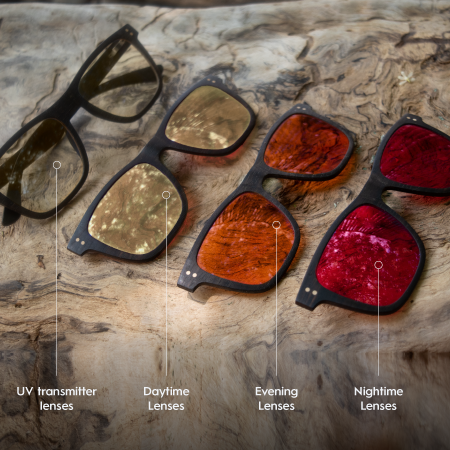
PS: And if you want to start protecting your circadian rhythm right now, our 3-in-1 Circadian Lenses are designed for this exact purpose:
Daytime Lenses: Filter out the harshest 455nm spike from LEDs and screens while letting in the beneficial wavelengths you need. No more burning eyes. No more circadian confusion.
Evening Lenses: After sunset, these protect your melatonin production by blocking the blue-green wavelengths that tell your brain it's still daytime. This is the seasonal signal your body needs to know it's winter and time to activate deep rest and repair.
Nighttime Lenses: Put these on 30 minutes to an hour before bed. These block the frequencies that suppress melatonin most aggressively, ensuring your body gets the long, dark signal it's expecting in winter.
Here's to a winter filled with health, vitality, and the vibrancy of nature's wisdom.
— Roudy
Leave a comment