


The 7 Steps to Get Out

Every step below comes with at least one Tiny Habits recipe you can copy. They're examples. Pick whichever one fits your routine, or use them as templates and design your own (instructions for that at the end of this guide).
A Tiny Habits recipe has three parts: after I (an anchor moment that already exists in your day), I will (a tiny new behavior, small enough that you can't fail), I will celebrate by (an immediate moment of positive emotion that wires the habit into your nervous system).
Don't skip the celebration. Behaviors that feel good get repeated. Behaviors that don't, fade. Your own emotion is what glues the habit in.
Catch the first light of the day
Within 30 to 60 minutes of waking, get your bare eyes outside. No glasses, no contacts, no windows in between.
- Clear sky: 15–20 minutes
- Cloudy: 30–35 minutes
- Overcast: 45 minutes
Bonus points if you can stand barefoot on grass, dirt, or sand. The earth is rich in electrons that flow through your body and discharge inflammation when you ground.
This one act sets your circadian rhythm for the next 24 hours. It tells your body when to release melatonin tonight. It lifts your mood for the rest of the day.
It's the closest thing to a free pill for your sleep.
Recipe A Anchored to your morning coffee
Recipe B Anchored to feet on the floor
Start at 30 seconds. That's it. Once it feels automatic, it'll naturally extend. Most people end up staying out 15 to 20 minutes within a week without ever forcing it.
Catch your UVA rise
About 60 minutes after sunrise, UVA wavelengths start arriving in your environment. This is the spark that turns morning light into fuel for your hormones.
UVA activates a photoreceptor in your eyes called neuropsin, which kicks off the production of serotonin (mood), dopamine (focus), and melatonin (sleep, set hours in advance). It also activates a protein called POMC that produces beta-endorphin (your natural painkiller), MSH (which builds your melanin and tan), and nitric oxide (which dilates your blood vessels and gives your skin its glow).
The challenge: UVA rise time changes every day with the season. You can't anchor a habit to "60 minutes after sunrise" because that's a moving target. The fix is to use your morning to set the alarm, then let the alarm trigger the behavior.
Find your local UVA time: Download the MyCircadian App by Sarah Kleiner. It tracks the exact UVA, UVB, sunrise, and sunset times for your location and season. Use code VIVA10 for 10% off lifetime access and an extended free trial.
Recipe A Morning setup — sets both alarms for the day
Recipe B Alarm execution — when the UVA alarm rings
Recipe A is what makes Recipe B work. Without the alarm, you'll forget. With the alarm, you don't have to remember anything.
Put your skin in the midday sun
Around solar noon, UVB arrives. This is where you build vitamin D, real melanin, and the cardiovascular benefits of sun exposure (a 39% increase in cardiac output and lower blood pressure for 5 to 6 days after a single session, according to the research).
How much sun you can take depends on your skin type. Start with what your skin can actually handle today. You'll build from there.
Skin Type Guide Find your Fitzpatrick type and starting dose
| Type | Description | Start with |
|---|---|---|
| Type 1 | Very pale, freckles, red or blonde hair. Almost always burns, never tans. | 3 min/side +1 min every 3 days |
| Type 2 | Fair skin, blue or green eyes. Usually burns, tans minimally. | 5 min/side +2 min every 3 days |
| Type 3 | Medium skin. Sometimes burns, gradually tans. | 10 min/side +3 min every 3 days |
| Type 4 | Olive skin. Rarely burns, tans easily. | 15 min/side +5 min every 3 days |
| Type 5 | Brown skin. Very rarely burns. | 20 min/side build to 30+ |
| Type 6 | Deep brown to black skin. Never burns. | 20–30 min/side more sun, not less |
Stop before pink. Pink today equals red tomorrow. Real melanin takes weeks to build. There's no shortcut.
Sunscreen blocks the exact wavelengths your skin needs to make vitamin D, nitric oxide, and pre-melatonin. Most regular sunscreens also contain photo-toxic chemicals that release toxins into your skin when light hits them. If you absolutely need extended exposure, use natural zinc oxide.
We blame the sun. The real problem is that we lost our tolerance to it.
Recipe A Anchored to finishing lunch
The eye-closing celebration is doing double duty. It's your moment of positive emotion (which wires the habit), and it's also part of the protocol since your eyes need the light too.
Watch the sun go down
Sunset is the third major light signal of your day. 5 minutes outside as the sun drops starts the melatonin chain reaction hours before you sleep.
The red and infrared wavelengths at sunset also do something the rest of the day's light can't. They penetrate deeper into your eyes and skin, helping repair mitochondria and prep your body for sleep.
The same problem as UVA: sunset time shifts every day. The same fix applies. Use the alarm you already set in Step 2.
Recipe A Anchored to your sunset alarm
This becomes your daily transition from work mode to home mode. Within two weeks, your nervous system starts using it as a shutdown ritual on its own.
Manage your artificial light exposure throughout the day
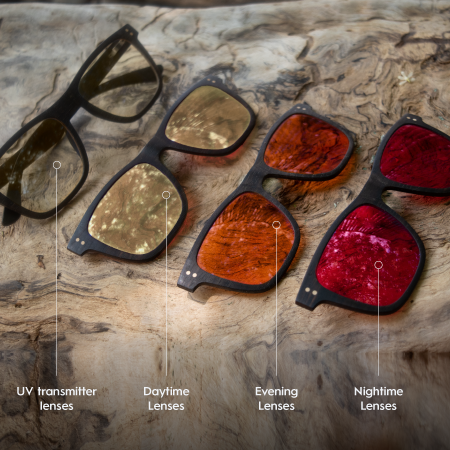
Artificial light isn't going away. The job is to manage it across the day. Different times call for different protection, which is why VivaRays Circadian Glasses come with three lens types, each one matched to a different part of the light cycle.

5a. During the day, when you're on a screen or under indoor light → Daytime Harmonizing lens

Modern screens, phones, and overhead bulbs flood your eyes with a narrow spike of blue light at 455nm. In nature, that frequency is balanced by red, orange, and yellow wavelengths. From an LED, it comes alone, isolated, and unbalanced. Your mitochondria respond by producing reactive oxygen species that drive inflammation, eye strain, and fatigue.
You still need daytime light hitting your eyes to stay awake and alert. The trick is harmonizing the spike, not killing the whole spectrum. Most yellow-tinted blue blockers wipe out the beneficial blue-turquoise between 470 and 500nm that you actually need during the day. The Daytime Harmonizing lens balances the 455nm frequency without eliminating it, while keeping the beneficial range intact.
Recipe A Anchored to opening your laptop
5b. After sunset → Evening lens

Once the sun is down, your brain is supposed to start producing melatonin. But every artificial light in your home is sending the opposite signal. The Evening lens kicks in at sunset and blocks the wavelengths that suppress melatonin while still letting you function in your house. Cook dinner, read, watch TV. Your brain will start the sleep signal anyway.
Recipe A Anchored to noticing it's dark outside
Recipe B Anchored to the first lamp you turn on
Recipe B is the one most people stick with longest. The "first light I turn on" cue is bulletproof: every single evening, at some point, you flip a switch. That switch becomes your trigger.
5c. One hour before bed → Nighttime lens

This is where you go full lockdown. The Nighttime lens blocks every wavelength that interferes with melatonin production. Your house should look like a candlelit cabin in this last hour, not a 7-Eleven.
If you only do one part of this step, do this one. The hour before bed determines the depth of your sleep more than anything else.
Recipe A Anchored to brushing teeth at night
Recipe B Anchored to turning off the kitchen light
The bathroom anchor in Recipe A matters. The Nighttime lens has to go on before you walk back into bedroom or living room light. Putting it in the same room as your toothbrush guarantees you never forget.
Sleep in a cave
Black out your bedroom completely. Tape over the LEDs on the smoke alarm and the cable box. No nightlight. No phone face-up on the nightstand.
If you can't black out the room, wear a real eye mask. Drop the room to 65 to 68 degrees. Your body falls asleep when its core temperature drops.
This is a one-time setup, not a daily habit. Spend 10 minutes one evening walking through your bedroom finding every source of light. Tape, unplug, or cover each one. Once it's done, it's done. The room stays dark forever after.
Eat with the sun
Front-load your calories earlier in the day. Stop eating 2 to 3 hours before bed.
Your body digests food best when it's lit by sunlight, and the worst metabolic damage from modern eating comes from late-night meals under bright kitchen lights.
Eat food your great-grandmother would recognize. Skip the seed oils. The food rules will make a lot more sense after Part 2 drops.
Two paths to get there:
Path A Ready to stop eating 2–3 hours before bed today
The clap is not a typo. Physical motion plus a verbal cue makes the celebration land harder than either one alone.
Path B Build up gradually with the 11-week ramp
This is the same gradual ramp we use inside our coaching program. You're not white-knuckling a 3-hour gap on day one. You're inching the window earlier every two weeks until it becomes second nature.
The schedule
- Weeks 1–2 Stop eating 20 min before bed
- Weeks 3–4 Stop eating 40 min before bed
- Weeks 5–6 Stop eating 60 min before bed
- Weeks 7–8 Stop eating 90 min before bed
- Weeks 9–10 Stop eating 2 hours before bed
- Week 11+ Stop eating 3 hours before bed
The recipe (gradual ramp)
The setup: at the start of each two-week phase, change your daily kitchen-closed alarm to the new time. Most people who try to jump straight to 3 hours quit by week one. Most people who ramp gradually never quit at all.
Design your own recipe
The recipes above are starting points. They might not all fit your life. A truck driver, a new mom, and a night-shift nurse all need different anchors. Here's how to build your own.
Workbook Open the 6-step recipe designer
1. Pick the new behavior you want
Make sure it's the smallest possible version of that behavior. Not "morning sun for 20 minutes" but "30 seconds of morning sun." Tiny is the whole point. Once it sticks, it'll grow on its own.
2. Find your anchor
An anchor is something you already do without thinking. Brushing teeth. Pouring coffee. Closing the laptop. Putting kids to bed. Locking the front door. Walk through your day and write down the moments that happen at the right time for the new behavior. Pick the one that's most reliable.
If the right time is variable (UVA rise, sunset, anything that shifts daily), use a two-step chain like the one in Step 2: a reliable morning anchor sets the alarm, then the alarm becomes your trigger.
3. Write it out
Use this exact template:
4. Pick a celebration that actually feels good
This is where most people fail. The celebration is not optional. It can be a fist pump, a "yes!", a smile in the mirror, a hand on your chest, a thumbs up, a small dance move. It has to be physical or verbal (ideally both), and it has to make you feel a real moment of positive emotion. If it feels stupid at first, that's normal. Do it anyway. Your nervous system can't tell the difference between "real" pride and "manufactured" pride. Both wire the habit.
5. Run it for one week
If the habit isn't sticking, one of three things is wrong:
- The behavior is still too big. Cut it in half.
- The anchor is unreliable. Pick a different anchor that happens at the same time every single day.
- The celebration is too weak. Make it bigger, more physical, or more verbal.
6. Stack
Once a recipe is automatic, you can use it as the anchor for the next one. That's how the program builds. Step 4 (sunset) becomes the anchor for Step 5b (Evening lens). Step 5c (Nighttime lens) becomes the anchor for the start of your bedtime routine. Within 30 days, your whole evening is on autopilot.
Almost none of this costs money. You won't need a prescription or a gym membership. The healthiest people who ever lived didn't have any of those things either.
What they had was the sun overhead, the dark at night, real food on the table, and people they loved within walking distance.
You can have all of that back. It starts tomorrow morning when you step outside and look up. Everything else follows from there.
— Roudy
Founder, VivaRays
Ready to dial in your light environment?
The 3-in-1 Circadian Glasses cover daytime, evening, and nighttime in a single magnetic frame. The exact tool I built to make Step 5 effortless.
Get the 3-in-1 BundleResources mentioned in this guide
-
MyCircadian App
UVA, UVB, sunrise, and sunset times by your exact location and season. Built by Sarah Kleiner. Use code VIVA10 for 10% off lifetime access and an extended free trial.
-
VivaRays Circadian Glasses
Daytime Harmonizing, Evening, and Nighttime lenses. Engineered to handle the full light cycle, including the LED bulbs all around you, not just screens.
-
F.lux
Free desktop screen filter. Helps with your screen, but not the LED bulbs in the room around you. A small assist before you have the glasses.