


Best Mineral Sunscreen + Toxic Ingredients to Avoid (2026)

Picture this.
It is first day of the summer.
After six months under fluorescent office lights, you finally grab the beach towel, drive down to the shore, and roll onto the sand at 11 a.m to enjoy the first real sunny day of the year.
And you do what every dermatologist has told you to do
You slather on SPF 50 and reapply every two hours.
After all, you want to be responsible and you're thinking you're doing the right thing. It's totally understandable
By 6 p.m., when the sun starts to soften, you pack up and head home. In doing so, you miss the sunset.
It's 8:00 pm and you're in your kitchen cooking dinner under bright LED lights.
By 9:30 p.m., you're on the couch with the family watching a Netflix movie, under more LEDs.
By 11:00 p.m., you're hungry so you walk to the kitchen, grab a snack, take your phone to bed, and scroll until 1 a.m.
At 2:00 a.m., when you finally put the screen down, you start to notice it....
Your back is burning and your shoulders are stinging. The sun got you after all.
You wake up the next morning and you're feeling exhausted.
You look in the mirror and notice that your nose is already peeling.
A few hours later, you step outise to go to the car, and moment the light hits your eyes, you reach for sunglasses and tell yourself, "My eyes are sensitive to the sun."
So you blame the sun.
But here's what most people don't realize.
The sun did not cause you to burn
Your lifestyle did... and before you roll your eyes, let me explain
Before that sunny weekend, you spent six months indoors and never gave your body the chance to build its solar resilience properly.
The artificial light at night on that night after your exposure destroyed your melatonin, the highest antioxidant your body makes.
You also skipped the sunrise and sunsets , the times of day that prime your skin to absorb infrared from sunlight safely and repair afterward.
And I don't blame you, because nobody had told you about how to prepare your skin and eyes to absorb more sunlight safely and without burning.
This is what this guide is about.
By the end of this guide, you'll understand exactlY:
1) What your skin was built to do and how to prepare it
2) The benefits of sun exposure on your health beyond tanning
3) Which sunscreen ingredients to throw out today
4) How to choose a clean mineral sunscreen the few times you actually need one.
Why most sunscreens make you less safe, not more
I want you to imagine an experiment.
You take a fresh bottle of conventional SPF 30. You apply it the way the label tells you to, all over the body, the way millions of people do every summer day.
Now somebody draws your blood a few hours later.
What do you think they find?
In 2020, the FDA actually ran this experiment. The results were published in JAMA, one of the most respected medical journals on the planet.
Six UV filters were tested and every single one flooded the bloodstream with endocrine disruptors within hours.
Oxybenzone peaked at 258 nanograms per milliliter in human blood. The FDA's own safety threshold for a chemical filter is 0.5 nanograms per milliliter.
That's 500 times higher than the threshold their own scientists set.
And here's the part that should make you rethink everything you've been taught about sunscreen.
Some of those chemicals were still detectable in the blood seven days after the last application.
💡 Nerd Section
Research: Matta et al. (2020) ran a randomized maximal-usage trial on six chemical filters: avobenzone, oxybenzone, octocrylene, homosalate, octisalate, and octinoxate. All six exceeded the FDA's 0.5 ng/mL plasma threshold after a single day of normal application. Oxybenzone reached 258.1 ng/mL with lotion and 180.1 ng/mL with aerosol spray. Several remained measurable in plasma 21 days later. The authors concluded that all six warrant further toxicological study before being classified as Generally Recognized As Safe and Effective. Read the full JAMA study here.
Now ask yourself this.
If a food product was found at 500 times the safety threshold of its own regulator, would you eat it?
If a baby product was that far out of range, would you use it on your child?
Yet we rub this on the largest organ in our body. We rub it on our kids. We do it every two hours and call it protection.
That's the first thing you need to see clearly.
What your skin was built to do (before we sold it a bottle)
Melanin isn't a pigment. It's a battery.
I grew up in Lebanon.
My grandparents lived under that Mediterranean sun their whole lives. They farmed. They walked to the market at noon. They sat in the shade after lunch and went back out in the late afternoon.
None of them owned a single bottle of sunscreen.
None of them had skin cancer.
The first time I really thought about why, I was in my late twenties, knee-deep in chronic fatigue and burnout, reading everything I could about how light works on the body.
That's when I learned about the solar callus.
Your skin is designed to absorb sunlight.
When UVB hits your skin gradually, the melanocytes in your epidermis start producing melanin.
Melanin (the brown pigment that creates a tan) is what makes you tan beautifully.
It's also the original sunscreen, written into your body before anyone invented a bottle.
Most people stop the story there.
But melanin is doing far more inside your body than coloring your skin.
- Melanin neutralizes free radicals.
- It quenches reactive oxygen species.
- It tells your immune system when to stand down.
- And it protects every cell underneath your skin from oxidative damage (Hong et al., Int. J. Mol. Sci., 2026).
That alone would make it one of the most valuable substances your body produces.
But here's where it gets fascinating.
Peer-reviewed research has shown that melanin actually conducts electricity.
It functions as a semiconductor inside human tissue, and it absorbs light across nearly the entire UV and visible spectrum (Mostert et al., PNAS, 2012; Cao et al., Chem. Rev., 2024).
This literally means the Melanin absorbs sunlight and converts it into electrons that your cell can use to do real work.
Think of it like tiny solar panels layered into your skin.
Sunlight hits, charge is generated and your body gets a clean, ambient energy source that fuels you.
The more melanin you build through slow, gradual sun exposure, the deeper your reserve becomes.The greater your reserve is , the more resilient you are to every kind of stress your body deals with daily.
Why is that?
It turns out that when your body is under stress, your body starts using its Melanin reserve to deal with the stress
Think about the hours of blue light exposure from screens, sitting under LED lights all day, taking a long flight, and being exposed to Wi-Fi at night .
All of these are highly inflammatory, and they require your body to use Melanin to deal with all the inflammation
Your body responds by mobilizing melanin to neutralize the damage.
You can actually test this in real time:
1) Before a long flight, build up a beautiful tan and take a picture of yourself before you fly.
2) Take another picture , after you have landed.
3) Compare your Melanin levels: Before and after flying
You will see that after a few hours of flying on the plane, you had lost a lot of your tan. That's literally your body mobilizing Melanin to neutralize the damage and inflammation from flying
💡 Nerd Section
Research: Hong, Lim & Kim (Int. J. Mol. Sci., 2026) document melanin as a free radical scavenger, reactive oxygen species quencher, immune modulator, and broad-spectrum photoprotectant (PMC link). Mostert et al. (PNAS, 2012) demonstrated that melanin functions as a hybrid electronic-ionic semiconductor in biological tissue, capable of conducting both electrons and protons (PNAS link). Cao et al. (Chem. Rev., 2024) reviewed melanin's redox-active properties, electron transport capacity, and photoprotective mechanisms across biological and synthetic systems (ACS link). The "human photosynthesis" hypothesis (melanin actively splitting water under light) was first proposed by Dr. Arturo Solis Herrera in a 2007 Nature Precedings preprint. That specific water-splitting claim remains debated outside his lab, but the underlying property (light-driven electron generation in melanin) is now established in mainstream peer-reviewed work.
And melanin is only one of the gifts.
The same sunlight that builds the callus also triggers vitamin D synthesis, alpha-MSH (the hormone that regulates appetite ), and beta-endorphins (the molecules that make you feel calm and happy in the sun).
It's a whole hormonal cascade and it only fires when light actually touches your skin.
💡 Nerd Section
Research: A NHANES analysis of 71,685 US adults from 2001 to 2018 found that 24.6% were vitamin D deficient and 40.9% were insufficient. Using the optimal range of 40 to 60 ng/mL, roughly 90% of US adults fall below. Vitamin D is synthesized in the skin from UVB exposure and supports immune function, mood, bone health, and metabolic resilience. SPF 8 sunscreen blocks roughly 92% of vitamin D synthesis. SPF 30 blocks ~95%. (Cui et al., 2022)
How your body actually builds a solar callus
Now the obvious question.
If melanin is this powerful, how do you actually build it?
Think of it like calluses on a farmer's hands. You don't build them in a day. You build them through repeated, gradual contact with the work. And once they're there, they protect you the rest of the season.
Your skin works the same way. Spring is the training season. Summer is the payoff. (PS: it is still never late)
Here's the simplest protocol: (Read this article to dive deeper)
That's the entire build.
If you skip the training season and head straight into summer weekend at noon, your skin is unprepared, your melanin reserve is empty, and the burn is inevitable
The chemicals in the bottle can not replace the work that you need to do in order to prepare your skin for sunlight
How many sunscreen ads mention any of this?
None of them do.
Because here's the uncomfortable truth.
If your body can build its own protection, the bottle becomes unnecessary.
The sunscreen paradox: why melanoma keeps rising
There's a strange chart almost nobody shows you.
Plot the rise of sunscreen use against the rise of melanoma over the last forty years. The two lines climb together.
Sunscreen sales tripled. Melanoma rates tripled too.
If sunscreen worked the way the bottle promises, you'd expect the opposite. You'd expect melanoma to fall as the cream spread.
Instead, the more we slather, the more we burn.
Dr. Ivan Litvinov, a dermatologist at McGill University, has a name for this. He calls it the "sunscreen paradox."
His research suggests sunscreen creates a false sense of security. People apply it, then stay out longer than they otherwise would. They overexpose themselves. They skip the hat and skip the shade.
And many of the chemical filters break down in sunlight.
When they break down, they generate free radicals on your skin, the very thing the cream was supposed to prevent.
It's like pouring gasoline on the fire you're trying to put out.
💡 Nerd Section
Research: Avobenzone, the most common UVA filter in chemical sunscreens, is photo-unstable. It degrades within hours of sun exposure into compounds that generate reactive oxygen species (free radicals) on the skin's surface. Octocrylene, frequently added to "stabilize" avobenzone, degrades on the shelf into benzophenone, a probable human carcinogen per the IARC. Melanoma incidence in Canada rose by roughly 17% between 2020 and 2024, despite record sunscreen sales. (Litvinov, McGill University, 2024)
Let that sink in.
The ingredients to stop using today

The first step is to flip the bottle.
The front of the bottle is marketing. The back of the bottle is the truth.
If you see any of the names below in the active ingredient list, put it down and walk away.
Oxybenzone (Benzophenone-3, BP-3)
The worst offender on the list.
It's an endocrine disruptor. Studies have linked it to lower testosterone in adolescent boys, abnormal mammary gland development in mice at human-relevant doses, and the ability to bind to estrogen receptors and proliferate breast cancer cells in lab settings.
The CDC has measured oxybenzone in the urine of 97% of Americans.
And it bleaches coral reefs. Hawaii banned it in 2021. Key West banned it. Aruba and Palau banned it.
What you're putting on your skin is now in your bloodstream, your urine, and the ocean.
💡 Nerd Section
Research: A NHANES cross-sectional analysis of US adolescents found a significant inverse association between urinary BP-3 levels and total testosterone in adolescent boys (Scinicariello and Buser, Environmental Health Perspectives, 2016). LaPlante et al. (2018) found that oxybenzone exposure at doses comparable to human use altered mammary gland development in mice and proliferated MCF-7 human breast cancer cells in vitro (J Endocr Soc, 2018). CDC biomonitoring data: 97% of Americans tested positive for BP-3 in urine.
Octinoxate (Octyl methoxycinnamate)
Estrogenic. Disrupts thyroid hormone signaling. Highly toxic to coral.
Often paired with oxybenzone in conventional drugstore sunscreens. The two of them together are the reason Hawaii passed the first statewide reef ban in 2018.
Octocrylene
This one is sneaky.
Octocrylene degrades into benzophenone, a compound the International Agency for Research on Cancer classifies as a probable human carcinogen. The degradation happens in the bottle, on the shelf. So even if you bought it fresh, by the end of the summer it's worse than when it started.
Homosalate
Another endocrine disruptor. Disrupts estrogen, androgen, and progesterone signaling.
The European Union restricts its use in cosmetic products. The FDA still allows up to 15% concentration in the United States.
Avobenzone
Photo-unstable. Breaks down under UV exposure into free radicals on your skin.
Imagine putting on a coat to keep warm, and the coat slowly turns into ice as you wear it. That's avobenzone.
Octisalate
On its own, less concerning than the others. But it's a penetration enhancer. It helps the other chemicals get deeper into your skin and into your bloodstream.
If oxybenzone is the bullet, octisalate is the gun.
Retinyl palmitate (Vitamin A palmitate)
This one shows up in moisturizers and sunscreens labeled as "anti-aging."
Here's the cruel joke. Retinyl palmitate is a form of vitamin A that, when exposed to UV light, has been shown in National Toxicology Program studies to accelerate tumor formation on the skin of test animals.
A skin cancer accelerator. In a sunscreen. Marketed for daily use in the sun.
Parabens, fragrance, methylisothiazolinone, nanoparticles
Parabens (methyl, ethyl, propyl, butyl) are xenoestrogens. They accumulate in breast tissue.
"Fragrance" or "parfum" is a legal black box. It can hide dozens of undisclosed chemicals, including phthalates and synthetic musks.
Methylisothiazolinone (a preservative) was named Allergen of the Year by the American Contact Dermatitis Society. It's a common cause of contact dermatitis in kids.
Nanoparticles in sprays are a separate problem. The mineral itself (zinc oxide) is safe on intact skin, but the European Chemicals Agency restricts nano zinc oxide in spray form because the particles can reach the lungs, where the body has no good way to clear them.
If you went to the drugstore right now and grabbed a random sunscreen off the shelf, four out of five would fail a clean safety review.
That's the industry you've been trusting to protect your kids.
How to read a mineral sunscreen label (the 4 criteria)
Now the good news.
You don't need a degree in cosmetic chemistry. You don't need to memorize a list of fifty bad ingredients. You just need four rules. Apply them at any store, anywhere in the world, and you'll be right almost every time.
That's the whole framework.
Flip the bottle. Read the active ingredient line. If it's anything other than non-nano zinc oxide, put it back. Then read the inactive list. If it has fragrance or parabens, put it back.
What you're left with on the shelf will be small. Maybe one or two options. That's normal.
Clean is a small category. Loud is a big one.
💡 Nerd Section
Research: Multiple reviews (over 50 studies) confirm that zinc oxide does not penetrate intact, healthy skin at either nano or non-nano size. It sits on the stratum corneum and is washed off in the shower. Non-nano (greater than 100 nm particle size) is preferred where possible because compromised or broken skin may allow some absorption of smaller particles. The European Chemicals Agency restricts nano zinc oxide in spray form due to inhalation risk, since particles small enough to reach the deep lung cannot be cleared by the body's normal mechanisms (EWG, 2025).
When you actually need sunscreen (and when you don't)

Here's where I want to be careful.
We're not anti-sunscreen. We're anti-sunscreen dependence. There's a difference.
Think of sunscreen like a tool, not a uniform. You wear it when you actually need it. You don't wear it as a constant baseline.
Here's when the bottle stays in the bag.
Morning sun (sunrise to about 10 a.m.)
This is the most important light of your day. It sets your circadian clock, kicks off cortisol production, and triggers the hormones that build sun tolerance later.
The UV index at sunrise is essentially low. You cannot burn at 7 a.m.
Go outside. Face the sun and stay for as long as you can. No sunscreen, no sunglasses.
Mid-morning, once your solar callus is built
This is the season you're in right now.
If you've been outside daily since early spring, exposing your skin gradually, you've built a baseline. Your melanin is up. Your skin can handle real UVB without burning.
Most of the day, you don't need a bottle. You may need the wisdom to step into the shade when needed.
Peak hours, with no solar callus built, no shade, and no clothing option
This is when sunscreen earns its place.
You're at the beach. You're on hike . You're at the waterpark with your kids. There's no escape, no shade and you'll be there for hours.
This is the moment for clean, non-nano zinc on the exposed skin. Face, shoulders, tops of feet. The places that catch the sun first.
What to pair with mineral sunscreen for real sun resilience

Your skin is one part of a bigger system.
The sun resilience you're after is built on a few things to layer in.
Real food fats. Grass-fed butter, pasture-raised eggs, wild-caught fish, olive oil, raw nuts. The cell membranes of your skin are made of fat. Healthy fats build healthy membranes. Sun-resilient skin starts at the cellular level, and the cellular level is built in the kitchen.
Astaxanthin. A red pigment from microalgae, the same molecule that makes wild salmon pink. It's been called an internal sunscreen because it accumulates in your skin and helps quench the free radicals produced by UV exposure.
Protect your melatonin like it's a vault. Most people think of melatonin as a sleep hormone. It's far more than that.
Melatonin is the highest antioxidant nature has ever made.
- It scavenges free radicals inside your cells.
- It repairs sun-damaged skin overnight.
- It is the most powerful internal sunscreen your body has, and it costs nothing to make.
You just have to let it rise naturally at night.
But the moment artificial light hits your eyes after sunset, melatonin production stops.
The kitchen LEDs. The Netflix TV. The phone in bed. Every blue and green wavelength after dark suppresses melatonin and shuts down the repair shift your skin was waiting for.
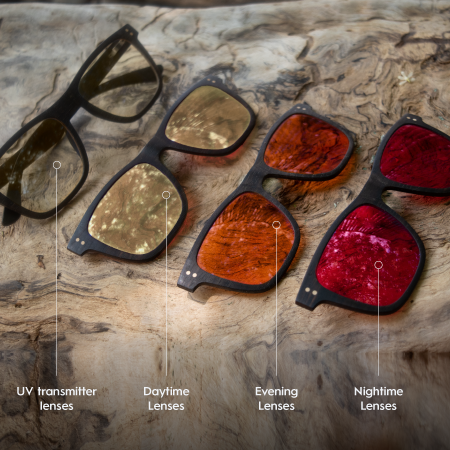
That's why we built VivaRays 3-in-1 Circadian Glasses.
Three lenses in one frame.
Daytime for the daytime hours when you're exposed to the inflammatory frequency from your screens and office lights
Evening orange for sunset through dinner.
Red nighttime for the last hour before bed.
Together, they protect your morning circadian signal AND your evening melatonin in a single device that lives on your face from sunrise to bedtime.

Sleep in real darkness. Once the lenses come off at bedtime, the room itself has to be dark too. Even small amounts of light in the bedroom suppress melatonin. Black out the windows. Cover the LEDs on your devices. Your skin will heal faster, and your tan will deepen instead of peel.
Frequently asked questions
Is mineral sunscreen actually safer than chemical sunscreen?
Yes. The FDA recognizes only zinc oxide and titanium dioxide as Generally Recognized As Safe and Effective. All other chemical filters (oxybenzone, octinoxate, octocrylene, homosalate, avobenzone, octisalate) remain in Category III, meaning the FDA does not yet have sufficient data to confirm they're safe. The 2020 JAMA study showed all six absorb into human blood at levels above the safety threshold within hours. Zinc oxide does not absorb through intact skin.
What does "non-nano" zinc oxide mean and why does it matter?
Non-nano means the zinc oxide particles are larger than 100 nanometers, the threshold the European Union uses to classify a particle as a nanoparticle. Larger particles stay on the surface of the skin and cannot be inhaled deeply if accidentally aerosolized. Nano-sized zinc is generally safe on intact skin but the European Chemicals Agency restricts it in spray sunscreens because tiny particles can reach the lungs.
Can I still get vitamin D while wearing mineral sunscreen?
Most people get enough vitamin D from the times they're not wearing sunscreen, like early morning sun on bare skin and short outdoor breaks during the day. A 2019 review found SPF 30 sunscreen reduces vitamin D synthesis by roughly 95% when applied perfectly. In real life, most people miss spots and reapply unevenly, so some synthesis still happens. The cleanest fix is to get morning sun without sunscreen, then apply mineral only during peak-hour beach days.
Is titanium dioxide as safe as zinc oxide?
Both are recognized as safe by the FDA, but zinc oxide is the better choice. Zinc offers true broad-spectrum protection across UVA and UVB. Titanium dioxide protects strongly against UVB and short UVA but is weaker against long UVA, which is the wavelength most linked to deep skin aging and DNA damage. A clean mineral sunscreen with zinc as the only active is the simplest, most reliable choice.
How much zinc oxide concentration is enough?
For real protection during peak sun exposure, look for a concentration in the 20 to 25 percent range. This typically corresponds to roughly SPF 30 to SPF 50 in mineral formulations. Lower concentrations (10 to 15 percent) can work for daily incidental sun, but for a beach day, a boat day, or a hike at altitude, go higher. The active percentage is always listed at the top of the back label.
The takeaway
So here's what to do, starting today.
- Flip the bottle in your bathroom and on the shelf. If the active ingredient list has anything other than non-nano zinc oxide, replace it.
- Start tomorrow morning. Step outside within 30 minutes of sunrise. No sunscreen. No sunglasses. Ten minutes is enough.
- Add gradual midday sun two or three times a week. Start with five minutes. Build over the spring. Listen to your skin and step into shade before pink turns to red.
- Save mineral zinc for the moments that really needs it. Beach days, hikes or boat days without access to shade or clothing.
- Eat for sun resilience. Real food fats. Astaxanthin from wild salmon . Hydrate with mineral-rich water.
- Protect your melatonin at night. Your internal sunscreen costs nothing if you stop destroying it. Vivarays glasses after sunset. Dim lights. A dark bedroom.
Your body was built for this light.
Give it the chance to remember.
Ready to protect the melatonin that powers your skin repair? Start with the lenses that live on your face from sunrise to bedtime.
Explore VivaRays 3-in-1 Glasses
Leave a comment