


How to sunbathe safely: the gradualism protocol that builds a sun-tolerant body

You've been told the sun is the enemy.
Cover up. Slather on. Hide indoors. And if you must go outside, treat the brightest, oldest, most life-giving force on this planet like it's coming to kill you.
Here's the thing.
The sun was never the enemy. We just forgot how to live with it.
This guide is the map back.
By the end, you'll understand:
1- why your great-grandparents spent whole summers outdoors without a bottle of sunscreen.
2-You will understand what went wrong in the last hundred years
3-The exact protocol for building a body that handles real sunlight the way it was always meant to.
The sun was never the enemy. We just forgot how to live with it.
Think of the last time you saw someone come home burned from vacation.
They flew somewhere equatorial.
They stripped down on a beach at noon.
They stayed out for four hours because they'd been cooped up all winter and wanted to make the most of it.
That night, they glowed red. They couldn't sleep on their back. They peeled for a week.
We watched that happen and blamed the sun.
But a body that hasn't seen direct sunlight in six months cannot handle four hours of equatorial midday UV.
Of course it burns. Of course it suffers.
That's not the sun's fault.
That's a body without preparation meeting a stimulus it wasn't designed to receive that way.
The dose is what makes the poison.
A drop of sun every day, year-round, building gradually, with the right diet underneath it, is medicine.
A flood of sun once a year on unprepared skin is damage.
Same sun. Two completely different outcomes.
For instance, studies have shown that outdoor workers, the ones who get sunlight every day for hours, have lower melanoma risk than office workers who only see the sun on vacation.
Not because the sun is weaker on a farm. Because their skin is trained.
Nerd Section: the 2003 outdoor-worker melanoma study
Kennedy et al., writing in the Journal of Investigative Dermatology in 2003, analyzed melanoma incidence by occupation. Indoor office workers had higher melanoma rates than outdoor workers, despite far less cumulative UV exposure. The authors concluded that chronic daily sunlight, which builds melanin gradually, is protective compared with the high-dose intermittent exposure pattern seen in weekend and vacation sunburns. Full study on PubMed.
Isn't it strange that we've been told the opposite of this for forty years?
We didn't lose the ability to live with the sun. We just stopped practicing.
When doctors prescribed sun: the forgotten medicine
Before antibiotics, there was sunlight.
And doctors prescribed it, and built entire hospitals around it.
At 5,000 feet elevation in Leysin, Switzerland, a Swiss physician named Dr. Auguste Rollier ran a clinic for patients dying of tuberculosis.
He did something that now sounds almost mystical. He put his patients in the sun.

He started them on a very simple protocol.
Day one: five minutes of sun on the feet.
Day two: add the lower legs. Then the thighs. Then the abdomen. Then the chest.
Body part by body part, day by day, he'd build the body's tolerance the way you'd build any other capacity.
By day 5, his patients could sit fully exposed in powerful Alpine sun for over an hour without burning.
By Week 2, they were often outside for several hours per day.
And the tuberculosis? Rollier's clinic records reported cure rates of roughly 80 percent across more than 2,000 patients, a figure that still looks staggering to modern physicians.
Nerd Section: the history of Rollier's Alpine heliotherapy
Hobday's 1997 paper in Medical History documents Rollier's clinic at Leysin, Switzerland. Between 1903 and the 1940s, Rollier treated thousands of patients with surgical tuberculosis using carefully graded sunbathing in cold Alpine air. His reported cure rate was roughly 80 percent, derived from his own clinical records across more than 2,000 patients. The work was widely replicated across Europe in the 1920s and 30s before antibiotics made heliotherapy obsolete. Full paper on PMC.
Rollier wasn't alone.
Dr. Niels Finsen won the 1903 Nobel Prize in Medicine for treating lupus vulgaris (a form of tuberculosis of the skin) with concentrated UV light.
Across the channel, Dr. Henry Gauvain ran open-air hospitals in England where children with rickets and bone tuberculosis received up to six hours of sunlight a day, with skin that adapted gradually over weeks.
And across Europe and North America in the 1920s and 30s, schools built rooftop solaria so kids could soak up real light even in winter.
Nerd Section: Finsen's 1903 Nobel Prize for UV therapy
Niels Ryberg Finsen received the 1903 Nobel Prize in Physiology or Medicine "in recognition of his contribution to the treatment of diseases, especially lupus vulgaris, with concentrated light radiation." Finsen built devices that focused specific UV wavelengths onto diseased skin. Hundreds of patients with lupus vulgaris (skin-form tuberculosis) recovered using his treatment, years before antibiotics existed. Nobel Prize record.
Can you imagine today's schools doing the same?
Some German and Scandinavian schools required shirtless sunbathing during recess.
Then antibiotics arrived. Then sunscreen became an industry. Then air conditioning arrived. Then we moved inside.
And within two generations, the entire medical tradition of heliotherapy, which had cured tens of thousands of people, was quietly erased from the textbooks.
Gradualism: the principle that changes everything
If there's one idea I want you to take from this guide, it's this👇
The sun is medicine at the right dose and can damage you at the wrong one.
The difference between the two is gradualism.
Think about how a farmer's hands get their calluses.
A farmer doesn't wake up one day and decide to do eight hours of hoeing with soft office-worker hands.
If he did, he'd get blisters. He'd be useless for a week.
What actually happens is this. He works for thirty minutes. His skin responds. It thickens. It prepares.
He works a little longer the next day. The skin thickens a little more.
Over weeks, his hands become tools that can hold a shovel for a whole day without a single blister.
Your skin does the exact same thing with light.
The adaptation is called a solar callus.
It's built from two things working together: melanin (your body's own intelligent, dynamic sunscreen) and a gentle thickening of the outer skin layer.
Combined, they can raise your skin's natural SPF to around 3 or 4, and they push back the UV dose your skin can handle before it reddens (see our spring solar callus guide for the full biology).
This is what Rollier knew. This is what your great-grandparents knew without being told. And this is what the modern world forgot.
Gradual beats sudden. Every time.
The protocol: how to build your solar callus in seven days
This is the practice. It works in any season, at any latitude, for any skin type.
Fairer skin needs longer ramps and shorter ceilings. Darker skin can push harder earlier. The principle is the same.
Phase 1: Catch the sunrise and the sunset
Before UVA and UVB ever shows up, the sun gives you something most people miss entirely.
When the sun is sitting on or just off the horizon, its light is heavy with red and near-infrared wavelengths.
There's no UV yet. No burn risk. Just the long, warm wavelengths soaking into your skin and eyes.
These are the colors and frequencies that prepare your skin to absorb more UV later in the day without burning.
Get outside within the first hour of sunrise. Around sunset too, if you can.
Expose yourself, full body If possible up to 90 minutes.
The longer the better.
What's even more important is that you start. Even one minute makes a difference.
No sunglasses. No contact lenses. No window in between. No sunscreen.
Phase 2: The seven-day ramp
This is Rollier's protocol, lightly modernized, done between 11 am and 3 pm, when the UV light is present.
Here's the key to how it works. Each new day adds five minutes of total session time.
When you introduce a new body part, that part only gets those final five minutes.
The parts already introduced keep accumulating their exposure.
That way, the newest skin always gets the gentlest dose, while the skin you introduced earlier keeps building its tolerance.

Day 1: Feet only. 5 minutes per side.
That's the whole session. Feet get five minutes. Nothing else is uncovered.
Day 2: 10 minutes total per side.
First five minutes, feet only. At the five-minute mark, uncover the lower legs. Both feet and lower legs get sun for the final five minutes. Feet end up with 10 minutes of exposure. Lower legs: 5 minutes.
Day 3: 15 minutes total per side.
Feet uncovered the whole time (15 minutes). Lower legs uncovered from minute five onward (10 minutes). In the final five minutes, you introduce the thighs (5 minutes).
Day 4: 20 minutes total per side.
Same layered pattern. In the final five minutes, the abdomen and lower back come out. Feet: 20 min. Lower legs: 15. Thighs: 10. Abdomen and lower back: 5.
Day 5: 25 minutes total per side.
In the final five minutes, the chest, shoulders, and upper back come out. That's the last new body part you'll introduce. The upper body is now in.
Day 6: 30 minutes total per side.
No new body parts today. Every tier you've already introduced just gets another five minutes of sun. Feet: 30. Lower legs: 25. Thighs: 20. Abdomen: 15. Chest and shoulders: 10.
Day 7: 35 minutes total per side. Full body, head still shaded.
Same again. Another five minutes added to every tier.
Feet: 35mins.
Lower legs: 30mins
Thighs: 25mins.
Abdomen: 20.mins
Chest and shoulders: 15mins.
By now the feet have had a full week of building, while the newest skin (chest, shoulders) has only had 15 minutes across three days. That's exactly how Rollier wanted it.
According to your skin type, and by continuing to observe yourself and how you're responding to sunlight, you may want to add more time or decrease the time. The most important thing is that you go gradually, and then you listen to your body.
Your skin has now built a foundation. A solar callus. A baseline of tolerance and a baseline of melanin that lets you keep going without burning.
Phase 3: The vitamin D window
Once the foundation is in, you can start using the midday sun for a bit longer.
Here is the simple rule, derived from Michael Holick's landmark work on solar zenith angle: if your shadow is shorter than your height, UVB is present. That's the only window when your skin can actually make vitamin D.
Nerd Section: Holick's 2007 NEJM review on vitamin D
Michael Holick's 2007 New England Journal of Medicine review established that UVB (280 to 315 nm) is required for cutaneous synthesis of vitamin D3 from 7-dehydrocholesterol. UVB availability depends on solar zenith angle: when the sun is low in the sky (winter, early morning, late afternoon), the atmosphere filters out most UVB. The practical "shadow rule" (if your shadow is shorter than your height, UVB is present) is a field-friendly derivation of Holick's zenith-angle work. Full review (NEJM).
In most of North America, that window is about two hours on either side of solar noon, only in spring, summer, and early fall.
30 to 60 minutes minutes in this window, with as much skin exposed as you can manage, will do more for your vitamin D status than any supplement.
IMPORTANT: the time I'm recommending is a baseline that may not work for everybody. Remember n = 1.
It is very important in this practice that you observe how your skin is responding and you listen to your body. You may scale the practice up or down depending on how your skin is responding
Stop well before pinking. Pink is not progress. Pink is overshoot.
Phase 4: The lifestyle, not the event
After the foundation is built, sun stops being an event and becomes a rhythm.
A few minutes here. Twenty minutes there. A walk at lunch with sleeves rolled up. Coffee on the back step in the morning. A meal outside. The slow accumulation of small doses, every day, in every season, is what turns a body into one that lives easily with light.
This is what your great-grandparents did without thinking about it.
This is what we forgot.
Eat for a skin that loves the sun

![]() Stop eating these
Stop eating these
Industrial seed oils are the problem. They're unstable polyunsaturated fats that oxidize easily in your fat stores and even more easily under UV.
Here is a list:
- Soybean oil.
- Corn oil.
- Canola oil.
- Sunflower oil.
- Safflower oil.
- Cottonseed oil.
- Grapeseed oil.
- Rice bran oil.
- "Vegetable oil."
- Margarine and most spreads.
These are in almost every processed food, every restaurant kitchen, every chip, cracker, granola bar, and frozen meal.
They weren't in the human diet at any meaningful scale a hundred years ago. Today, foods containing seed oils make up roughly 40 percent of the average American's calories.
And here's the slow, inconvenient truth. You won't get them out in a week.
Studies have shown that adipose tissue turnover is slow, taking up to 1360 days for your fat stores to reflect what you're eating now.
Read that again.
It can take up to many months to many years for your body to completely cleanse itself from the seed oil that you're eating today.
But don't let this discourage you. Small, tiny, healthy habits will compound over time and will make an exponential difference, even if your body is still holding a little bit of seed oil in your fat tissues.
Nerd Section: the 2015 adipose linoleic acid study
Guyenet and Carlson's 2015 review in Advances in Nutrition documented a 136 percent rise in linoleic acid concentration in US adult adipose tissue between 1959 and 2008. Linoleic acid has a half-life of roughly 680 days in adipose tissue, meaning your fat stores still reflect years of prior intake even after you change your diet. This is why cleaning out seed oils is the slowest-acting but highest-impact dietary change you can make for skin resilience. Full review on PMC.
Cook with these instead
- Butter, preferably grass-fed.
- Ghee.
- Beef tallow.
- Lard from pasture-raised pigs.
- Coconut oil.
- Extra virgin olive oil at low to medium heat.
- Avocado oil.
These are the fats your great-grandparents cooked with. They're stable. They handle heat. They store well in your tissue and don't oxidize easily under UV.
Eat these for sun
A handful of foods carry real weight for skin tolerance. Build your week around them.
Wild salmon, salmon roe, shrimp, krill. Astaxanthin is the pigment that makes them pink and one of the most-studied dietary photoprotectors. A 9-week trial found 4 mg daily measurably raised the minimal erythemal dose (the UV intensity required to redden skin) and reduced UV-induced moisture loss in healthy adults. Two to three servings a week, or a 4 to 12 mg supplement daily.
Nerd Section: the 2018 astaxanthin skin trial
Ito et al., in a 2018 randomized placebo-controlled trial published in Nutrients, gave healthy adults 4 mg of astaxanthin daily for 9 weeks. The treatment group showed a measurable increase in minimal erythemal dose (the UV intensity required to visibly redden the skin) compared with placebo, along with reduced UV-induced moisture loss. The protective mechanism is astaxanthin's accumulation in skin tissue as a potent antioxidant that neutralizes UV-driven free radicals. Full study on PMC.
Pastured egg yolks. Carotenoids, vitamin E, choline, sulfur amino acids, retinol. The whole skin-supportive package in one cheap food. Eat them daily.
Liver, once a week. Vitamin A as retinol, copper, zinc, B vitamins. Copper and zinc are required to build melanin. Most people are quietly low in both.
Carrots, sweet potatoes, leafy greens, mango, pumpkin. Carotenoids that quench oxidative stress directly in skin tissue and even deposit visible pigment in your skin over time.
Cooked tomatoes with fat. Lycopene is fat-soluble and concentrated by cooking. Tomato sauce with olive oil is the classic delivery system and one of the most-studied photoprotective foods in the literature.
Berries. Dark chocolate (70 percent and up). Green tea. Polyphenols and catechins.
Bone broth, gelatin, collagen. Glycine and proline for the structural integrity of your skin.
Oysters, beef, lamb. Zinc, copper, B12, heme iron, and tyrosine, the amino acid melanin is built from. Without tyrosine, no melanin. Without zinc and copper, no melanin synthesis.
Sea salt and mineral water. Sun makes you sweat. Sweat takes sodium, magnesium, and potassium with it. Replace what leaves, before and after.
You don't need every one of these every day. You need a kitchen that's regularly stocked with real food, cooked in stable fats, with the seed oils gone. The rest takes care of itself.
Cold body, hot sun: the most underrated protocol
Picture a Swiss Alpine clinic in 1920.
It's five degrees Celsius. There's still snow on the ground in patches. The air is thin and sharp. And Rollier's tuberculosis patients are sunbathing outside, shirtless, for hours.
Ask most people to do that today and they'd think it was madness.
But that cold was doing something for those patients that modern sunbathers almost never get.
And once you understand it, you'll never sunbathe in hot air on a hot body again.
Three things happen when you put a cold or cool body into the sun.
1. Thermal headroom
Most of what people call "too much sun" is actually heat stress which cases headaches and nausea.
That's your core temperature climbing past where your body wants it.
Lower the starting temperature and you double or triple the time you can stay in the sun before any of that kicks in.
A cold shower or plunge before a session does it.
Cool morning air does it.
A breeze does it.
Shade between rounds does it.
All of it buys you minutes, sometimes hours, of usable sun your body actually tolerates.
2. Cross-tolerance (the Nrf2 angle)
Cold exposure activates many of the same protective pathways that handle UV stress. T
he big one is Nrf2, which you can think of as your built-in damage shield.
When it's activated, it ramps up your own internal antioxidants: glutathione, superoxide dismutase, and catalase.
Nerd Section: Nrf2 and the endogenous antioxidant system
The Nrf2 transcription factor regulates the body's own antioxidant defenses, including glutathione, superoxide dismutase, and catalase. When activated by stressors like cold exposure, exercise, or certain plant compounds, Nrf2 moves to the cell nucleus and turns on the genes that produce these protective enzymes. The cold-to-Nrf2-to-UV-cross-tolerance link is mechanistically well-supported in animal models and remains an emerging area in human research. Nrf2 overview on PMC.
UV damage is largely an oxidative event. Anything that raises your antioxidant capacity may raise the threshold at which UV starts doing net damage.
The cold-to-UV cross-tolerance is mechanistically plausible and has strong animal data, though it's still an emerging area in human research.
3. The practice
A cold shower or cold plunge in the morning, before you sun.
Cool air during the session whenever possible.
A cold rinse after, within an hour of getting out, to blunt the inflammatory cascade and stop a borderline dose from tipping into a burn.
If you sun a hot body in hot air, you don't get more sun. You get less, because your body forces you out before your skin needed to leave.
If you sun a cold body in cool air, you get the dose you came for and your skin handles it the way it was built to.
The night half: why melatonin is a sun protocol
Here's something most people don't understand.
Your skin's ability to handle the sun is regulated by the same rhythm that governs your sleep.
Every cell in your skin has a clock.
Those clocks run on circadian time. They expect bright light during the day and darkness at night, and they coordinate the entire repair cycle around that pattern.
Melatonin is one of the most powerful antioxidants your body produces. It's made at night, in darkness.
Every molecule neutralizes up to ten free radicals, and it upregulates your body's own antioxidant enzymes.
Nerd Section: melatonin as a master antioxidant
Reiter and colleagues' 2016 review in the Journal of Pineal Research summarizes decades of research showing melatonin directly scavenges reactive oxygen and nitrogen species, with each molecule capable of neutralizing up to ten free radicals. Beyond direct scavenging, melatonin upregulates the body's own antioxidant enzymes (glutathione peroxidase, glutathione reductase, superoxide dismutase). Its production is synchronized to darkness, which is why breaking your circadian rhythm with evening artificial light also breaks the nighttime repair cycle. Full review (Wiley).
One of melatonin's key jobs is cleaning up oxidative damage your skin took during the day.
If you sit under bright lights until bedtime, your body stops making melatonin. That means the nighttime repair work in your body can't happen the way it should.
This is the part of sun health almost nobody talks about, and it is what quietly decides whether the sun makes you stronger or older.
The night-half practice
Catch the sunset. The amber light at the end of the day tells your body the day is ending, melatonin can begin, repair mode can switch on.
Even five minutes outside as the sun gets low does the work.
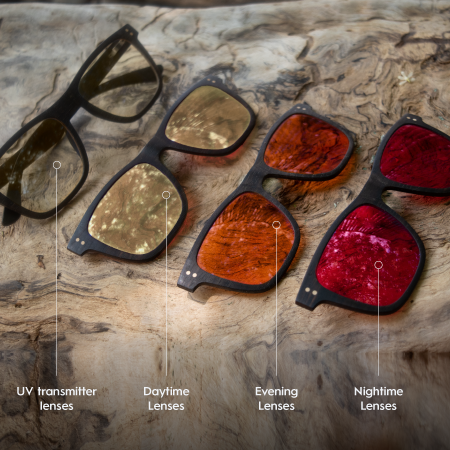
If you are exposed to any form of artificial light from LED bulbs, phones, screens, it's absolutely radical for you to use circadian glasses that filter out the blue and green light from entering your eyes and protecting your brain so that it can properly secrete melatonin.

Sleep in real darkness.Your bedroom should be dark enough that you can't see your hand in front of your face.
Eat in alignment with light. Most of your calories should land inside the daylight window.
Heavy late-night eating throws metabolic and circadian signals out of phase.
The sun-skin protocol works much better when digestion isn't running at midnight.
A body in rhythm tans easily, sleeps deeply, and recovers from stress (including UV stress) without drama.
A body out of rhythm fights everything. Including the sun.
What to avoid
These are the traps that undo the whole protocol.
Sunscreen during the conditioning phase. The wavelengths that build the callus are the same ones sunscreen blocks. If you cover yourself in SPF 50 the moment you step outside, you never let your skin learn. Once you have a real baseline and you're going way past your tolerance (a long beach day, an alpine ski day, a tropical vacation), the best thing to do is to seek shade or to cover up with clothing . Also, mineral sunscreens with zinc oxide are reasonable.
Burning. The single hard rule. A burn sets you back to day one. Stop at the first hint of pinking. Use a watch and a timer until you know your body. The callus is built by repeated sub-burning doses, not by toughing it out.
Glass. Window glass blocks UVB. You can sit by a sunny window all day and get zero vitamin D. The signal you need comes through open air.
Sunglasses by default. Sunglasses block your brain from knowing that there is UV in the environment, and therefore your skin stops producing melanin. This means that you are more likely to burn when you have sunglasses on
Going from zero to hero. A winter spent indoors followed by a Cabo vacation is the most predictable burn in the world. Re-ramp before any big sun exposure. Two weeks of morning sun and short sessions before the trip will completely change what your skin can handle.
Heat without the cool. A hot body in hot sun overheats fast. Build cool into the protocol. Cool morning air. Cold rinses between sessions. Shade.
When to be more careful
Some bodies need a different approach. Not no sun. Just less of it, more carefully built.
Photosensitizing medications. Certain antibiotics, antidepressants, blood pressure drugs, and acne medications make skin much more reactive to UV. If you're on something, look it up before you ramp.
Medical conditions. Lupus, porphyria, and a personal history of melanoma are reasons to work with someone who knows your case before you start building sun exposure.
Very fair skin (Fitzpatrick I). Longer ramps, shorter ceilings, and a calmer relationship with midday sun. Build the solar callus in smaller doses over more weeks.
Pregnancy and different life stages. Hormonal shifts change how your skin responds. The principles stay the same (gradualism, morning light, real food, cool body), but the doses get smaller. We wrote a full guide to how light shapes every stage of a woman's life if you want to go deeper.
Children. Kids need real sunlight more than almost anyone, but their skin is thinner and their ramps should be gentler. We've also written about how artificial light is affecting kids' health, because the other half of the equation (protecting their eyes at night) matters just as much for them.
You belong to the sun
We are beings of light.
That's not poetry. That's biology.
Every cell in your body is built to read the spectrum of the day and the night. Your hormones are timed to the angle of the sun. Your skin is a solar panel and a chemistry lab and a piece of intelligent technology that no lab on earth has come close to replicating.
For two hundred thousand years, every human ancestor of yours lived their entire life outside. Sunrise to sunset, in the open air, eating what the land provided, sleeping in the dark, waking with the light.
Then in a single century, we moved indoors. We covered our skin. We replaced our food. We lit our nights. We told ourselves the sun was dangerous.
And we got sicker.
The path back is a slow, daily practice.
A little at a time. Every day. For the rest of your life.
Frequently asked questions
How long does it take to build a solar callus?
The first visible foundation takes about 7 to 14 days of gradual daily exposure, using the Rollier-style ramp outlined above. Full tolerance keeps deepening over several months as melanin, stratum corneum thickness, and the fat layer under your skin all adapt. Fitzpatrick I (very fair) skin types need longer, gentler ramps. Darker skin types adapt faster. The principle is the same: every day, a little more than yesterday, and never into pink.
Can you get vitamin D through a window?
No. Window glass blocks UVB (the wavelength required for your skin to convert 7-dehydrocholesterol into previtamin D3). You can sit in a sunny window all day and get zero vitamin D synthesis. The only way to build vitamin D from sunlight is direct exposure to open air during the UVB window, which Holick (2007, NEJM) defines by solar zenith angle: roughly when your shadow is shorter than your height.
Is morning sun actually doing anything if there's no UVB yet?
Yes, and it's one of the most important parts of the whole protocol. Morning light, rich in infrared and red wavelengths, sets your circadian rhythm, primes your skin for later UV, and triggers hormonal cascades through your eyes and skin that no other signal can replicate. It's not about vitamin D. It's about telling every cell in your body what time it is.
Does cold exposure help you tan?
Indirectly, yes. A cold or cool body in the sun can stay out longer before overheating, activates antioxidant pathways (Nrf2, glutathione, SOD), and creates a lower-stress environment for the skin to adapt. That combination lets your body take in more usable UV per session without burning. The cold itself doesn't make you tan, but it changes the dose your body can tolerate, which is how tanning actually works.
What fats cause the most sun damage?
Industrial seed oils (soybean, corn, canola, sunflower, safflower, cottonseed, grapeseed). These are unstable polyunsaturated fats that accumulate in your subcutaneous fat layer and oxidize easily under UV. A 2015 review in Advances in Nutrition found linoleic acid in US adult adipose tissue rose 136 percent between 1959 and 2008, with a half-life of roughly 680 days. Getting them out of your diet takes months to years to fully show up in your tissue, but it's the single most powerful dietary change for skin resilience.
Is sunscreen bad for you?
If you cover yourself in SPF 50 every time you step outside, your skin never builds its own protection. For long exposures past your current tolerance (a beach day, alpine skiing, tropical travel), mineral sunscreens with zinc oxide are reasonable. Chemical sunscreens are a different conversation, since several active ingredients have been found to release toxins into the bloodstream at meaningful levels.
Do I really need to protect my eyes from screens at night?
Yes, if you care about sun recovery. Artificial blue light in the evening suppresses melatonin, and melatonin is one of your body's primary nighttime antioxidants (Reiter et al., 2016). If your repair shift doesn't run, the oxidative damage from daytime UV accumulates. The most effective fix is dimming your home to warm light after sunset and wearing circadian lenses that block the suppressive wavelengths. Your skin's response to tomorrow's sun is being shaped tonight.
Ready to protect the night half of your sun protocol?
VivaRays circadian glasses match your eyes to the time of day, so your melatonin and skin-repair cycle stay intact.
Leave a comment