


How to Build Your Solar Callus This Spring (Without Getting Burned)

I was volunteering on a farm one spring when something caught my eye.
Every morning, the horses would come out of the barn slowly.
They'd stand in the soft early light for a while.
As the days got longer, they'd spend a little more time in the open pasture.
I asked the farmer about it. He looked at me like I'd asked why water is wet.
"The horses know," he said. "They come out a little longer each morning. By summer, they can stand in full sun all day without a problem."
That's when something clicked.
Every animal on this planet builds its sun tolerance gradually in spring.
The horses didn't jump from barn to midday sun overnight.
They followed a slow, steady rhythm, increasing in light exposure, day by day, week by week.
Our ancestors did the same thing during the spring.
They spent their days outside, and that naturally prepared their skins and eyes for the stronger light during summertime.
But here's the thing most people in the modern world miss:
Your skin isn't supposed to jump from zero sun all winter to a beach vacation in June.
That's how you end up burning.
Nature is intelligent. During the spring, she slowly and gradually turns up the UV dial so your skin can build what's called a "solar callus."
By the end of this guide, you'll understand exactly what the solar callus is and how to build one so you can absorb more sunlight without burning.
What Exactly Is a Solar Callus?
A solar callus is your skin learning to handle sunlight.
It's exactly what those horses were building every morning at the edge of the barn.
Your skin has the same built-in intelligence.
Give it two to three weeks of steady, gentle exposure, never enough to burn, and two things happen.
First: your skin starts making more melanin.
Most people think melanin is just what gives you a tan.
It's not only that.
Melanin is a natural antioxidant and an anti-inflammatory. It plays a real role in your overall well-being (Brenner & Hearing, 2008). We'll go deep into melanin's broader benefits in a future blog, because it deserves its own conversation.
Second: your outer skin layer thickens.
The stratum corneum, the outermost layer of your skin, can thicken up to two to three times its normal depth.
That creates a natural SPF of roughly 3 to 4, built from the inside out (Brenner & Hearing, 2008).
Now here's what's important for you to know.
New melanin doesn't appear overnight.
The initial darkening you see within minutes? That's just existing melanin redistributing.
Real new melanin synthesis starts around 48 to 72 hours after UV exposure. It peaks somewhere between 7 and 10 days.
You can't rush it. And you wouldn't want to.
Think of it like warming up a car on a cold morning. You don't slam the gas. You let it come up to temperature first.
Same logic applies here.
What Does the Research Actually Say About Sun Exposure?
Here's a question that will make you think...
The Maasai people of East Africa spend their entire lives under equatorial sun.
The UV index there regularly exceeds 11.
They don't wear sunscreen. They don't wear sunglasses. Their children grow up under open sky from birth.And they have virtually zero rates of skin cancer.
Meanwhile, office workers in Northern Europe, who see maybe a few hours of moderate sun per week, have some of the highest melanoma rates on the planet.
How is that possible?
The answer is in the pattern.
A landmark meta-analysis found that people with chronic, gradual sun exposure (outdoor workers) had a lower melanoma risk than people with intermittent, intense exposure (office workers on beach vacations) (Gandini et al., European Journal of Cancer, 2005).
Gradual beats sudden. Every time.
Now consider the historical timeline.
Our ancestors spent nearly all their waking hours outdoors. Melanoma was virtually unheard of.
Then the industrial revolution moved the workforce indoors.
Fluorescent lighting became widespread in the 1940s and 1950s.
Office work replaced farm work.
And melanoma incidence began climbing sharply.
Ask yourself: if the sun causes melanoma, why did melanoma spike the moment we moved indoors?
Now here is another fascinating study to ponder...
A 20-year Swedish study following nearly 30,000 women found that women who avoided the sun had roughly double the all-cause mortality of those with the highest sun exposure (Lindqvist et al., Journal of Internal Medicine, 2016).
The effect size was comparable to smoking.
Sun avoidance may be as dangerous as smoking cigarettes.
Worth sitting with
Sunburns don't happen simply because the sun is too strong. They happen because our modern lifestyle has completely disconnected us from the sun.
We spend months indoors, then blast ourselves with hours of intense UV without any preparation. Combine that with diets high in seed oils (which are roughly 40x more susceptible to photooxidation than stable fats like olive oil), and chronic exposure to artificial light at night that floods the skin with inflammation, and you have the perfect recipe for burning and skin damage.
A study in the New England Journal of Medicine showed that reducing dietary polyunsaturated fat significantly lowered pre-cancerous skin lesion incidence (Black et al., NEJM, 1994).
It's the combination of bad fats, artificial light, and sudden overexposure that causes problems.
How Do You Safely Build Sun Tolerance This Spring? (6 Steps)
Each step below follows the natural progression your body needs.
It's the same sequence the horses follow. The same rhythm indigenous cultures have honored for thousands of years.
Don't skip ahead. The sequence matters.
Get Morning Sun Before UV Peaks
Step outside within the first hour after sunrise for at least 5 to 10 minutes.
Make sure you aren't wearing sunglasses.
Let the light hit your eyes and skin directly.
The more time you spend in morning sunlight, the more you prime your skin to absorb UV without burning later in the day.
Why?
Because morning sunlight is roughly 49% red and infrared light, and it contains zero UV at that time of day.
Nature is very purposeful, and there's a reason why it gives off the infrared and the red first before UV arrives: it turns out that those frequencies of light are antidotes to UV. They prepare and prime our skin to absorb UV light without burning.
And here's the study that proves it:
Research Finding: Research from the Barolet group found that pre-exposure to near-infrared light reduced UV-induced DNA damage by approximately 50% in human skin.
The infrared acts as a biological primer, making your cells more resilient before the UV even arrives (Barolet & Boucher, PLOS ONE).
Nerd Section: What's happening at the cellular level
That infrared light activates something called cytochrome c oxidase in your mitochondria (Hamblin, 2017), increasing ATP production and switching on the Nrf2 antioxidant pathway (your built-in damage shield). In plain language: morning light turns on your engine and raises your shields before UV arrives.
Increase Your Time Gradually
Start with 2 to 3 minutes per side (front and back) during mid-morning or late afternoon when UV is moderate.
Over the first two weeks, work up to 10, then 20, then 30 minutes as your skin adapts.
Remember the timeline from the solar callus section: new melanin takes 7 to 10 days to build. Your outer skin layer takes the full 2 to 3 weeks to thicken.
Patience is the strategy here. Not willpower.
| Skin Type (Fitzpatrick) | Starting Exposure | Time to Solar Callus | Notes |
|---|---|---|---|
| Type I (very fair) | 2-3 min per side | 3-4 weeks | Increase very slowly |
| Type II (fair) | 3-5 min per side | 2-3 weeks | Standard gradual ramp |
| Type III (medium) | 5-8 min per side | 2-3 weeks | Standard gradual ramp |
| Type IV (olive) | 8-12 min per side | 1-2 weeks | Faster adaptation |
| Type V-VI (dark) | 12-15 min per side | 1-2 weeks | Higher baseline melanin |
Starting exposure times for building a solar callus by skin type. Adjust based on UV index and individual sensitivity.
But here's the exciting thing that most people don't know:
Once you've built your melanin over a month of gradual exposure, these numbers shift dramatically.
Your built-up melanin starts acting like a solar battery, allowing you to absorb higher UV index light without burning, and the benefits go beyond protection:
- UV light triggers the release of nitric oxide from your skin, which lowers blood pressure and supports your cardiovascular system (Liu et al., Journal of Investigative Dermatology, 2014).
- It activates alpha-MSH, one of the most important appetite-regulating hormones in your body (Cui et al., Cell, 2007).
- It improves sleep: workers with more daylight exposure and UV slept 46 minutes longer per night than those in windowless offices (Boubekri et al., Journal of Clinical Sleep Medicine, 2014).
I've personally seen this in friends who started with very fair skin and green eyes and gradually built their solar callus over time. They're now spending hours in the Mexican sun at high UV index without burning.
The body adapts when you give it the right signals.
For more on how light affects your health at a cellular level, read our deep dive on blue light and your health.
Develop Your Sun Intuition
I once met an elderly woman in a small Mediterranean village. She must have been in her late seventies.
Every morning, she'd sit outside in the soft early light, tending to her garden.
By midday, she'd move under a grape arbor for shade.
Late afternoon, she'd come back out into the golden light.
Her skin was weathered but healthy.
She'd never burned a day in her life. Never owned a bottle of sunscreen.
When I asked her what her secret was, she laughed and said something I'll never forget:
"I just follow the sun."
That's solar intuition in practice. Passed down through generations without anyone naming it.
You can develop this same instinct.
The more consistently you're outside, the better you'll get at sensing when you've had enough.
Your skin will tell you: it starts to feel warm and you'll notice a slight tingle.
That's the signal. Seek shade or cover up with clothing.
Stop Blocking UV from Your Eyes When You're Outside
This is the step that surprises most people.
Your eyes contain a photoreceptor called neuropsin (OPN5) that detects UV light (Kojima et al., PLoS One, 2011).
Think of neuropsin as a UV antenna. It picks up the signal and broadcasts it to the rest of your body.
When you wear sunglasses outdoors, your brain never gets the message that UV is present.
So your skin stays unprepared. It never releases melanin in proper amounts.
That's actually more dangerous than the UV itself.
Without melanin, your skin has no built-in protection.
Does that mean you should stare at the sun? Absolutely not.
It means letting your eyes receive the natural light from your environment so your biology can adapt to what's happening around you.
That same UV signal through your eyes also plays a role in regulating your hormones, your circadian rhythm, and your body's ability to produce vitamin D efficiently.
When the sun is strong, wear a hat for comfort. But don't cover your eyes with dark lenses.
Let them receive the signal they were designed to process.
What about people who wear prescription glasses?
Standard lenses block 100% of UV. That's a problem if you're trying to build a solar callus.

Block Artificial Light After Sunset
This is where most solar callus strategies fall apart.
Not because people get too much sun. Because they sabotage their recovery at night.
Here's why.
Your body produces melatonin in the dark.
And melatonin isn't just a sleep hormone. It's the master switch for your body's nightly repair system.
It activates three processes:
- Autophagy: clearing out damaged cell parts.
- Apoptosis: removing cells that are too far gone.
- Mitophagy: replacing broken mitochondria with fresh ones.
Think of your body as a house.
If you never took out the trash, at first you wouldn't notice. But day after day, it piles up.
Eventually your home becomes cluttered, dirty, and toxic.
That's exactly what happens to your cells when melatonin doesn't flow.
Blue light in the 460 to 480nm range suppresses melatonin production by up to 85% compared to dim light (Cajochen et al., JCEM, 2005).
Even moderate room lighting, around 100 lux, cuts melatonin by about 50% (Gooley et al., 2011).
When melatonin doesn't flow, your body can't fully repair the day's UV exposure.
You wake up with leftover free radicals, and your skin feels more sensitive the next day.
That inflammation accumulates. And it makes you less able to absorb sunlight the following day.
People blame the sun. But the real problem is the phone in your hand and the LED lights above your head.
What's the fix?
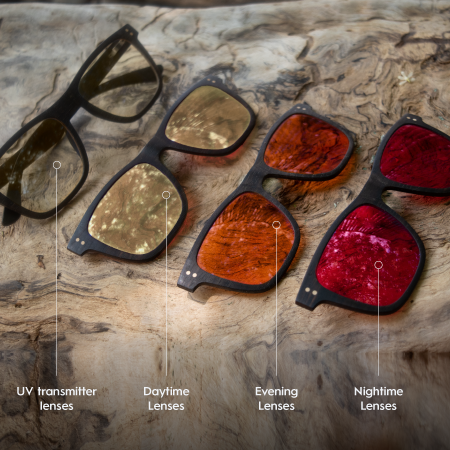
Wear orange and red-tinted circadian glasses after sunset.
VivaRays evening circadian glasses are designed for the hours after sunset, and sleep circadian glasses take over for the final hour before bed.
A 2017 study found that orange-tinted lenses worn for 2 hours before bed increased melatonin levels by about 58% compared to clear lenses (Ostrin et al., 2017).
That's your body getting back its entire repair system.

One important note. Not all orange and red-tinted glasses are created equal.
At VivaRays, we've tested dozens of orange and red lenses from other brands, and many of them leak significant amounts of blue and green light across the spectrum.
That's why lens quality matters. We invest in engineering lenses that are spectrally verified to truly block the wavelengths that interfere with melatonin production.
If you want to understand the deeper impact of artificial light on your hormones, read our article on the 6 forces targeting your pineal gland.
Nerd Section: What blue light does to your mitochondria
Blue light at the 450 to 460nm range floods the body with reactive oxygen species, causing mitochondrial DNA damage (Godley et al., Journal of Biological Chemistry, 2005). Healthy mitochondria normally cycle through splitting (fission) and fusing back together (fusion), like breathing in and out. Blue light drives excessive fission through oxidative stress, but the fusion doesn't happen. The mitochondria split apart and can't put themselves back together (Nakashima et al., Free Radical Biology and Medicine, 2017). It's like an engine tearing itself apart from the inside. And without melatonin to clean up the damage, there's no repair crew coming.
Eat the Right Fats and Minerals
Your body can't process sunlight properly without the right raw materials.
Think of sunlight as the spark that ignites your metabolism. But even the best engine needs fuel.
Without the right nutrients, the spark has nothing to work with.
Vitamin D synthesis alone requires cholesterol as a precursor.
Converting light into electrical signals for cell communication depends on DHA, a fatty acid found almost exclusively in animal sources and algae.
What should be on your plate?
Grass-fed meats. Wild-caught fatty fish like salmon and sardines. Shellfish. Pastured eggs. Sulfur-rich vegetables like broccoli and garlic.

You also need magnesium, vitamin A, vitamin K, and sulfur for the full light-processing chain to work.
If you're vegetarian, algae-based DHA supplements are the only plant source that provides this fatty acid. Don't skip it. DHA is essential for proper photoreception.
How fast does vitamin D build up? In about 15 minutes of midday summer sun (UV Index ~7, lighter skin), your body can produce 10,000-20,000 IU of vitamin D3. That's 100-200x the daily recommended intake (Wacker & Holick, 2013). But you need the nutrient building blocks in place first.
Frequently Asked Questions
How long does it take to build a solar callus?
Most people need 2 to 3 weeks of consistent, gradual UV exposure below the sunburn threshold. New melanin production peaks at 7 to 10 days, and your outer skin layer (which adds a natural SPF of about 3-4) takes the full 2 to 3 weeks to thicken (Brenner & Hearing, 2008).
Can I build sun tolerance if I have fair skin?
Yes, but it takes more caution. Fair-skinned individuals (Fitzpatrick Type I-II) have a lower threshold before burning, roughly 200 J/m2 compared to 350 J/m2 for medium skin. Start with shorter sessions (2 to 3 minutes per side) and increase more slowly. Your body still adapts. It just needs a gentler ramp.
Do I need sunscreen while building my solar callus?
Not during short, controlled exposure sessions (under 15 minutes at moderate UV). The goal is to let UV reach your skin so adaptation can happen. If you'll be outdoors for extended periods before your callus is built, cover up with light clothing first, or seek shade under a tree or umbrella. If you really can't do either, a natural mineral sunscreen with zinc oxide is a far better backup than getting fried. We're not anti-sunscreen. We're anti-sunscreen dependence. There's a difference.
What about chemical sunscreens?
Chemical sunscreens contain phototoxic compounds like oxybenzone that actually increase free radical production in skin when exposed to light (Hanson et al., 2006). An FDA study found oxybenzone exceeded safety thresholds for blood absorption after just one day of use (Matta et al., JAMA, 2019). Use zinc oxide mineral sunscreen instead.
Why shouldn't I wear sunglasses during sun exposure?
Your eyes contain photoreceptors (including neuropsin/OPN5) that detect UV and signal your body to produce melanin. Sunglasses block 100% of UV, so your brain never registers that the sun is strong. Your skin stays unprepared and doesn't produce melanin in adequate amounts. This actually makes you more vulnerable to sunburn, because you lose your body's natural protection mechanism.
How much sun do I need for adequate vitamin D?
For light-to-medium skin, 10 to 30 minutes of midday sunlight on arms, legs, and face (without sunscreen), 2 to 3 times per week, is sufficient. In just 15 minutes of midday summer sun, your body can produce 10,000 to 20,000 IU of vitamin D3 (Holick, NEJM, 2007). Darker-skinned individuals may need 3 to 6 times longer.
Ready to protect your melatonin and support your solar callus?
Our circadian glasses filter artificial blue and green light after sunset so your body can repair, recover, and build real sun resilience.
This spring, follow the horses.
Explore Circadian Glasses
Leave a comment