


Winter flow 4: The Winter Solstice Secret Indigenous People Never Forgot

In our last blog, we discovered how morning and midday light set your daily and seasonal clocks. You learned why that first signal from the sun matters, and why missing it keeps you cold, tired, and gaining weight.
My First Winter Solstice
It's December 21st, 2018, the longest night of the year.
Here I'm on a farm in northern Canada, celebrating the winter solstice with indigenous families who've lived on this land for generations.
It's my first time honoring this day. My first time understanding what it means.
Earlier that afternoon, one of the elders, a farmer named Hunt whose family had worked this land for over 200 years, sat with me by the wood stove.
He places his warm hand on my shoulder, looks me in the eye with his gentle, glowing eyes, and starts sharing a story I will never forget:
"10 years ago, my daughter Kaya moved to the city. Toronto.
She got a good job in a corporate office. For the first time in her life, she was under fluorescent lights day and night.
She'd call us every few weeks. Always tired. Always stressed. Couldn't sleep. Gaining weight. Getting sick constantly.
Doctors gave her pills for anxiety. Pills for sleep. Pills for her thyroid.
One December, Kaya came home for the solstice. She looked... grey. Depleted. Like something inside her had dimmed.
Her grandmother, Nokomis, took one look at her and said: 'You've forgotten the way back to... yourself.'"
Hunt pauses, adding a log to the fire.
"Nokomis means 'wisdom keeper.' It symbolizes the feminine power.
The name was given to my mother by her grandmother, acknowledging her role as the holder of ancient knowledge. The keeper of balance.
In our tradition, the feminine represents receptivity. Stillness. The inward journey. Rest.
This is the energy of winter itself.
While summer is yang—active, bright, outward, doing—winter is yin: restful, dark, inward, being.
The solstice marks the peak of this feminine power. The deepest darkness. The most profound rest.
Nokomis understood this deeply.
Every year from the winter solstice until the spring equinox, she followed what her grandmother had taught her:
Every evening, as the sun set, she would light a small fire.
This little ceremony became a keystone habit, symbolizing the end of the active day.
No more knitting. No more cooking. No more preserving food. No more work of any kind.
From that moment on, she would simply sit by the fire.
Watching the flames flicker.
Listening to the wood crackle.
Doing nothing.
Just sitting in stillness, honoring the deep wisdom of nature. The same wisdom that makes the trees drop their leaves, the bears retreat to their dens, the land itself go dormant and quiet.
Nokomis knew something most humans today have forgotten:
We are part of nature. We follow the same cycle.
When we're in sync with the cycle, we thrive.
When we move away from our roots, we suffer.
When darkness came, she let her body follow what the earth was already doing.
Resting. Restoring. Preparing for spring's return.
She told Kaya: 'Stay with me. Do what I do. Just this once.'"
Hunt's voice softens.
"Kaya was desperate. Desperate to find her way back to herself.
And she knew her grandmother carried deep wisdom.
So for three months, she lived the old way.
Every evening, she helped Nokomis light the fire at sunset.
And from that moment on, no activity. No screens. No lights.
Just firelight and stillness.
At first, she'd sit there restless. Her mind racing. Her body twitching with the need to do something.
Her whole life had been about productivity. Movement. Constant activity.
Sitting still felt unbearable. Like she was 'wasting' her time.
But Nokomis would just smile and say: 'Give it time. You will naturally return to balance.'
And slowly, night by night, something shifted.
The restlessness began to fade.
Kaya started noticing things she'd never noticed before: the way the firelight danced on the walls, the rhythm of her own breathing, the heaviness in her body that signaled true tiredness.
Not exhaustion. Not depletion.
Natural tiredness.
The kind that comes when darkness tells your body it's time to rest.
She'd go to bed when the fire died down. Sometimes 8 PM. Sometimes 9 PM.
And she'd sleep 10, 11, sometimes 12 hours on the longest nights.
Waking naturally with the sunrise. no alarm. Her body naturally saying: 'It's time.'
Within weeks, her face started to change.
The grey pallor faded. Color returned to her cheeks.
Her eyes,which had been dull and lifeless, began to clear.
The inflammation in her joints decreased. The brain fog lifted. The weight started coming off without any diet changes.
Her anxiety... disappeared.
By the spring equinox, she looked like a different person.
Alive. Vibrant. Glowing.
Like she'd come back to herself.''
Hunt looks at me directly now.
"The doctors who have been prescribing anxiety and thyroid medication couldn't explain it. They said the medication must have finally kicked in.
But we knew what had happened.
She'd stopped fighting nature's rhythm
She'd stopped trying to live in summer mode during winter.
She'd let winter do what winter is meant to do: restore her.
She once again returned to balance, rhythm and ultimately to… herself
Our people have always honored the winter solstice. The longest darkness. The deepest night.
We knew that darkness was not the enemy. It is the medicine.
We knew that after this night, the light would slowly return.
But we also knew something modern people have forgotten:
It's winter darkness that makes it possible for us to withstand the strong summer light.
Without deep rest in winter, you can't sustain the long active days of summer.
Without the restoration that darkness brings, you burn out under the brightness.
Winter doesn't just heal what summer depleted.
Winter prepares you for what summer demands.
Modern people fight this. They stay in yang mode all year long,active, under static artificial lights that never change, doing, producing, 14 hours a day, every day, no matter the season.
The never sync with nature's rhythm
They never rest.
They never restore.
And when summer comes, they have nothing left to give.
That's why they're exhausted. Depressed. Sick.
Not because of winter.
Because they refused winter's gift.
He stands up, adding another log to the fire.
"Tonight, we honor the solstice the way our grandparents did. The way their grandparents did.
No electric lights. Just fire and candles.
When this fire is lit at sunset, the active day ends.
Let your body remember what it's supposed to do when darkness comes."
What That Night Taught Me
The sun sets at 4:30 PM.
I'm sitting across from Hunt by the wood stove, watching him add another log to the fire.
As he tells me this story: Nokomis, Kaya, the fire ceremony, the return to balance…I find myself mesmerized.
Not just by the story….
By the stillness.
The long pauses he takes between sentences.
The silence that feels... full.
On this night, I feel something I've never felt before on December 21st of the year
I feel deep reverence and gratitude…
For nature. For the seasons. For the cycles that govern all of life.
For the ancestors who lived in tune with these rhythms, who didn't fight them, but flowed with them.
For the first time in my life, I see the darkness of the winter solstice in a completely new light.
I realize that I have been running away from the very thing that would heal me…
And in that moment, I make a commitment to myself:
This ritual, passed from Nokomis's grandmother to Nokomis, from Nokomis to Hunt, from Hunt to Kaya, and now offered to me…would become part of who I am.
Part of how I honor the seasons.
The beginnings and the endings.
The rhythmic interchange of light and dark, activity and rest, that is the core essence of all nature.
That night, I naturally drift off to bed at 8:00 PM.
And I sleep like I haven't slept in years.
The next morning, I wake at 5:45 AM. No alarm. Fully rested. Alert. Energized.
Being on this farm without artificial lights, honoring the solstice the way humans had for thousands of years, my body is remembering something it had forgotten.
It remembers how to rest.
It remembers how to come back to balance.
How to come back to the roots.
GOLDEN NUGGET: Your body doesn't just need light. It needs darkness. Real darkness. The kind that tells your pineal gland: "It's time to repair, regenerate, and restore." This is ancient wisdom that modern life has made us forget. Without it, you're running on empty, even if you sleep 8 hours.
When the Pendulum Swings Toward Winter
As we come closer to December 21st, have you noticed how the days get shorter?
In some places, darkness arrives by 4:30 PM. In others, by 3 PM.
Your body notices this too.
Specifically, a tiny pine-cone-shaped gland deep in your brain: your pineal gland.
From July 21st to December 21st, as the days grow progressively shorter, your pineal gland tracks this change.
It notices darkness arriving earlier each day.
And it responds by releasing melatonin, your sleep hormone, a little earlier each evening.
Day by day, minute by minute, your melatonin cycle lengthens.
Research confirms this seasonal pattern. A 2018 study published in Frontiers in Physiology found that animals measured on the winter solstice had significantly higher melatonin levels than those measured on the summer solstice, with the duration of melatonin secretion directly corresponding to the length of darkness.
By December 21st, the winter solstice, something profound happens:
The longest night.
The deepest darkness.
The longest melatonin cycle of the entire year.
This is the night when your body spends the most hours in deep repair and rejuvenation.
The night when cellular restoration reaches its peak.
The night when your immune system does its deepest work.
But when artificial light floods your evenings, your pineal gland never gets the message.
Your melatonin cycle stays locked in summer mode: short cycle
You never experience the deep restoration December 21st is designed to give you.
And you wonder why winter feels so hard.
Melatonin Is Far More Than a Sleep Hormone
Here's what most people don't know:
Melatonin isn't just about making you sleepy.
It's your body's master regeneration signal.
When darkness triggers melatonin production, here's what happens:
Antioxidant Power:
- Research published in Current Topics in Medicinal Chemistry (2002) found that one melatonin molecule can scavenge up to 4 or more reactive species through what's called a "cascade reaction"
- Naturally produced melatonin is 5-10 times stronger than any antioxidant you can eat.
Anti-Inflammatory:
Melatonin fights inflammation, reduces muscle pain and aches, and protects you from winter colds.
A 1995 study in the Journal of Pineal Research found that melatonin has profound effects on immune function and disease resistance, especially during winter months.
Anti-Aging:
Melatonin slows cellular aging and activates repair mechanisms throughout your body.
A 2016 study in the Journal of Pineal Research confirmed melatonin is "uncommonly effective in reducing oxidative stress" and acts as a mitochondria-targeted antioxidant.
Anti-Cancer:
A 2011 review in Progress in Neurobiology showed melatonin suppresses tumor growth and supports immune surveillance against cancer cells.
Serotonin Production:
Here's something critical: serotonin is the precursor to melatonin.
During the day, your body maintains serotonin levels for mood regulation.
At night, in darkness, your body converts serotonin into melatonin.
But when artificial light suppresses melatonin production, you disrupt this entire system.
You deplete the serotonin available for mood regulation.
You block the melatonin needed for restoration.
A 2021 study in Frontiers in Pharmacology found that patients with depression had significantly lower melatonin concentrations, and treatment that increased melatonin improved depressive symptoms.
A 2022 study in the Journal of Traditional Chinese Medical Sciences confirmed that seasonal photoperiod changes in melatonin secretion may be the pathophysiological basis for seasonal affective disorder.
GOLDEN NUGGET: Most people attribute winter depression (SAD) to lack of light. But it's equally caused by lack of darkness. When artificial light suppresses melatonin, you deplete serotonin, the neurotransmitter that prevents depression.
The Solution: Protect Your Darkness
The good news?
The solution is simpler than you think.
We can get back on track by managing artificial light better after sunset.
By giving your body the darkness it needs, you protect your melatonin cycle and restore your natural rhythm.
Think about those wild chickens.
They didn't need advanced science.
They just followed nature's rhythm: light during the day, darkness at night.
You can do the same.
5 Actions to Reclaim Winter's Darkness
Action #1: Download the Circadian App
Before you do anything else, get this amazing tool: my circadian app
Get started with a 3-week free trial on Android or a 1-month free trial on Apple, plus a 10% discount on Lifetime Access for subscribers.
Google Play
Store Apple Store
Simply select Try MyCircadian Full Access or Start Trial and enter code "VIVA10" for an extended free trial and a 10% discount.
This app is one of my favorite resources for anyone just starting this journey.
Here's what it does:
- Identifies your exact location
- Shows you local sunrise and sunset times
- Tells you when UVA light begins (about an hour after sunrise)
- Suggests optimal times to wake up, eat meals, and go to sleep
- Shows you when to limit artificial light exposure
Based on your geographical location and the current season, it gives you personalized timing for everything we've discussed in this series.
Think of it as your seasonal guide.
It takes the guesswork out of when darkness begins, when your body should start producing melatonin, and when you should start protecting your eyes from artificial light.
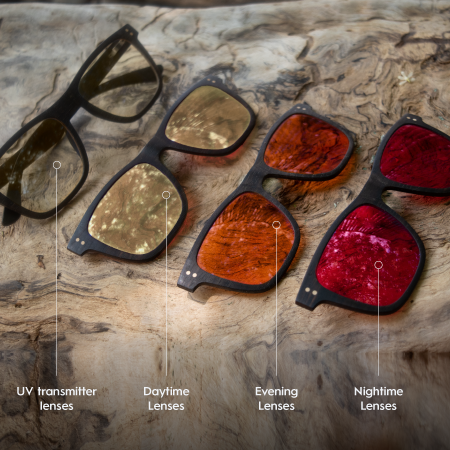
Action #2: Wear Evening Lenses After Sunset
Once the sun sets (check the app for your exact time), put on your Evening Circadian Lenses.
These are designed to filter out the blue-green wavelengths (up to 550nm) that suppress melatonin while still letting you see clearly and function normally.
They allow you to use lights and screens without disrupting your biology.
Action #3: Switch to Nighttime Lenses 1 Hour Before Bed
About an hour before sleep (again, the app can help you time this), switch to Nighttime Lenses (red lenses).
These block 100% of light up to 570nm—the complete melatonin suppression zone.
This signals to your brain: "The day is over. It's time for deep restoration."
Within 30-60 minutes, your melatonin levels rise naturally, and you'll feel genuine tiredness.
Action #4: Use Fire, Candlelight, and Warm Lighting After Sunset
Opt for natural light sources after sunset:
- Firelight
- Candles
- Himalayan salt lamps
- Warm, dim incandescent bulbs (under 2700K)
These emit healing infrared light that doesn't disrupt melatonin.
Create a cave-like environment in your bedroom with blackout curtains or a sleep mask.
Action #5: Keep Your Bedroom Free From EMF
WiFi routers and phone signals operate at microwave frequencies that can disrupt melatonin production.
Transform your bedroom into a sanctuary:
- Turn off WiFi at night
- Keep phones out of the bedroom (or in airplane mode)
- Remove electronic devices
- Eliminate LED lights (alarm clocks, chargers, etc.)
Start with one.
Maybe it's downloading the app.
Maybe it's wearing Evening Lenses tonight.
Maybe it's lighting a candle instead of turning on the overhead lights.
One action creates momentum.
The Science Behind This Blog
Key Research Citations:
Zhang Y, et al. (2018). "Association of Melatonin Production with Seasonal Changes, Low Temperature, and Immuno-Responses in Hamsters." Frontiers in Physiology, 9, 334.
Wehr TA. (2001). "Photoperiodism in humans and other primates: evidence and implications." Journal of Biological Rhythms, 16(4), 348-364.
Tan DX, et al. (2002). "Chemical and physical properties and potential mechanisms: melatonin as a broad spectrum antioxidant and free radical scavenger." Current Topics in Medicinal Chemistry, 2(2), 181-97.
Pieri C, et al. (1994). "Melatonin: a peroxyl radical scavenger more effective than vitamin E." Life Sciences, 55(15), PL271-6.
Nelson RJ, et al. (1995). "The influence of season, photoperiod, and pineal melatonin on immune function." Journal of Pineal Research, 19(4), 149-65.
Hardeland R, et al. (2011). "Melatonin, a pleiotropic, orchestrating regulator molecule." Progress in Neurobiology, 93(3), 350-384.
Reiter RJ, et al. (2016). "Melatonin as an antioxidant: under promises but over delivers." Journal of Pineal Research, 61(3), 253-278.
Burns AC, et al. (2021). "Time spent in outdoor light is associated with mood, sleep, and circadian rhythm-related outcomes." JAMA Psychiatry, 78(7), 723-730.
Wang F, et al. (2022). "Seasonal photoperiodic influence of pineal melatonin on hypothalamic-pituitary-adrenal axis-hippocampal-receptor in male rats." Journal of Traditional Chinese Medical Sciences, 7(3), 283-290.
Dmitrzak-Węglarz M, et al. (2021). "Molecular Regulation of the Melatonin Biosynthesis Pathway in Unipolar and Bipolar Depression." Frontiers in Pharmacology, 12, 666541.
Corrêa FMA, et al. (2021). "Melatonin and Depression: A Translational Perspective From Animal Models to Clinical Studies." Frontiers in Psychiatry, 12, 638981.
Leave a comment