


Winter Flow 3: The Missing Winter Signal Keeping You Cold, Tired & Gaining Weight

In our last blog, we discovered the hidden biological switch animals use to thrive in winter: Activating the winter programming.
You learned that your body has two metabolic modes: summer and winter.
Which one runs depends entirely on the signals you receive from nature.
Today, we dive into the first force that controls that switch: LIGHT
Meeting the Sun
Picture this:
It's December 4th 2018.
7:45 AM. Still dark. -10°C.
I'm standing barefoot in the snow outside the farmhouse, waiting.
The sky is deep purple. Stars still visible. No sunlight yet.
But I'm here anyway.
Weeks earlier, the farmer had said something I couldn't forget:
"If you want to feel alive in winter, you have to greet the sun every morning.
And you have to develop a friendship with the crisp cold."
I remember thinking he was being poetic. Turns out, he was being scientific.
At around 8:30 am, the horizon begins to glow: Deep orange. Then pink. Then gold.
And the moment the first sliver of sun breaks the horizon, something shifts.

My body wakes up.
I feel energized.
I feel oriented.
Like my body suddenly knows what time it is.
And over the weeks of doing this, standing outside every morning, letting that early light hit my face, I notice something remarkable:
I start falling asleep earlier. Naturally.
I wake before my alarm. Without grogginess.
My energy stabilizes. No 2 PM crash.
My mood lifts. Even in the darkest months.
Some mornings, the sun breaks through cleanly.
Other mornings, it stays hidden behind thick winter clouds.
It doesn't matter.
I'm out there anyway.
Standing in the cold.
Greeting the sun: whether I can see it or not.
GOLDEN NUGGET: Your eyes aren't just for seeing. They're the master switch for your entire circadian system. The light that enters your eyes in the morning sets your biological clock for the next 24 hours, determining when you'll be alert, when you'll be hungry, and when you'll be able to sleep.
Why Morning Light Is Everything
Here's what most people don't understand about light:
It's not for vision.
95% of the light entering your eyes doesn't help you see. It regulates your hormones.
Your eyes have specialized cells called ipRGCs that detect light and send signals directly to your SCN: your brain's master clock.
That clock controls everything:
==> When you feel alert or sleepy
==> When your body temperature rises or falls
==> When you're hungry
==> When your metabolism speeds up or slows down
==> When your immune system repairs itself
Your entire physiology runs on the light signals your SCN receives.
And it needs the right light at the right time.
A 2018 study in Nature found these cells respond most strongly to the specific wavelengths of natural sunlight, especially the blue and cyan light at sunrise.
But here's the key: they need outdoor light to activate properly.
The difference is staggering.
Lux measures light intensity = how bright something is to your body.
Indoor light: 100-500 lux.
Cloudy winter morning outside: 10,000+ lux.
Sunny winter morning outside: 50,000+ lux.
Even on the darkest winter day, outdoor light is 20-100 times brighter than indoor light.
Indoor light doesn't trigger the full circadian response your body needs.
So what happens when morning light hits your eyes?
Within seconds, your ipRGCs signal your SCN.
Within minutes:
==> Cortisol rises (waking you up)
==> Serotonin increases (making you feel content and peaceful)
==> Body temperature climbs (energizing you)
==> Metabolism activates
But here's the critical part:
12-14 hours later, your pineal gland uses that morning light as a reference point to trigger melatonin production: your sleep hormone
The light you see at 8:00 AM determines whether you can fall asleep at 9:00 pm
A 2019 study in Sleep Medicine Reviews found people who got morning light fell asleep 37 minutes faster and slept significantly better than those who didn't.
Morning light wasn't just waking them up.
It was programming their entire 24-hour cycle.
Winter Light: Why You Need More, Not Less
Here's the cruel irony of winter:
The days get shorter. The sun gets weaker. You need light more than ever.
But you go outside less.
You wake up when it's still dark.
You walk 30 seconds from your house to your car.
You drive with sunglasses on. Windows block natural light.
You arrive at your office and sit under artificial lights all day.
You drive home in the dark.
You never see the sun.
And your body interprets this as: "I don't know what time it is. I don't know what season it is. I don't know what to do."
Research published in Journal of Affective Disorders (2020) found that winter depression (SAD) isn't caused by darkness alone.
It's caused by insufficient daytime light exposure.
The study showed that people who got at least 30 minutes of outdoor light in the morning, even on cloudy winter days, had significantly lower rates of SAD compared to those who stayed indoors.
Your body needs enough light first thing in the morning to understand it's daytime.
And in winter, with weaker sun and shorter days, you need to be more intentional about getting it.
But morning light only solves half the problem.
There's another signal your body desperately needs in winter.
The seasonal signal.
What the Buffalo Knew
Back on the farm, I noticed something fascinating about the buffalo.
They didn't wait for the first snowfall to grow their winter coat.
By the time winter arrived, they were already bundled up in thick fur that helped them retain heat.
But how did they know?
It wasn't temperature. September was still warm.
It wasn't snow. The ground was still bare.
It was the UV light.
As summer shifted to fall, the UV index started dropping. Their eyes detected this change and sent the signal to their brain: "Winter is coming. Activate winter programming."
By the time the cold hit, their bodies had already made the switch.
Thicker fur. Slower metabolism. Mitochondria primed for thermogenesis.
Seamless. Automatic. Perfect.
Meanwhile, remember those caged chickens under 24/7 artificial lights?
They struggled. Got sick. Couldn't adapt.
Because they never received clear seasonal signals from UV light.
Your Seasonal Clock Runs on UV
Remember in Blog 2 when we talked about infradian rhythm, your body's yearly clock that tells you whether it's summer or winter?
That clock reads UV intensity.
In summer, abundant UVA tells your body: "Activate summer programming. Speed up metabolism. Stay active. Store fat for winter."
In fall, as UV decreases, your body receives the message: "Winter is coming. Switch to winter programming. Slow metabolism. Activate thermogenesis. Prepare for cold and darkness."
GOLDEN NUGGET: Morning light sets your daily clock. UV light sets your seasonal clock. Without both signals, your body doesn't know what time it is or what season you're in, and your metabolism, sleep, and energy suffer accordingly.
Why Modern Humans Stay Stuck in Summer Mode
Your body is designed to read UV light for two critical pieces of information:
What season is it? (Summer vs winter)
Where am I? (Equator vs northern latitude)
Think about it:
In Mexico, the difference between summer and winter UV isn't huge. Your body experiences relatively stable seasonal signals.
In Canada? The UV swing is massive.
Long, bright summers with 16+ hours of intense UVA.
Short, dark winters with maybe 4-6 hours of weak UVA (if you're lucky).
Your infradian rhythm needs to track this massive swing to adapt properly.
But modern life blocks the signal entirely.
You work indoors under LEDs. No midday UV.
You drive in cars. Windows block UV.
You spend fall and winter exactly like summer: same indoor temperature and same artificial light,
Your infradian rhythm never receives the signal to switch to winter programming.
So ponder on those questions:
How much natural midday light am I getting in fall and winter?
How much UV actually reaches my eyes and skin between September and March?
If the answer is "very little" or "none," your body is facing the same problem those caged chickens faced.
Seasonal confusion.
The Cost of Missing the Seasonal Signal
Without proper UV signaling in fall and winter, your body never gets the message to:
==> Activate brown fat
==> Increase heat production
==> Shift into winter's conservation mode
==> Prepare your mitochondria for thermogenesis
You stay stuck in summer programming. In December
Your mitochondria keep trying to produce quick energy (summer mode) instead of energy and heat (winter mode).
You feel cold all the time because you're not generating internal warmth.
You gain weight because your metabolism never shifted to fat-burning.
You're exhausted because your body doesn't shift into deep repair and rejuvenation mode in the winter
And you wonder what's wrong with you
You ponder why winter is so hard!
But here's the truth : Nothing is wrong with you and winter is not meant to be torturing
Your body just never got the right signal.
3 Actions to Receive the Seasonal Signal
Here's how to give your body what it needs:
Action #1: Go Outside Within 30 Minutes of Waking
Even for 5-10 minutes. Even if it's cloudy. Even if it's cold.
Face east (toward the rising sun). Let the light hit your eyes and face.
Don't wear sunglasses. Don't look through windows (glass blocks UVA).
Just stand there. Breathe. Let your body receive the signal.
Action #2: Get Midday Sun Whenever Possible
Step outside for 10-15 minutes around noon.
Even 1 minute every 90 minutes is valuable.
This is when UVA is strongest (even in winter). This gives your body the seasonal signal it desperately needs.
Action #3: Open Your Windows
Here's something most people don't know:
Dr. Jamie Zeitzer from Stanford's Department of Psychiatry and Behavioral Sciences found:
"It takes 50 times longer to reset your circadian rhythm when you're behind windows compared to being outdoors."
Read that again.50 times longer.
Glass blocks critical UV wavelengths your body needs to set your seasonal clock.Even if you're sitting by a bright window, you're only getting a fraction of what your body requires.
So what do you do? Open your windows. Even a slick crack is enough to allow the UV light in. Let the full spectrum of light reach you, undistorted, unfiltered.
Action #4: Ditch the Sunglasses
Sunglasses block 100% of UV light.
That means they're blocking the exact signal your body needs to know what season it is.
Let your eyes receive the full spectrum.
Action #5: Upgrade Your Prescription Lenses (If You Wear Them)
Here's something that shocked me when I learned it:
Standard prescription glasses and contact lenses block 100% of UV light.
If you wear glasses or contacts all day, every day, you're essentially living behind UV-blocking windows, even when you're outside.Your eyes never receive the seasonal signal
So what can you do about this?- Remove your glasses/contacts occasionally when outdoors (if your vision allows it safely). Even 10-15 minutes of unfiltered light makes a difference.
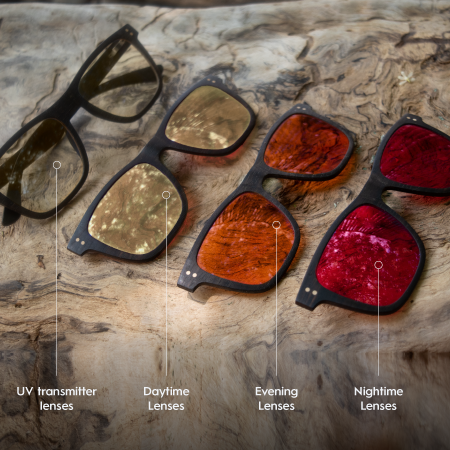
- Use Vivarays UV-transmitting lenses. We created our 4-in-1 UV Transmitting Prescription Lenses specifically for this. They let in 50-60% more beneficial UV light than standard lenses while still providing vision correction.
Action #6: Protect Your Circadian Rhythm Indoors
When you can't get outside, protect your eyes from artificial light that disrupts your internal clocks.
Our 3-in-1 Circadian Lenses are designed for this exact purpose:
Daytime Lenses:
Filter out the harshest 455nm spike from LEDs and screens while letting in the beneficial wavelengths you need. No more burning eyes. No more circadian confusion.
Evening Lenses:
After sunset, these protect your melatonin production by blocking the blue-green wavelengths that tell your brain it's still daytime. This is the seasonal signal your body needs to know it's winter and time to activate deep rest and repair.
Nighttime Lenses:
Put these on 30 minutes to an hour before bed. These block the frequencies that suppress melatonin most aggressively, ensuring your body gets the long, dark signal it's expecting in winter.
In Blog 4, we'll explore what happens after sunset: how darkness completes the light cycle and why protecting it is just as critical as getting morning and midday light.
Continue Your Winter Flow Journey
The Science Behind This Blog
Key Research Citations:
Zele et al. (2018) - Scientific Reports (Nature family): "Melanopsin photoreception contributes to human visual detection, temporal and colour processing"
Multiple 2018 Scientific Reports studies about ipRGCs, but none specifically about "mapping" them
Prayag AS, et al. (2019). "Light exposure and sleep quality in healthy adults." Sleep Medicine Reviews, 45, 24-35.
Münch M, et al. (2020). "Bright light therapy in the treatment of seasonal affective disorder." Journal of Affective Disorders, 276, 341-348.
Leave a comment