


Winter Flow 7: Why winter makes you gain weight and how to stop it

In our last blog, you discovered how cold and movement together restore dopamine and motivation: the neurochemical foundation you need to thrive in winter.
Today, I'm going to tell you about something I struggled with long before I understood any of this.
Something that made me feel weak, ashamed and out of control.
The Thing I Couldn't Stop
11:00 pm January 2014, I'm sitting on the couch in Beirut with the TV on.
Led light in the ceiling. Phone in my hand scrolling through social media.
And I'm eating my third bowl of cereal.
And here's the truth: I just ate dinner three hours ago.
I wasn't physically hungry when I started. I was full.
But the urge to eat was beyond my control. Almost automatic.
My hand reaches for the bowl without needing to think about it. Spoon to mouth. Again and again and again.
Some part of my brain is screaming: "You just ate dinner a few hours ago. Stop eating."
But a louder part is saying: "Just one more bite. Just finish this bowl."
I thought it was the depression and the lack of willpower.
I thought: "What's wrong with me?"
Years Later: The Discovery
Fast forward to winter 2018. I'm on the farm in Canada.
A year ago, I couldn't get out of bed before noon.
Now I wake up at 6 AM, naturally, without an alarm, feeling so alive
A year ago, I was prescribed antidepressants and anxiety medication that I thankfully refused to take.
Now I am elevated, inspired and buzzing with energy
A year ago, I'd eat that third bowl of cereal at 11 PM and still feel hungry.
Now I finish dinner at 4:00 PM and feel completely satisfied until morning.
A year ago, I had no direction. No purpose. No energy to pursue anything.
Now I'm obsessing over making light healthy again and helping every health seeker to come back to their vital self by returning to nature.
A year ago, stepping outside in winter felt like punishment.
Now I'm standing barefoot in the snow at -15°C, vibrating with life, collecting eggs from chickens who somehow thrive in this cold.
The habits that shifted:
Morning: The first thing I do is step outside. No phone. No coffee first. Just me and the sunrise.
Evening: candle and firelight after sunset. No screens no LED'S
Night: Bedroom cold and pitch black. Asleep by 9 PM.
Food: I eat when the sun is up. Dinner before sunset. Nothing after dark.
I've gone from desperation to inspiration.
I've transformed.
But how did I manage to do so? How did I manage to change all these habits in such a short period of time?
Thinking back, I frankly didn't try to use endless willpower to force myself to be different
It almost happened naturally.
I changed TWO keystone habits, and the rest followed automatically.
The Video That Changed Everything
March 2017.
I'm lying in bed in this dark basement in Canada, scrolling through my phone.
The blue light is shining on my face. I am feeling exhausted mentally and physically yet I am wired and I can't stop scrolling.
Suddenly a video popped up on my feed
I almost skipped it but something makes me click..
Dr. Jack Kruse on screen, saying:
"You can't get healthy in the same light environment that made you sick."
The video was called "Artificial Light Is Killing Us."
And I ask myself: '' Could this be the reason for everything I have been going through? The lack of energy… The constant fatigue? The depression?''
This question sends me on an odyssey.
Living on farms .Finding my way back to nature. Back to rhythm. Back to the light.
Back to the environment that ends up creating the epiphany that would transform me forever
An environment where I didn't need to work so hard to change all of my habits.
An environment that worked for me.
BACK TO NATURE
I naturally got sunrise.
I naturally was not exposed to artificial lights after sunset.
Two keystone habits that changed everything for me.
Just like it changed everything for Jack. His story is deeply inspiring. He lost 111 pounds in 11 months. Not from dieting or exercising or willpower. But from understanding one simple mechanism:
Light after sunset destroys the hormones that tell you you're full.

The Realization
Here's what Jack discovered, and what I was living unknowingly in Beirut:
Your brain expects a simple pattern:
Light during the day. Darkness at night.
When the sun sets, your body starts producing melatonin.
You know melatonin as the "sleep hormone."
But it does something else crucial: It signals your body to raise leptin.
Leptin is your satiety hormone.
The hormone that tells your brain: "I'm full. Stop eating."
But here's the problem:
When you're under bright light after sunset—TV, overhead lights, phone screens—melatonin production gets shut down.
And if melatonin doesn't rise? ⇒ Leptin doesn't rise.
You never get the "I'm full" signal. At the same time, ghrelin, your hunger hormone, starts climbing.
Ghrelin is what makes your stomach growl. What creates that "I need to eat" feeling.
So after sunset, under artificial light, you're getting a double hit:
- Leptin suppressed (no "stop eating" signal)
- Ghrelin elevated (strong "eat now" signal)
No wonder you can't stop snacking.
Your hormones are telling you you're starving, even when you're full.
The Research Confirmed It
A study by Albreiki and colleagues tested this directly.
They kept healthy adults awake at night under two conditions:
Bright indoor light versus very dim light.
Under dim light?
Leptin went up. Appetite shut down.
Under bright light?
Leptin stayed low. Participants reported being significantly hungrier throughout the night.
Light at night literally prevents your "I am satisfied" signal from turning on.
Another study by Qian simulated night-shift work.
Within just a few days of artificial light exposure at night, ghrelin levels rose and hunger increased, even when diet stayed the same.
And it doesn't take much light to trigger this.
A Japanese study found that people who slept with just 3 lux of light—basically a faint glow from a nightlight or streetlight—had higher body weight, worse cholesterol, and more signs of metabolic syndrome.
Just three lux.
The long-term consequences?
A massive NIH study followed 43,722 women over five years.
Women who slept with a TV on, a lamp, or even outdoor light coming in were significantly more likely to gain more than 5 kilograms and become overweight—even after accounting for diet, exercise, and sleep duration.
The light itself was driving the weight gain.
GOLDEN NUGGET: Winter weight gain is connected to spending less time in natural light during the day and more time under artificial light at night: a perfect storm that scrambles your hunger hormones and makes you eat when your body doesn't need food.
My Beirut Nights Finally Made Sense
Sitting on the farm, reading this research, everything clicked.
Those nights in Beirut?TV blazing. Overhead lights on. Phone screen glowing.
My body never got the signal that night had arrived.
My melatonin never rose. My leptin never rose.My ghrelin kept climbing.
My brain thought: "It's still daytime. Keep eating. You need energy."
And I listened. Bowl after bowl. Night after night.
Not because my willpower was weak. Not because I had a hormonal problem.. But because I was in the wrong light environment that is the root cause of wrecking my leptin and ghrelin .
And the reality is that in the winter, all of this gets worse. You're getting less natural sunlight during the day (which naturally boosts leptin and regulates appetite).
You're spending more hours indoors under artificial light at night.
Less of what balances your hormones and more of what destroys them
No wonder winter feels like a constant battle with food.
But There's Another Side: Cold
Jack didn't just fix his light environment. He added cold exposure. And this is where everything from Blogs 5 and 6 comes together.
You already know from Blog 5 that cold activates your mitochondria to burn your fat and generate heat from within.
You know from Blog 6 that cold + exercise amplifies dopamine and creates sustained motivation.
But cold does something else:
It transforms your fat tissue into a calorie-burning furnace.
Remember: your body has two types of fat.
White fat stores energy: belly fat, thigh fat, the stuff you want to lose.
Brown fat burns energy to generate heat.
Brown fat is packed with mitochondria: the cellular powerhouses you learned about in Blog 5.
When you expose yourself to cold, your body sends a cascade of signals:
- Norepinephrine: "We need heat. Start burning."
- Irisin: Released during shivering ⇒ signals fat to switch from storage to burn mode.
- FGF21: Released by your liver ⇒accelerates fat burning.
- UCP1: The protein that allows mitochondria to burn fat directly for heat.
All these signals converge into : Stop storing. Start burning.
And your white fat listens. It starts building more mitochondria. The cells transform from pale white to beige-brown.
Scientists call this "beige fat"—and it behaves like brown fat, burning stored fat as fuel.
Research in Frontiers in Physiology found that cold exposure for just 1-3 hours activated brown fat and increased energy expenditure by about 188 extra calories per day, with no exercise, no dieting.
Also, studies show that weeks of regular cold exposure can double brown fat activity.
GOLDEN NUGGET: During the winter your body is literally designed to use your stored fat as firewood. This is what our ancestors had that we've lost.
Putting It Together: Light + Cold
This is Jack's formula.This is what changed his life. This is what I wish I'd known in Beirut.
Protect your darkness at night → Balance your hunger hormones (leptin rises, ghrelin falls, you feel satisfied)
Embrace cold during the day → Activate your fat-burning furnace (white fat converts to beige, mitochondria multiply, metabolism strengthens)
One rebalances the hormones that control appetite. The other transforms your fat tissue into an active metabolic engine.
Together, they solve winter weight gain at the root.
GOLDEN NUGGET: By embracing the cold during the day and protecting your darkness at night, you address winter weight gain from both directions. Activating your fat-burning furnace AND balancing the hormones that control hunger. That's the complete picture.
5 Actions to Reclaim Your Metabolism
Here's how to implement what Jack discovered and what transformed my relationship with food and my body:
Action #1: Protect Your Evening Light Environment
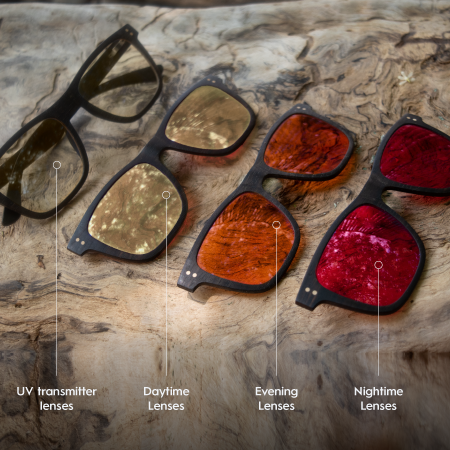
After sunset, switch to Evening Lenses. These filter out the blue light frequencies that suppress melatonin and scramble leptin/ghrelin. Your brain gets the signal: "The sun has set. Start the nighttime hormone cascade."
- Melatonin rises.
- Leptin rises.
- Ghrelin falls.
- Your appetite naturally regulates.
Action #2: Create Complete Darkness Before Bed
One hour before sleep, switch to Nighttime Lenses.
These block virtually all stimulating light, allowing melatonin to rise fully.
Combined with a dark bedroom (blackout curtains, no nightlights, no TV), this completes the hormonal reset your body needs.
Action #3: Morning Cold Exposure
Start your day with cold.
Cold shower. Or 30-60 seconds of cold water at the end of your warm shower.
This activates thermogenesis, triggers brown fat activation, and starts building your metabolic furnace first thing in the morning.
Action #4: Cold + Movement Outside
Step outside in lighter clothing.
Move your body for 10-15 minutes.
Jumping jacks. Squats. A brisk walk.
This combines cold exposure with exercise, amplifying the fat-burning effect while getting whatever natural light is available.
Action #5: Keep Your Bedroom Cool
60-65°F (15-18°C) at night.
This keeps your brown fat active overnight and supports the hormonal restoration that happens during deep sleep, including leptin and ghrelin regulation.
The Science Behind This Blog
Key Research Citations:
Albreiki MS, et al. (2021). "The effects of artificial light on leptin: Considerations for the metabolic syndrome." Journal of Obesity, 8(2), 103-112. [Bright light suppresses leptin, increases nighttime hunger]
Qian J, et al. (2019). "Circadian disruption and metabolic dysfunction in shift-work." Current Diabetes Reports, 19(3), 12. [Night-shift simulation: increased ghrelin and hunger]
Obayashi K, et al. (2013). "Exposure to light at night, nocturnal urinary melatonin excretion, and obesity/dyslipidemia in the elderly." Journal of Clinical Endocrinology & Metabolism, 98(1), 337-344. [3 lux light exposure linked to metabolic syndrome]
Park YM, et al. (2019). "Association of exposure to artificial light at night while sleeping with risk of obesity in women." JAMA Internal Medicine, 179(8), 1061-1071. [NIH study: 43,722 women, light exposure and weight gain]
Hanssen MJ, et al. (2022). "Effect of acute cold exposure on energy metabolism and activity of brown adipose tissue in humans: A systematic review and meta-analysis." Frontiers in Physiology, 13, 785928. [188 extra calories/day from cold exposure]
Yoneshiro T, et al. (2013). "Recruited brown adipose tissue as an antiobesity agent in humans." Journal of Clinical Investigation, 123(8), 3404-3408. [Cold exposure doubles brown fat activity]
Kruse J. Leptin prescription and cold thermogenesis protocols. [Jack Kruse's 111-pound transformation research]
Leave a comment