


How light restores sleep, fertility, and hormones at every stage of a woman's life

It's 2 a.m., March 2019, in my mother's bedroom.
She's lying on her back, eyes wide open, staring up at the ceiling fan.
My father sleeps beside her, oblivious.
The clock on the nightstand ticks while she's been awake since 10:30 p.m.
By 5:00 a.m., as the sky starts to soften, she is still wide awake.
By 6:00 a.m., she is pouring her first coffee, and her face looks grey, thin, and defeated.
She's sitting at the kitchen table, palms around the mug, not drinking, just staring at the steam.
This has been her ritual for a few years, as she kept struggling with insomnia.
Walk into that kitchen and you can feel it.
The weight of so much lost sleep.
The quiet grief of a woman who has tried everything, and doesn't remember what it feels like to wake up rested.
That's who my mother was 7 years ago.
Then, on her birthday, November 16th 2019, I sit down with her at that same kitchen table.
I don't bring flowers. I bring a pair of VivaRays glasses and two hours of everything I've learned about how light runs our biology.
I can see a glimmer of hope in her eyes while she makes a tremendous effort to keep herself focused.
I can tell that she is trying so hard to listen and take notes.
In that moment, I imagine her silently wondering:
"Will I finally overcome my insomnia and come back to myself again?"
Seven nights later, she sleeps straight through for 8 hours for the first time in many years.
Then it happens again. And again.
Today, at 66, she sleeps like an angel, wakes up glowing, and has more energy than most women half her age.
Her skin has changed. Her mood has brightened. Her glow have come back on.
Nothing in her diet changed. Nothing in her supplements changed. Just her light exposure.
How does that happen? And what does it mean for every woman moving through her life, from her fertile years into motherhood and all the way through menopause?
That's what this guide is about.
By the end of it, you'll understand exactly how light shapes every stage of a woman's life, and you'll know the simple changes that can rewrite what aging looks like for your mom, your partner, your daughter, or yourself.
What does a woman's circadian rhythm actually do?
Every living thing on earth is tuned to a 24-hour clock that controls the timing of all our biological functions.
That timing is called your circadian rhythm, and it's set by one thing above all others: the light hitting your eyes.
Here's what most people don't realize.
Your circadian clock controls when you digest, when you ovulate, when you sleep, when you burn fat, when you make milk, when you repair DNA damage, and when you detox.
The body is not designed to do everything at the same time.
Every one of those functions is supposed to happen at a very specific time throughout the day.
This kind of timing demands consistent light and dark patterns. This means light entering the eyes at sunrise and no artificial lights after the sunset
Nerd Section: the 2019 Nature Reviews study on women's circadian disruption
A 2019 review in Nature Reviews Endocrinology found that disrupted circadian rhythm is a major independent driver of infertility, metabolic disease, depression, and reproductive cancers in women (Fatima & Rana, Nature Reviews Endocrinology, 2019). The authors argue that chronodisruption should be treated as a distinct pathology, not just a lifestyle factor.
When a woman lives in sync with the sun, getting morning sunlight at a similar time every day and blocking artificial lights right after sunset, her body runs like an orchestra.
When she lives under artificial light at midnight, that orchestra has a single trumpet blaring while every other instrument sits silent.
The orchestra metaphor
At noon, the sun gives us a balanced spectrum of red, orange, yellow, green, blue, and UV, all at once.
After sunset, the blue drops off and light disappears into darkness, telling your brain the day has ended. This is the main signal that tells our body: it's time to rest, rejuvenate, and heal.
And here's the problem the average person is facing today:
After sunset, we are surrounded by LED lights and screens everywhere.
An LED bulb or phone screen sends only blue light. Nothing else.
So every time you stare at your phone at 10pm, your body thinks it's noon.
Your brain suppresses melatonin (the sleep hormone), spikes cortisol (the stress hormone), and stops your cells from repairing and cleaning.
Do you see the problem?


Your body evolved on daylight and sunset. Your nights are now lit by the panel on the right.
A regulated circadian rhythm equals true vitality.
A broken one underlies nearly every chronic condition women silently suffer with today.
If you want to go deeper on how artificial light became the quiet driver of modern disease, read our primer on artificial blue light and your health.
How does light affect fertility and preconception?
I had a friend who spent three years and $40,000 on IVF, and she still couldn't get pregnant.
She tracked her cycles. Her macros. Her stress. Her supplements.
The one thing her fertility clinic never asked her was what time she turned off the lights.
She worked in tech. She spent most of her days indoors, not getting sunlight, and her evenings blasted by artificial blue light from LED bulbs, the ring light on Zoom, and her devices.
And here's the thing. Her body was doing exactly what nature designed it to do under the disrupted light conditions she was giving it: blocking fertility.
Why light (not genes) runs your fertility
From your body's point of view, if the sun is still up at midnight, it's the middle of the day.
And daytime is not when a fertile female of any species does her reproductive work.
Daytime is for moving, hunting, surviving.
Ovulation, implantation, the deep hormonal work that makes a baby possible, all of that was built to happen in the dark.
Her cells weren't broken. They were obeying the light she was living under.
Here's what was actually happening inside her.
Pregnenolone is a master hormone. It's made in the inner membrane of your mitochondria, in response to sunlight landing on your skin and eyes.
Think of it as the raw clay that every other hormone in your body is sculpted from.
From pregnenolone, your body builds two families of hormones:
-
On one side, cortisol, your stress hormone.
-
On the other side, estrogen and progesterone, the sex hormones that prepare and hold a pregnancy.
In a balanced body, some of the pregnenolone gets converted into cortisol, which wakes you up in the morning, and the rest goes to sex hormones.
As a result, cycles come on time, moods stay steady, and fertility stays high.
But when artificial blue light hits your retina after sunset, your body flips into a stress mode and shunts nearly all your pregnenolone down the cortisol pathway.
Your estrogen and progesterone take the hit, day after day.
That's why my friend could not get pregnant for many years, even after spending $40,000 on IVF.
Her mitochondria were still making pregnenolone. It just wasn't getting delivered to the right place.
This is what clinicians call pregnenolone steal. But that framing makes it sound like something is being taken from you.
Nothing is being stolen. Your body is just doing exactly what you're telling it to do with your light exposure:"Stay alert, stay wired, increase cortisol."
Nerd Section: the Harvard melatonin suppression study
A 2011 Harvard study found that exposure to ordinary room light before bed suppressed melatonin in 99% of subjects, by an average of 85 minutes (Gooley et al., J Clin Endocrinol Metab, 2011). Melatonin isn't just a sleep hormone. It's a potent antioxidant that protects your eggs from oxidative damage every night you actually get to make it.
And here's the part that stops every woman I tell this to in her tracks.
The egg that will one day become '' your child'' isn't built in the month you conceive.
It's been sitting in your ovaries since the day you were in your mother's womb.
Every mitochondrion inside it was placed there generations ago and handed down, mother to daughter, unchanged.
So the artificial blue light my friend was living under wasn't just delaying her pregnancy. It was quietly writing instructions onto the exact eggs that would one day become her children.
Every late night on Zoom was a message sent not only to her body, but to the mitochondria of a child who didn't exist yet.
After three years of IVF failures, she finally stopped fighting her biology.
She moved her heavy laptop work to mornings, put on Vivarays evening glasses after sunset, and walked in sunrise light every day.
Within five months, she was pregnant. All she had added was the signals her body had been begging for.
Read that again.
How could this happen so fast?
It's because the mitochondria in the egg can repair themselves at an incredible speed.
This process requires two main things:
- Morning sunlight at a consistent time every day.
- Blocking artificial light after sunset at a consistent time every day.
Nerd Section: vitamin D and fertility outcomes
A 2012 review in the European Journal of Endocrinology found that vitamin D (which you make from UVB sunlight on skin) significantly improves fertility outcomes, endometriosis, and polycystic ovary syndrome (Lerchbaum & Obermayer-Pietsch, 2012).
If you're planning to become a mother, or trying, your light environment matters at least as much as your diet. And it's free.
Why does a pregnant belly get thinner each month?
Have you ever watched a pregnant friend in her ninth month and noticed how translucent her belly skin becomes?
You can almost see veins through it. You can feel the baby kick from the other side of the room.
Most people assume this is just mechanical stretching. It isn't.
The skin on a pregnant belly thins on purpose. Nature is doing something extraordinary, and she's doing it with light.
Babies are solar-powered
Infrared light penetrates human tissue deeply.
Studies using spectroscopy have shown near-infrared light reaching 5 to 10 centimeters into the body, and some longer wavelengths traveling much deeper still (Barolet et al., Seminars in Cutaneous Medicine, 2016).
However, shorter wavelength light, which is incredibly important for the development of the baby, cannot penetrate so deep.
And that's how nature guarantees that the baby's growing brain will receive all the nourishing frequencies of sunlight. it does it by thinning the mother's belly
The thinner the mother's belly, the more sunlight reaches the growing baby.
The bigger the baby grows, the more energy it needs. And roughly two-thirds of the energy a mitochondrion can produce is activated by light, not food.
Read that again.
Your baby isn't just being fed nutrients through your bloodstream. He or she is being charged up by sunlight passing through your skin.
Nature designed mothers to walk outside so that growing babies could drink photons through the belly wall.
So the lesson is simple. A pregnant woman who walks in morning sunlight and turns off screens after dinner is running the exact program her body was designed for.
A pregnant woman who spends all day under LEDs and all night under her phone is running an entirely different one.
The flip side: artificial light is enough to raise blood glucose and insulin levels even in non-diabetic adults. The higher those markers climb, the higher the risk of gestational diabetes, which in turn raises the lifetime risk of obesity and type 2 diabetes in the baby (Cheung et al., Sleep Health, 2019).
Both babies come out cute ,however, one baby will tend to get sick, and the other one will be healthy
How does artificial light lower milk supply?
Three o'clock in the morning. A new mother wakes up to a crying baby.
She reaches for her phone to check the time, flips on the bathroom light, and sits in bed to nurse under a lamp so she can see what she's doing.
Every single one of those actions just told her brain: it's noon.
And her brain responded accordingly: stop making milk.
Prolactin is a night hormone
Prolactin is the hormone that makes milk. Oxytocin is the hormone that lets it down. Both are released by the pituitary gland, and both follow your circadian rhythm.
A 2006 study in the Journal of Clinical Endocrinology & Metabolism showed that prolactin has a powerful nocturnal peak, with nighttime concentrations up to twice daytime levels, tightly synchronized to sleep and darkness (Spiegel et al., 2006).
If you flood your eyes with white light at 3am, you blunt that nighttime spike. You cut your own milk supply. Then your lactation consultant tells you to drink more fenugreek tea.
The tea isn't the problem. The ceiling light is.
And here's the second layer:That same blast of light makes it much harder to fall back asleep.
So the nursing mother becomes sleep-deprived, which further wrecks her hormones, which further lowers milk supply.
And here's the third tragic layer: Even if your milk supply did not get hit and you were able to feed the baby, with all this artificial light on, you had flooded your milk with cortisol. Now you're passing that cortisol on to your baby.
Your baby is supposed to have a lot of melatonin during that time in order to sleep and create the best environment for his growing brain.
But now, guess what? His body is flooded with cortisol.
That will not only mess with their ability to grow healthy. It will also make it harder for them to fall asleep. They will tend to start crying and fussing all night long.
It's a downward spiral, and almost nobody points to the real culprit.
Nerd Section: why blue light at night wrecks nursing sleep
Exposure to blue-wavelength light at night has been shown to suppress melatonin by up to 50% and delay sleep onset by over an hour, even at relatively low intensities (Chang et al., PNAS, 2015). For a nursing mom who wakes three times a night, that's a lot of lost sleep.
The fix is humble. Do not turn on any overhead lighting. Use incandescent Himalayan salt lamps.
And when you need to turn them on, make sure you put on your Vivarays Evening Glasses to protect your brain from receiving the wrong signal of light.
Why do moms of toddlers feel so drained?
Ask any mother with a three-year-old how she's doing and you'll hear the same answer. Tired. All day, every day, bone-deep tired.
Part of that is the obvious stuff: broken sleep, endless logistics, emotional labor nobody warned her about. But there's a quieter reason too, and it's one almost no one talks about.
Her mitochondria are running on fumes.
The mitochondria are your battery pack
Mitochondria are tiny engines inside every cell that convert food, oxygen, and light into your body's energy currency (ATP).
Think of them as the power plants for the entire country of you. When they run efficiently, you feel vibrant. When they run poorly, you feel foggy, exhausted, and irritable.
What charges the mitochondria?
Morning sunlight (especially red and near-infrared wavelengths, which activate the electron transport chain like a spark plug) and true darkness at night (which triggers a cleaning process called mitophagy, basically taking out the cellular trash).
What drains the mitochondria?
The opposite. Dim mornings indoors. Bright artificial lights at night.
Sound like the average mom's day?
She wakes up in a dim house, makes breakfast under LED bulbs, packs lunches under LED bulbs, drives kids to daycare without ever seeing the sun, works under fluorescents, picks kids up, makes dinner, and then finally sits down with a glass of wine and Netflix.
By the time she goes to bed, her mitochondria have gotten almost zero of the light they need and far too much of the light they don't.
For a closer look at how this same environment affects the kids she's raising, read our piece on how artificial light is quietly wrecking children's health.
How to take back control: 3 simple steps
No matter which stage of life you (or the woman you love) are in, the protocol is the same. Morning. Daytime. Evening. Get those three right, and the rest takes care of itself.
Step 1 (Morning): anchor her body clock with sunlight
Within 30 minutes of waking, get outside for at least 10 minutes. No sunglasses. No window in the way. Just eyes and skin to sky.
This morning signal tells every cell in her body: the day has started. It sets the melatonin timer for that night. It wakes up her mitochondria. It triggers the healthy cortisol rhythm that gives her energy without burning her out.
If she's pregnant, this is also when her baby gets charged.
If she's nursing, it's when her prolactin rhythm resets.
If she's perimenopausal, it's when her adrenals start to recover. Same sunlight. Different gifts.

Step 2 (Daytime): build a vitamin D reserve safely
Research shows that vitamin D (which we make from UVB light on bare skin) affects fertility, ovulation, progesterone and estrogen balance, and bone density in menopause. Depending on latitude and time of year, UVB is only available for a few hours around solar noon.
You can check the free D Minder or Circadian apps to see when vitamin D is actually being made at your location. Aim for 15 to 30 minutes in midday sun when it's available, without sunscreen, without burning. Build slowly. For a gentle, gradual spring routine, see our guide on building your solar callus.
Step 3 (Evening): block the light her body was never meant to see after dark
After sunset, turn off overhead lights.
Use himalian lamps with incodescent at eye level or below.
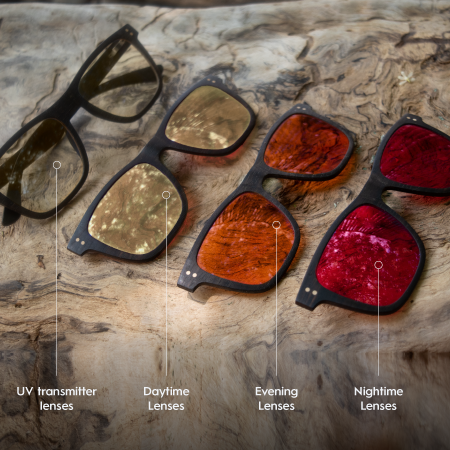
Wear VivaRays Evening Circadian Glasses after sunset.
Within a week of wearing evening glasses consistently after sunset, their sleep changes. Within a month, their hormones change. Within three months, their energy changes.
It's not magic. It's just restoring the one signal humans were always meant to receive: darkness after dark.

Frequently asked questions
Does blue light really affect fertility?
Yes. Nighttime blue light suppresses melatonin, which protects your eggs from oxidative damage. A 2011 Harvard study found room light before bed suppressed melatonin in 99% of subjects by an average of 85 minutes (Gooley et al., 2011). Chronic melatonin suppression is now tied to poorer egg quality, longer time to conception, and worse IVF outcomes.
Is it safe to wear blue-light-blocking glasses during pregnancy?
Yes. Blocking artificial blue light after sunset just restores the natural darkness your body is built for. There's no evidence of risk to mother or baby. The opposite is true: better sleep and lower cortisol in pregnancy are tied to healthier birth outcomes and a lower risk of gestational diabetes (Cheung et al., 2019).
Can morning sunlight really help with breastfeeding?
Yes, indirectly but powerfully. Morning sunlight anchors the circadian rhythm that controls prolactin release, which has a strong nighttime peak up to twice daytime levels (Spiegel et al., 2006). Mothers who get morning light and block blue light at night report more stable milk supply and faster post-feed sleep onset.
What time of night is artificial light most harmful?
The hours between sunset and bedtime are the most damaging. That's when your body is trying to ramp up melatonin, and even 10 minutes of bright blue light can knock it down for the rest of the night (Chang et al., PNAS, 2015). Middle-of-the-night exposure is also harmful but easier to fix with red nightlights.
Can light exposure ease menopause symptoms?
Yes. A 2019 review in Sleep Medicine Reviews found that restoring circadian rhythm through morning light and nighttime darkness reduced vasomotor symptoms (hot flashes, night sweats) and improved mood in perimenopausal and menopausal women (Baker et al., 2019). Your adrenals can still recover at any age if given the right signals.
My mom is in her 70s. Is it too late for her to benefit?
Not at all. My own mother was 61 when she started this protocol. Five years later she sleeps eight hours a night, wakes up vibrant, and has more energy than most 40-year-olds. The body remembers what to do the moment you give it the right light signals. It's never too late to give your mother (or yourself) this gift.
Give the mother you love the gift of true rest, radiant energy, and a body in rhythm with nature. VivaRays glasses make it simple.
Shop Circadian GlassesMothers are the light-bringers. Every cell in you, and every cell in the children you've brought or will bring into this world, was shaped by the light she lived under. Give her back the signal she was always meant to have.
Written by Roudy Nassif, founder of VivaRays and circadian light educator. Roudy has spent over a decade studying quantum biology, circadian health, and photobiology, and has helped thousands of families restore their natural rhythms.
Leave a comment